 [
[


A new Northwestern Medicine study has identified a previously unknown mechanism by which an enzyme promotes cancer cell proliferation, establishing it as a promising therapeutic target for cancer, according to findings published in Nature Communications.
N-acetyltransferase 10 (NAT10) is a multifunctional enzyme with oncogenic properties and has been associated with multiple types of cancer, including hepatocellular carcinoma—an aggressive type of liver cancer—and acute myeloid leukemia, among others.
NAT10 is known to acetylate, or chemically modify, RNA, but whether this mechanism supports the oncogenic properties of this protein has remained uncertain, said Daniel Arango, Ph.D., assistant professor of pharmacology and a co-corresponding author of the study.
“Some conflicting evidence existed in the literature, with most studies indicating a central role of the RNA acetylation activity of this protein, while others indicated that this function was not required for tumor growth,” said Arango, who is also a member of the Robert H. Lurie Comprehensive Cancer Center of Northwestern University.
Testing 1,900 NAT10 variants
To better understand the impact of NAT10’s molecular mechanisms in the context of cancer, the investigators used an unbiased functional genomics approach, including deep mutational scanning and nanopore sequencing of NAT10, to evaluate more than 1,900 mutants of the protein in a single assay.
“In other words, we created a library of 1,900 different versions of the protein, each version carrying a single amino acid substitution. Then you put all these versions of NAT10 to compete with each other in a proliferation assay. If one mutant affects cell proliferation, then cells carrying that mutant will disappear or drop out of the population,” Arango said.
The assay revealed that all versions of NAT10 that impaired cell proliferation clustered in the RNA helicase domain, away from the RNA acetyltransferase region.
Subsequent validation experiments, including biochemical, cellular and animal models, confirmed that the RNA helicase domain of NAT10, but not its RNA acetyltransferase activity, is required for cancer cell proliferation and tumor growth.
Ribosomes altered to favor growth
The assay also allowed the scientists to identify the downstream mechanisms by which NAT10 induces cancer cell proliferation and tumor growth.
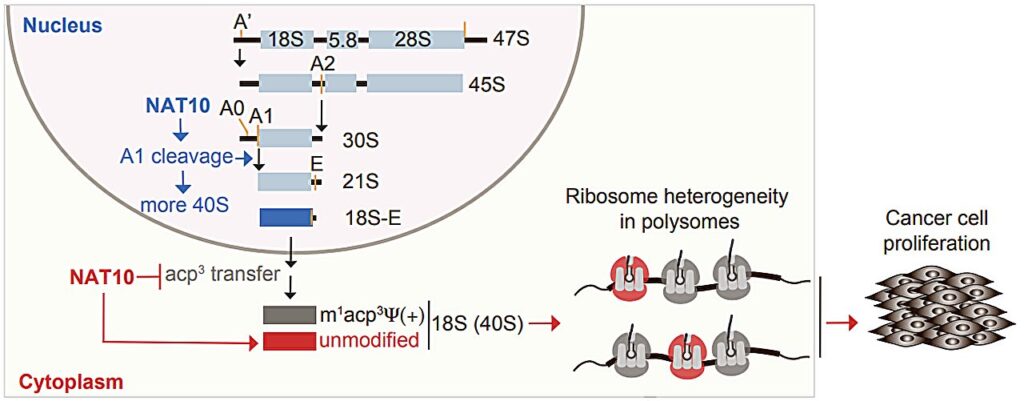
Through its RNA helicase function, they found that NAT10 promotes the development of cancer-specific ribosomes characterized by the loss of a chemical modification, called m1acp3Y, in RNA.
Specifically, NAT10 binding to ribosomes reduces the deposition of m1acp3Y, which is commonly reduced in ribosomes of cancer cells compared with those in tumor tissues, creating a subpopulation of ribosomes that helps cancer cells grow and proliferate.
The findings highlight a previously unknown mechanism by which NAT10 promotes cancer cell proliferation and establish NAT10’s RNA helicase domain as a new potential therapeutic target for cancer.
A shift in treatment strategy
“The finding that the RNA helicase domain, rather than its RNA acetyltransferase activity, is required for tumor growth is paradigm-shifting and can lead to redirecting therapeutic strategies that aim to target this protein for cancer treatment,” Arango said.
The next steps for the research will involve using a multidisciplinary approach to translate the current findings into tailored therapeutic strategies, Arango said.
“This type of multidisciplinary work is only possible through collaborations with scientists with complementary expertise. This message is very important now more than ever,” Arango said.
Publication details
Mahmood H. Dalhat et al, The RNA helicase domain of NAT10 promotes the biogenesis of hypomodified ribosomes to enhance cancer cell proliferation, Nature Communications (2026). DOI: 10.1038/s41467-026-76383-w
Journal information:
Nature Communications
Clinical categories


Citation:
Altered ribosomes help explain how an enzyme fuels tumor growth (2026, August 24)
retrieved 25 August 2026
from https://medicalxpress.com/news/2026-08-ribosomes-enzyme-fuels-tumor-growth.html
This document is subject to copyright. Apart from any fair dealing for the purpose of private study or research, no
part may be reproduced without the written permission. The content is provided for information purposes only.

Khamrah by Lattafa for Men - 3.4 oz EDP Spray
4% Off
Ghost Sweetheart Eau de Toilette | Pineapple, Jasmine and Sandalwood | Perfume for Women 50 ml
50% Off
Marc Jacobs Dot Eau De Parfum for Women, 100 ml
42% Off
Ted Baker W Eau de Toilette for Her, Fig Leaf, White Peony and Violet Top Notes, Pink Orchid and Raspberry Middle Notes, 75ml
£11.77 (£15.69 / 100 ml) (as of 26/09/2026 05:07 GMT +01:00 - More infoProduct prices and availability are accurate as of the date/time indicated and are subject to change. Any price and availability information displayed on [relevant Amazon Site(s), as applicable] at the time of purchase will apply to the purchase of this product.)
Ted Baker Woman Pink Eau de Toilette Spray Floral Green Feminine Fragrance, Opening Notes are Fresh Peach, Bergamot and Tangerine with Warm Musk, Vanilla and Vetiver Base, 100ml
11% Off
Vera Wang Princess Eau de Toilette - 30 ml

Choco Musk 50ml Eau De Parfum for men and women | Chocolate Musk by Jannat Aromas
17% Off
Christina Aguilera Signature Eau de Parfum (50ml) Floral, Fruity & Exotic Scent, Luxury Fragrance for Women
9% Off
Calvin Klein - Eau De Toilette CKIN2U - Calvin Klein Women, Ladies Perfume, Women's Perfume, Calvin Klein Perfume, Calvin Klein One - 150 ml
5% Off
Jimmy Choo Flash Eau de Parfum, 60 ml (Pack of 1)
3% Off
Fruit of the Loom Men's Heavy T Shirt, White, XL UK
28% Off
ATNKE LED Lighted Beanie Cap,USB Rechargeable Running Hat Ultra Bright 4 LED Waterproof Light Winter Warm Gifts for Men and Women/Pink
17% Off
Men's 1/4 Zip Pullover UK Sale Clearance, Fleece Sweatshirt Casual Jumper Long Sleeve T-shirt Top Stand Collar Sweater Plain Pullover Sports Leisure Workwear Quarter Zip Sweater Lightweight Jumpers
£5.88 (as of 12/11/2025 00:52 GMT +01:00 - More infoProduct prices and availability are accurate as of the date/time indicated and are subject to change. Any price and availability information displayed on [relevant Amazon Site(s), as applicable] at the time of purchase will apply to the purchase of this product.)
Crevice Cleaning Brush, Bathroom Tile Groove Gap Cleaning Brush,Premium Crevice Cleaning Tool Aluminum Support with 15° Angle Magic Brush, Thin Brush for Home Kitchen
19% Off
Wireless Earbuds, Bluetooth 5.3 Headphones in Ear with HiFi Stereo Deep Bass, 4 ENC Noise Cancelling Mic Wireless Earphones 40H Playtime, Bluetooth Earbuds Dual LED Display, IP7 Waterproof, USB-C
42% Off