 [
[

Age, genetics and lifestyle are known to influence how people respond to viral infections. Scientists also know that differences in immune responses play an important role, but exactly how these factors shape the course of an infection has remained unclear.
Now, new research from Hokkaido University, using mouse models, suggests that a critical part of the answer may lie in how the immune system responds during the first 24 hours after infection.
An early survival signal
Published in iScience, the study shows that, in mice, a powerful early immune response can determine whether an individual survives a severe viral infection. The researchers identified a previously unrecognized immune “checkpoint” that shapes the body’s antiviral defenses and could guide the development of future treatments for severe viral diseases.
Using genetically identical mice raised in the same controlled environment, the researchers infected the animals with a lethal virus called vesicular stomatitis virus (VSV). Some mice survived while others did not.
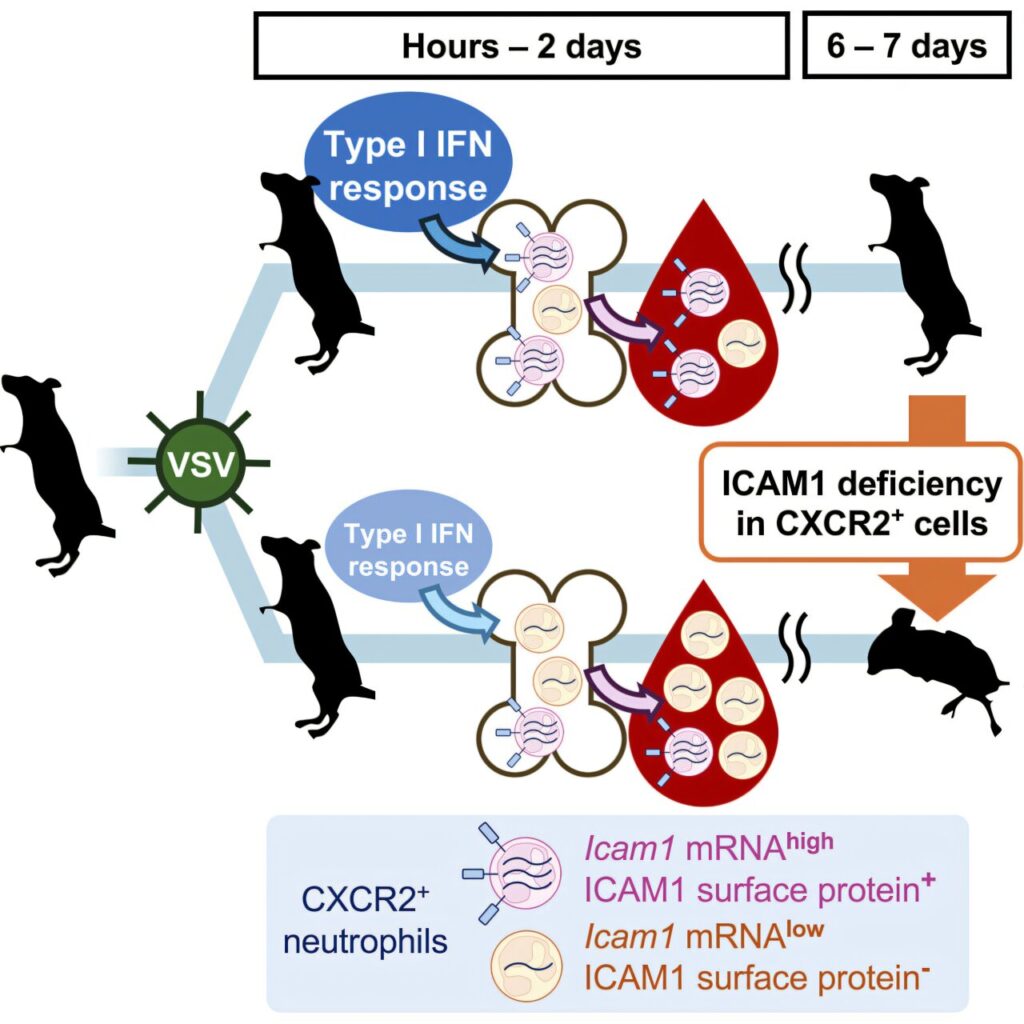
The team discovered that the surviving mice released a rapid burst of type I interferon (IFNβ), an immune signaling protein that helps coordinate the body’s defense against viruses. Mice that generated this early interferon response were much more likely to survive.
The early interferon response triggered another group of immune cells called neutrophils. Specifically, it induced a distinct population of neutrophils expressing the cell-surface marker ICAM1, which exhibited heightened inflammatory signaling and an enhanced antiviral immune profile.
The first day proved decisive
When the researchers blocked type I interferon during the first 24 hours after infection, most of the mice died. But blocking it two days after infection had little effect.
The findings suggest that there is a critical window early in infection during which the immune system decides to establish an effective antiviral response.
“Biological variability should not always be viewed as experimental noise,” said lead study author Tomohiko Okazaki, an associate professor.
“Instead of treating differences between genetically identical individuals as experimental noise, we viewed them as a source of biological insight. That approach allowed us to uncover an early immune checkpoint that would have been difficult to identify using conventional comparisons.”
A clue to uneven outcomes
The findings indicate that treatments designed to strengthen or mimic this early immune response could improve outcomes in severe viral infections.
Although the study was conducted in mice and further research is needed to determine whether a similar mechanism operates in humans, the work provides a clue to why identical infections can produce dramatically different outcomes.
“Since the COVID-19 pandemic, there has been growing interest in understanding why viral infections can produce dramatically different outcomes among individuals,” Okazaki said.
“Age and underlying medical conditions are well-known risk factors, but they do not fully explain this variability. Our findings identify an early immune mechanism that may help account for these differences and could inform future therapeutic strategies.”
Publication details
Riho Saito et al, Type I IFN dynamics orchestrate protective ICAM1+ neutrophil heterogeneity as an early checkpoint for survival in lethal viral infection, iScience (2026). DOI: 10.1016/j.isci.2026.117189
Journal information:
iScience
Key medical concepts
Clinical categories


Citation:
Early immune ‘checkpoint’ could help explain why the same virus affects individuals so differently (2026, August 19)
retrieved 19 August 2026
from https://medicalxpress.com/news/2026-08-early-immune-checkpoint-virus-affects.html
This document is subject to copyright. Apart from any fair dealing for the purpose of private study or research, no
part may be reproduced without the written permission. The content is provided for information purposes only.

Khamrah by Lattafa for Men - 3.4 oz EDP Spray
4% Off
Ghost Sweetheart Eau de Toilette | Pineapple, Jasmine and Sandalwood | Perfume for Women 50 ml
50% Off
Marc Jacobs Dot Eau De Parfum for Women, 100 ml
42% Off
Ted Baker W Eau de Toilette for Her, Fig Leaf, White Peony and Violet Top Notes, Pink Orchid and Raspberry Middle Notes, 75ml
£11.77 (£15.69 / 100 ml) (as of 24/08/2026 04:40 GMT +01:00 - More infoProduct prices and availability are accurate as of the date/time indicated and are subject to change. Any price and availability information displayed on [relevant Amazon Site(s), as applicable] at the time of purchase will apply to the purchase of this product.)
Ted Baker Woman Pink Eau de Toilette Spray Floral Green Feminine Fragrance, Opening Notes are Fresh Peach, Bergamot and Tangerine with Warm Musk, Vanilla and Vetiver Base, 100ml
11% Off
Vera Wang Princess Eau de Toilette - 30 ml

Choco Musk 50ml Eau De Parfum for men and women | Chocolate Musk by Jannat Aromas
17% Off
Christina Aguilera Signature Eau de Parfum (50ml) Floral, Fruity & Exotic Scent, Luxury Fragrance for Women
9% Off
Calvin Klein - Eau De Toilette CKIN2U - Calvin Klein Women, Ladies Perfume, Women's Perfume, Calvin Klein Perfume, Calvin Klein One - 150 ml
5% Off
Jimmy Choo Flash Eau de Parfum, 60 ml (Pack of 1)
3% Off
Fruit of the Loom Men's Heavy T Shirt, White, XL UK
28% Off
ATNKE LED Lighted Beanie Cap,USB Rechargeable Running Hat Ultra Bright 4 LED Waterproof Light Winter Warm Gifts for Men and Women/Pink
17% Off
Men's 1/4 Zip Pullover UK Sale Clearance, Fleece Sweatshirt Casual Jumper Long Sleeve T-shirt Top Stand Collar Sweater Plain Pullover Sports Leisure Workwear Quarter Zip Sweater Lightweight Jumpers
£5.88 (as of 12/11/2025 00:52 GMT +01:00 - More infoProduct prices and availability are accurate as of the date/time indicated and are subject to change. Any price and availability information displayed on [relevant Amazon Site(s), as applicable] at the time of purchase will apply to the purchase of this product.)
Crevice Cleaning Brush, Bathroom Tile Groove Gap Cleaning Brush,Premium Crevice Cleaning Tool Aluminum Support with 15° Angle Magic Brush, Thin Brush for Home Kitchen
19% Off
Wireless Earbuds, Bluetooth 5.3 Headphones in Ear with HiFi Stereo Deep Bass, 4 ENC Noise Cancelling Mic Wireless Earphones 40H Playtime, Bluetooth Earbuds Dual LED Display, IP7 Waterproof, USB-C
42% Off