
 [
[


Researchers at the Fraunhofer Institute for Integrated Circuits IIS and the Technical University of Dresden have tested a new approach for investigating disease-related changes in body odor. Using laser-based photoacoustic spectroscopy, they analyzed volatile organic compounds in simple body swabs. An initial study revealed differences between samples from healthy individuals and those from people with Parkinson’s disease, COVID-19, and other diseases. The results, published in Scientific Reports, demonstrate the method’s potential for faster preliminary screenings in the future.
Body odor as a source of information for diagnostics
Diseases can alter the composition of volatile organic compounds (VOCs) and thus body odor. These characteristic odor patterns can be detected in exhaled breath and bodily fluids—the human volatilome. However, existing analytical methods are often complex, time-consuming and require specialized personnel. As a result, rapid, simple methods suitable for widespread onsite use are lacking.
The research team from Fraunhofer IIS and TU Dresden combined a simple method for collecting samples from participants with highly sensitive laser measurement technology. Swab samples were taken from the anterior nasal cavity, the navel and the outer ear. A spectrometer then recorded the patterns of volatile compounds. The nasal swab proved particularly promising.
Laser technology reveals the composition of disease-related body odors
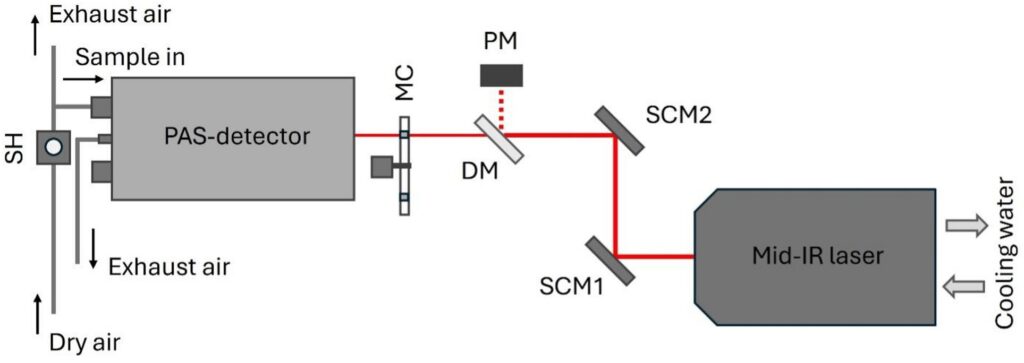
The measurement system developed at Fraunhofer IIS uses widely tunable quantum cascade lasers and a sensitive photoacoustic detector. It generates a characteristic spectral fingerprint of the VOCs. Statistical analysis showed that the scope of measurement can be significantly reduced without losing relevant information. This paves the way for the development of a compact, fast and cost-effective measurement technique.
Initial study provides promising evidence
This proof-of-concept study was conducted under controlled laboratory conditions. Twenty-four participants were randomly selected from a large-scale study (SMELLODI): six healthy controls and six people each with Parkinson’s disease, COVID-19 and other conditions. Additional measurements of samples from three participants with Parkinson’s disease after two weeks provided initial evidence that the results were stable over time.
The results are not a substitute for a medical diagnosis. Before the technology can be used in a clinical setting, larger studies involving a more diverse range of participants under real-world conditions are necessary. In the long term, however, the technology could provide early indications of potential diseases and support decisions about further testing.
Fraunhofer IIS developed the experimental setup, conducted the laboratory measurements and performed statistical analysis of the data. The Technical University of Dresden contributed medical and clinical expertise and coordinated recruitment, diagnosis and sample collection.
Publication details
Thorsten Graunke et al, Detection of disease-associated VOC signatures with laser-based photoacoustic spectroscopy (LPAS), Scientific Reports (2026). DOI: 10.1038/s41598-026-68298-9
Journal information:
Scientific Reports
Clinical categories
Provided by
Fraunhofer-Institut für Integrierte Schaltungen IIS


Citation:
Detecting diseases through body odor? New laser technology shows potential for non-invasive diagnostics (2026, September 29)
retrieved 29 September 2026
from https://medicalxpress.com/news/2026-09-diseases-body-odor-laser-technology.html
This document is subject to copyright. Apart from any fair dealing for the purpose of private study or research, no
part may be reproduced without the written permission. The content is provided for information purposes only.

Khamrah by Lattafa for Men - 3.4 oz EDP Spray
4% Off
Ghost Sweetheart Eau de Toilette | Pineapple, Jasmine and Sandalwood | Perfume for Women 50 ml
50% Off
Marc Jacobs Dot Eau De Parfum for Women, 100 ml
42% Off
Ted Baker W Eau de Toilette for Her, Fig Leaf, White Peony and Violet Top Notes, Pink Orchid and Raspberry Middle Notes, 75ml
£11.77 (£15.69 / 100 ml) (as of 29/09/2026 05:08 GMT +01:00 - More infoProduct prices and availability are accurate as of the date/time indicated and are subject to change. Any price and availability information displayed on [relevant Amazon Site(s), as applicable] at the time of purchase will apply to the purchase of this product.)
Ted Baker Woman Pink Eau de Toilette Spray Floral Green Feminine Fragrance, Opening Notes are Fresh Peach, Bergamot and Tangerine with Warm Musk, Vanilla and Vetiver Base, 100ml
11% Off
Vera Wang Princess Eau de Toilette - 30 ml

Choco Musk 50ml Eau De Parfum for men and women | Chocolate Musk by Jannat Aromas
17% Off
Christina Aguilera Signature Eau de Parfum (50ml) Floral, Fruity & Exotic Scent, Luxury Fragrance for Women
9% Off
Calvin Klein - Eau De Toilette CKIN2U - Calvin Klein Women, Ladies Perfume, Women's Perfume, Calvin Klein Perfume, Calvin Klein One - 150 ml
5% Off
Jimmy Choo Flash Eau de Parfum, 60 ml (Pack of 1)
3% Off
Fruit of the Loom Men's Heavy T Shirt, White, XL UK
28% Off
ATNKE LED Lighted Beanie Cap,USB Rechargeable Running Hat Ultra Bright 4 LED Waterproof Light Winter Warm Gifts for Men and Women/Pink
17% Off
Men's 1/4 Zip Pullover UK Sale Clearance, Fleece Sweatshirt Casual Jumper Long Sleeve T-shirt Top Stand Collar Sweater Plain Pullover Sports Leisure Workwear Quarter Zip Sweater Lightweight Jumpers
£5.88 (as of 12/11/2025 00:52 GMT +01:00 - More infoProduct prices and availability are accurate as of the date/time indicated and are subject to change. Any price and availability information displayed on [relevant Amazon Site(s), as applicable] at the time of purchase will apply to the purchase of this product.)
Crevice Cleaning Brush, Bathroom Tile Groove Gap Cleaning Brush,Premium Crevice Cleaning Tool Aluminum Support with 15° Angle Magic Brush, Thin Brush for Home Kitchen
19% Off
Wireless Earbuds, Bluetooth 5.3 Headphones in Ear with HiFi Stereo Deep Bass, 4 ENC Noise Cancelling Mic Wireless Earphones 40H Playtime, Bluetooth Earbuds Dual LED Display, IP7 Waterproof, USB-C
42% Off