Data journalism team

 BBC
BBCMark Carney’s Liberal Party is expected to win enough seats in the House of Commons to form a government in Canada. It is not yet clear whether they will be able to secure a majority.
Carney is set to remain prime minister, having only assumed the role in early March following Justin Trudeau’s resignation.
Carney’s Liberals are leading in 168 seats but are currently short of the 172 needed for a majority.
The Conservatives, led by Pierre Poilievre, are set to remain in opposition as the second-largest party and are leading in 144 seats, with 99% of polls having reported results.
Bloc Québécois – is leading in 23 seats and only runs candidates in the province of Quebec. The NDP is leading in seven seats and the Green Party in one.
Both the Liberals and the Conservatives have seen a significant rise in their share of the national vote compared with four years ago.
Increased support for Canada’s two largest parties has come at the expense of smaller parties, particularly the New Democratic Party (NDP) whose share of the popular vote is down by around 12 percentage points.
The NDP’s leader, Jagmeet Singh, has lost his own seat in the House of Commons and came third behind the Liberal and Conservative candidates.
Canada has a “first-past-the-post” electoral system.
The candidate who gets the most votes in each electoral district, or riding, wins that seat and become a Member of Parliament (MP).
The Liberals and the Conservatives have dominated the popular vote, with both parties receiving more than 40% each of ballots counted across Canada so far.
This has them on track to win a combined 90% of seats.
The NDP has received just over 6% of the total vote declared so far, but this translates to just 2% of seats in the House of Commons.
Bloc Québécois has just over 6% of the vote and a similar share of seats.
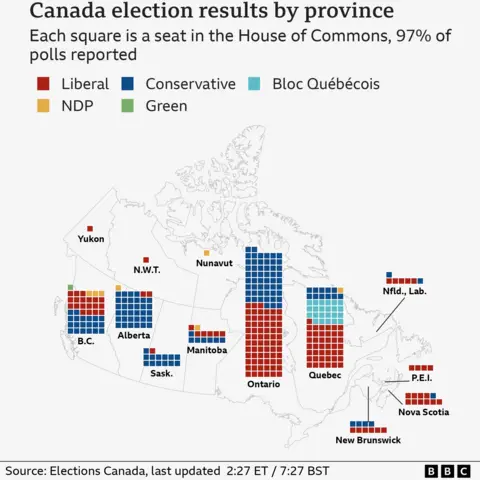
The Liberals are on course to win the most seats in the key provinces of Ontario and Quebec, which account for 200 of Canada’s 343 electoral districts.
The Conservatives are ahead in Alberta, while there is little to choose between the two main parties in British Columbia.

BBC News

Khamrah by Lattafa for Men - 3.4 oz EDP Spray
4% Off
Ghost Sweetheart Eau de Toilette | Pineapple, Jasmine and Sandalwood | Perfume for Women 50 ml
50% Off
Marc Jacobs Dot Eau De Parfum for Women, 100 ml
42% Off
Ted Baker W Eau de Toilette for Her, Fig Leaf, White Peony and Violet Top Notes, Pink Orchid and Raspberry Middle Notes, 75ml
£11.77 (£15.69 / 100 ml) (as of 12/07/2026 03:56 GMT +01:00 - More infoProduct prices and availability are accurate as of the date/time indicated and are subject to change. Any price and availability information displayed on [relevant Amazon Site(s), as applicable] at the time of purchase will apply to the purchase of this product.)
Ted Baker Woman Pink Eau de Toilette Spray Floral Green Feminine Fragrance, Opening Notes are Fresh Peach, Bergamot and Tangerine with Warm Musk, Vanilla and Vetiver Base, 100ml
11% Off
Vera Wang Princess Eau de Toilette - 30 ml

Choco Musk 50ml Eau De Parfum for men and women | Chocolate Musk by Jannat Aromas
17% Off
Christina Aguilera Signature Eau de Parfum (50ml) Floral, Fruity & Exotic Scent, Luxury Fragrance for Women
9% Off
Calvin Klein - Eau De Toilette CKIN2U - Calvin Klein Women, Ladies Perfume, Women's Perfume, Calvin Klein Perfume, Calvin Klein One - 150 ml
5% Off
Jimmy Choo Flash Eau de Parfum, 60 ml (Pack of 1)
3% Off
Fruit of the Loom Men's Heavy T Shirt, White, XL UK
28% Off
ATNKE LED Lighted Beanie Cap,USB Rechargeable Running Hat Ultra Bright 4 LED Waterproof Light Winter Warm Gifts for Men and Women/Pink
17% Off
Men's 1/4 Zip Pullover UK Sale Clearance, Fleece Sweatshirt Casual Jumper Long Sleeve T-shirt Top Stand Collar Sweater Plain Pullover Sports Leisure Workwear Quarter Zip Sweater Lightweight Jumpers
£5.88 (as of 12/11/2025 00:52 GMT +01:00 - More infoProduct prices and availability are accurate as of the date/time indicated and are subject to change. Any price and availability information displayed on [relevant Amazon Site(s), as applicable] at the time of purchase will apply to the purchase of this product.)
Crevice Cleaning Brush, Bathroom Tile Groove Gap Cleaning Brush,Premium Crevice Cleaning Tool Aluminum Support with 15° Angle Magic Brush, Thin Brush for Home Kitchen
19% Off
Wireless Earbuds, Bluetooth 5.3 Headphones in Ear with HiFi Stereo Deep Bass, 4 ENC Noise Cancelling Mic Wireless Earphones 40H Playtime, Bluetooth Earbuds Dual LED Display, IP7 Waterproof, USB-C
42% Off