 [
[

Scientists looking for the causes of neurodegenerative diseases like Parkinson’s and Alzheimer’s generally focus on the buildup of aberrant proteins in the brain that impede normal neural connections. But new research from Binghamton University and Drexel University looks at a different, lesser-studied issue that also hurts patients and their quality of life: how Parkinson’s affects the human vascular system.
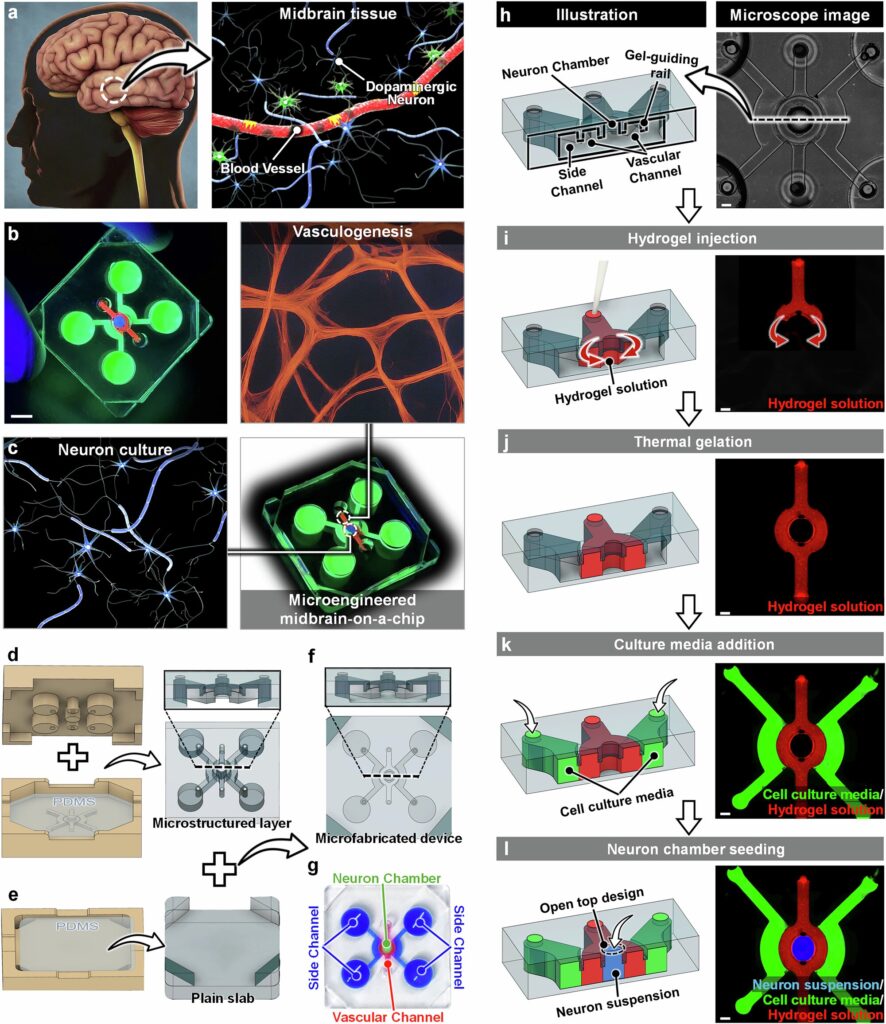
Assistant Professor Jungwook “Jay” Paek and Ph.D. student Anika Alim from the Thomas J. Watson College of Engineering and Applied Science’s Department of Electrical and Computer Engineering used organ-on-a-chip technology to mimic how cells behave inside the human body.
For this latest paper published in Communications Engineering, Paek, Alim, Drexel Assistant Professor Myungwoon Lee, and Ph.D. student Yoongyeong Baek take an engineering approach to examine how the blood-brain barrier degrades as Parkinson’s progresses.
“The inside of blood vessels in the brain is covered by endothelial cells that form a protective barrier to prevent harmful substances from entering the brain tissue,” Paek said. “Parkinson’s disease impairs the endothelial barrier functions and causes blood-vessel degeneration. Potentially, that increases neuronal exposure to circulating pathogenic substances and hurts their function as blood vessels for providing nutrients and oxygen for neurons.”
Organ-on-a-chip technology cultivates living human cells in 3D microfluidic platforms about the size of a computer memory stick, and it can simulate the physiological functions, mechanics, and response of entire organs in a way that’s easy to observe.
After introducing alpha-synuclein protein aggregates—similar to Lewy bodies in Parkinson’s patients—into the organ-on-a-chip environment, the Binghamton and Drexel researchers tracked the progression of vascular degradation. They observed abnormalities such as endothelial dysfunction, barrier disruption, vascular regression, and impairment of blood flow.
“Before this research, most studies on Parkinson’s disease have focused on the aggregation of specific proteins and their impacts on neurodegeneration,” Paek said. “However, how the protein aggregation contributes to vascular complications remains largely underexplored, so this is an exciting finding.”
Based on this research, future work will include more testing and improved artificial-intelligence modeling for disease progression. Paek hopes that understanding more about neurological disorders will lead to innovative therapies.
“Parkinson’s is a multifaceted disease,” he said. “Understanding the complex interplay between neurodegeneration and vascular pathology offers unique opportunities to help patients.”
Publication details
Anika Alim et al, Microengineering of the capillary interface of midbrain dopaminergic neurons to study Parkinson’s disease vascular alterations, Communications Engineering (2026). DOI: 10.1038/s44172-025-00581-5
Journal information:
Communications Engineering
Clinical categories
Citation:
Brain-on-a-chip reveals how Parkinson’s proteins weaken the brain’s vascular barrier (2026, April 18)
retrieved 18 April 2026
from https://medicalxpress.com/news/2026-04-brain-chip-reveals-parkinson-proteins.html
This document is subject to copyright. Apart from any fair dealing for the purpose of private study or research, no
part may be reproduced without the written permission. The content is provided for information purposes only.

Khamrah by Lattafa for Men - 3.4 oz EDP Spray
4% Off
Ghost Sweetheart Eau de Toilette | Pineapple, Jasmine and Sandalwood | Perfume for Women 50 ml
50% Off
Marc Jacobs Dot Eau De Parfum for Women, 100 ml
42% Off
Ted Baker W Eau de Toilette for Her, Fig Leaf, White Peony and Violet Top Notes, Pink Orchid and Raspberry Middle Notes, 75ml
£11.77 (£15.69 / 100 ml) (as of 15/07/2026 03:57 GMT +01:00 - More infoProduct prices and availability are accurate as of the date/time indicated and are subject to change. Any price and availability information displayed on [relevant Amazon Site(s), as applicable] at the time of purchase will apply to the purchase of this product.)
Ted Baker Woman Pink Eau de Toilette Spray Floral Green Feminine Fragrance, Opening Notes are Fresh Peach, Bergamot and Tangerine with Warm Musk, Vanilla and Vetiver Base, 100ml
11% Off
Vera Wang Princess Eau de Toilette - 30 ml

Choco Musk 50ml Eau De Parfum for men and women | Chocolate Musk by Jannat Aromas
17% Off
Christina Aguilera Signature Eau de Parfum (50ml) Floral, Fruity & Exotic Scent, Luxury Fragrance for Women
9% Off
Calvin Klein - Eau De Toilette CKIN2U - Calvin Klein Women, Ladies Perfume, Women's Perfume, Calvin Klein Perfume, Calvin Klein One - 150 ml
5% Off
Jimmy Choo Flash Eau de Parfum, 60 ml (Pack of 1)
3% Off
Fruit of the Loom Men's Heavy T Shirt, White, XL UK
28% Off
ATNKE LED Lighted Beanie Cap,USB Rechargeable Running Hat Ultra Bright 4 LED Waterproof Light Winter Warm Gifts for Men and Women/Pink
17% Off
Men's 1/4 Zip Pullover UK Sale Clearance, Fleece Sweatshirt Casual Jumper Long Sleeve T-shirt Top Stand Collar Sweater Plain Pullover Sports Leisure Workwear Quarter Zip Sweater Lightweight Jumpers
£5.88 (as of 12/11/2025 00:52 GMT +01:00 - More infoProduct prices and availability are accurate as of the date/time indicated and are subject to change. Any price and availability information displayed on [relevant Amazon Site(s), as applicable] at the time of purchase will apply to the purchase of this product.)
Crevice Cleaning Brush, Bathroom Tile Groove Gap Cleaning Brush,Premium Crevice Cleaning Tool Aluminum Support with 15° Angle Magic Brush, Thin Brush for Home Kitchen
19% Off
Wireless Earbuds, Bluetooth 5.3 Headphones in Ear with HiFi Stereo Deep Bass, 4 ENC Noise Cancelling Mic Wireless Earphones 40H Playtime, Bluetooth Earbuds Dual LED Display, IP7 Waterproof, USB-C
42% Off