 [
[

New research from King’s College London and the University of Porto has mapped the histamine system in the brain. Histamine, a molecule more commonly associated with allergies, plays a separate but poorly understood role in brain function. This study addresses this gap, building the first multiscale map of the histamine system that spans from genetics to behavior and related mental health conditions.
The findings provide a new framework for understanding how this often-overlooked chemical system contributes to brain function and could point toward new treatment strategies for histamine-related conditions such as depression, ADHD, and schizophrenia. The study is published in Nature Mental Health.
Histamine is a neurotransmitter, a molecule crucial for neurons to communicate with one another. Neuroscience research has classically focused on understanding other neurotransmitter systems such as dopamine and serotonin.
Building a multiscale brain map
Dr. Daniel Martins, visiting Senior Research Fellow at the Institute of Psychiatry, Psychology & Neuroscience (IoPPN) King’s College London, and first author on the paper said, “This work provides a crucial foundation for future research. By integrating molecular biology, brain imaging, and computational analysis, it offers a new perspective on how neurotransmitter systems are organized across the human brain. As neuroscience moves toward more integrated and personalized models of mental health, understanding systems like histamine may prove essential for unlocking new approaches to diagnosis and treatment.”
Histamine molecules are caught by proteins called receptors, which are responsible for how the signal will influence receiver neurons. There are several types of receptors that catch histamine and they can have varied effects on neuron activity.
Through mapping the histamine system, researchers found that different histamine receptors were found on brain cells that either turn activity up (excitation) or turn it down (inhibition). This suggests that histamine may be important in maintaining the balance between excitation and inhibition, a fundamental property of healthy brain function.
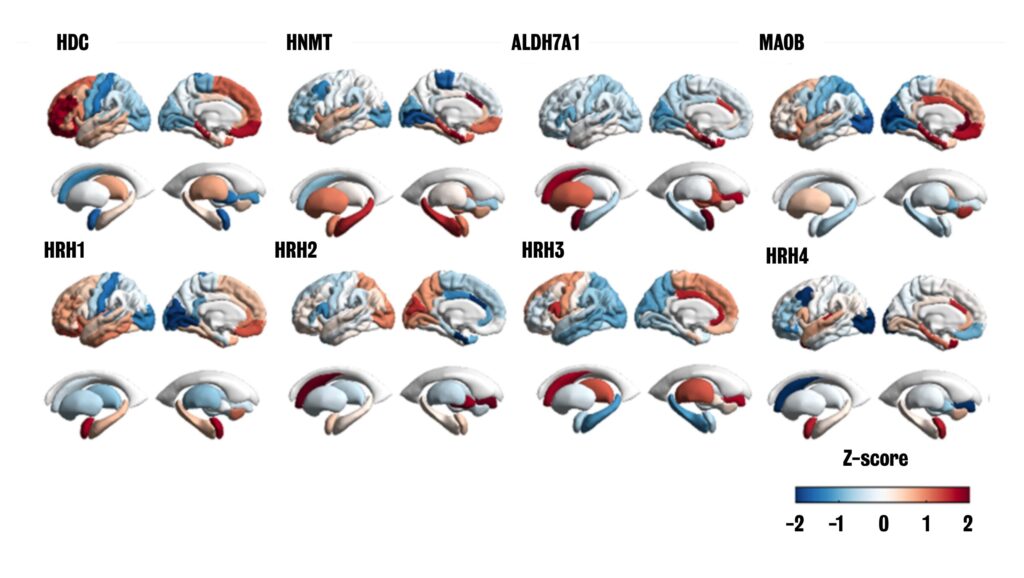
To build a comprehensive map of how histamine acts in the brain, researchers first combined genetic and molecular data with physical maps of the brain. This revealed which brain regions receive more input from the brain’s histamine system, and which parts show greater capacity to respond to histamine. These molecular data were then linked with positron emission tomography imaging of histamine receptors in living individuals, as well as functional neuroimaging databases that map brain regions to specific cognitive processes and mental health conditions. This type of scan shows how different parts of the brain are working by tracking a tiny amount of radioactive tracer in real time.
Links to cognition and psychiatry
Brain regions with higher histamine-related gene expression were consistently associated with processes such as emotional regulation, stress and fear responses, decision-making, impulsivity, reward, sleep, and memory.
The parts of the brain where histamine-related genes were most active also overlapped significantly with brain regions known to be affected in several psychiatric conditions, including attention-deficit/hyperactivity disorder, major depressive disorder, schizophrenia, and anorexia nervosa. This is in keeping with previous hypotheses linking histamine to these disorders.
Dr. Daniel Martins said, “Current psychiatric treatments largely target neurotransmitters such as serotonin and dopamine, yet histamine interacts closely with these systems and influences their activity. By providing a detailed map of histamine-related pathways, this work suggests new opportunities for developing treatments that target this system more directly, particularly for symptoms such as cognitive dysfunction, fatigue, and impaired motivation.
“While these findings do not establish a direct causal role, they suggest that histamine signaling may contribute to regional vulnerability in these disorders. This aligns with a growing view in psychiatry that mental health conditions arise from disruptions across interacting brain systems rather than a single chemical imbalance.”
Next steps for histamine research
This new map paints a neural picture of a previously lesser-studied molecule. It opens up future avenues of research into exactly what histamine is doing in various cell types and parts of the brain.
“We want to emphasize that these findings are hypothesis-generating and based on large-scale datasets that capture patterns rather than direct mechanisms,” comments Professor Steve Williams, Professor of Neuroimaging at IoPPN King’s College London and senior author on the paper.
Future studies will focus on testing how histamine signaling changes in living individuals, for example through pharmacological interventions or longitudinal imaging approaches.
Dr. Daniel Van Wamelen, Clinical Senior Lecturer in Neuroscience at IoPPN, King’s College London and one of the authors on the paper said, “This kind of work is already taking place at King’s College London, for example, in the iMarkHD project. In this project, we use positron emission tomography scans to study a specific histamine receptor (called H3) in people with Huntington’s disease, an inherited condition that affects the brain. The goal is to see how histamine activity changes in different parts of the brain over time, and how these changes relate to symptoms such as apathy, depression, and anxiety.”
Publication details
Mapping Histamine Pathway Networks in the Human Brain Across Cognition and Psychiatric Disorders, Nature Mental Health (2026). DOI: 10.1038/s44220-026-00637-1
Journal information:
Nature Mental Health


Citation:
Brain histamine map connects genes to brain function and mental health (2026, May 12)
retrieved 12 May 2026
from https://medicalxpress.com/news/2026-05-brain-histamine-genes-function-mental.html
This document is subject to copyright. Apart from any fair dealing for the purpose of private study or research, no
part may be reproduced without the written permission. The content is provided for information purposes only.

Khamrah by Lattafa for Men - 3.4 oz EDP Spray
4% Off
Ghost Sweetheart Eau de Toilette | Pineapple, Jasmine and Sandalwood | Perfume for Women 50 ml
50% Off
Marc Jacobs Dot Eau De Parfum for Women, 100 ml
42% Off
Ted Baker W Eau de Toilette for Her, Fig Leaf, White Peony and Violet Top Notes, Pink Orchid and Raspberry Middle Notes, 75ml
£11.77 (£15.69 / 100 ml) (as of 14/09/2026 05:03 GMT +01:00 - More infoProduct prices and availability are accurate as of the date/time indicated and are subject to change. Any price and availability information displayed on [relevant Amazon Site(s), as applicable] at the time of purchase will apply to the purchase of this product.)
Ted Baker Woman Pink Eau de Toilette Spray Floral Green Feminine Fragrance, Opening Notes are Fresh Peach, Bergamot and Tangerine with Warm Musk, Vanilla and Vetiver Base, 100ml
11% Off
Vera Wang Princess Eau de Toilette - 30 ml

Choco Musk 50ml Eau De Parfum for men and women | Chocolate Musk by Jannat Aromas
17% Off
Christina Aguilera Signature Eau de Parfum (50ml) Floral, Fruity & Exotic Scent, Luxury Fragrance for Women
9% Off
Calvin Klein - Eau De Toilette CKIN2U - Calvin Klein Women, Ladies Perfume, Women's Perfume, Calvin Klein Perfume, Calvin Klein One - 150 ml
5% Off
Jimmy Choo Flash Eau de Parfum, 60 ml (Pack of 1)
3% Off
Fruit of the Loom Men's Heavy T Shirt, White, XL UK
28% Off
ATNKE LED Lighted Beanie Cap,USB Rechargeable Running Hat Ultra Bright 4 LED Waterproof Light Winter Warm Gifts for Men and Women/Pink
17% Off
Men's 1/4 Zip Pullover UK Sale Clearance, Fleece Sweatshirt Casual Jumper Long Sleeve T-shirt Top Stand Collar Sweater Plain Pullover Sports Leisure Workwear Quarter Zip Sweater Lightweight Jumpers
£5.88 (as of 12/11/2025 00:52 GMT +01:00 - More infoProduct prices and availability are accurate as of the date/time indicated and are subject to change. Any price and availability information displayed on [relevant Amazon Site(s), as applicable] at the time of purchase will apply to the purchase of this product.)
Crevice Cleaning Brush, Bathroom Tile Groove Gap Cleaning Brush,Premium Crevice Cleaning Tool Aluminum Support with 15° Angle Magic Brush, Thin Brush for Home Kitchen
19% Off
Wireless Earbuds, Bluetooth 5.3 Headphones in Ear with HiFi Stereo Deep Bass, 4 ENC Noise Cancelling Mic Wireless Earphones 40H Playtime, Bluetooth Earbuds Dual LED Display, IP7 Waterproof, USB-C
42% Off