
 Getty Images
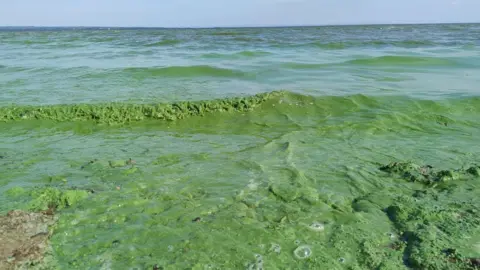
A bathing ban is in place at a popular north coast beach over the August bank holiday weekend due to the presence of blue-green algae.
High levels of the potentially toxic algae was found at Benone Strand on Thursday.
No other beaches on the north coast are affected at this time, the Department of Agriculture, Environment and Rural Affairs (Daera) said.
It comes amidst a number of reports of blue-green algae in loughs and waterways in Northern Ireland over the last few months, namely at Lough Neagh.
In a statement on Friday, Daera said blue-green algae was detected during a regular sample of bathing waters at the beach, where later analysis confirmed “high levels” of the bacteria in the water.
“The Department has issued the bathing water operator, Causeway Coast and Glens Borough Council, an ‘Advice against Bathing’ notification,” it added.
“No other north coast beaches are affected at this time.
“The department will continue to monitor these beaches for blue-green algae and provide advice to bathing water operators when required.”
What is blue-green algae?
 PA Media
Blue-green algae, technically known as cyanobacteria, is a collection of microscopic organisms that are naturally present in lakes and streams.
Under certain conditions, blue-green algae can become abundant in warm, shallow, undisturbed, nutrient-rich surface waters that receive a lot of sunlight.
When this occurs, blue-green algae can form blooms that discolour the water, or produce floating mats or scums on the water’s surface.
It can spread rapidly, with blooms beginning to double every seven to 14 days.
While some blue-green algae can produce toxins, it is not possible to tell by sight alone. For pets, livestock and wildlife, the blooms can be extremely dangerous.
If people are exposed to high levels of blue-green algae, either through contact with water blooms, swallowing the water or inhaling airborne droplets, may cause health effects.
These can include diarrhoea, nausea or vomiting, skin, eye or throat irritation; and allergic reactions or breathing difficulties.
Read more here.
BBC News

Khamrah by Lattafa for Men - 3.4 oz EDP Spray
4% Off
Ghost Sweetheart Eau de Toilette | Pineapple, Jasmine and Sandalwood | Perfume for Women 50 ml
50% Off
Marc Jacobs Dot Eau De Parfum for Women, 100 ml
42% Off
Ted Baker W Eau de Toilette for Her, Fig Leaf, White Peony and Violet Top Notes, Pink Orchid and Raspberry Middle Notes, 75ml
£11.77 (£15.69 / 100 ml) (as of 16/07/2026 03:58 GMT +01:00 - More infoProduct prices and availability are accurate as of the date/time indicated and are subject to change. Any price and availability information displayed on [relevant Amazon Site(s), as applicable] at the time of purchase will apply to the purchase of this product.)
Ted Baker Woman Pink Eau de Toilette Spray Floral Green Feminine Fragrance, Opening Notes are Fresh Peach, Bergamot and Tangerine with Warm Musk, Vanilla and Vetiver Base, 100ml
11% Off
Vera Wang Princess Eau de Toilette - 30 ml

Choco Musk 50ml Eau De Parfum for men and women | Chocolate Musk by Jannat Aromas
17% Off
Christina Aguilera Signature Eau de Parfum (50ml) Floral, Fruity & Exotic Scent, Luxury Fragrance for Women
9% Off
Calvin Klein - Eau De Toilette CKIN2U - Calvin Klein Women, Ladies Perfume, Women's Perfume, Calvin Klein Perfume, Calvin Klein One - 150 ml
5% Off
Jimmy Choo Flash Eau de Parfum, 60 ml (Pack of 1)
3% Off
Fruit of the Loom Men's Heavy T Shirt, White, XL UK
28% Off
ATNKE LED Lighted Beanie Cap,USB Rechargeable Running Hat Ultra Bright 4 LED Waterproof Light Winter Warm Gifts for Men and Women/Pink
17% Off
Men's 1/4 Zip Pullover UK Sale Clearance, Fleece Sweatshirt Casual Jumper Long Sleeve T-shirt Top Stand Collar Sweater Plain Pullover Sports Leisure Workwear Quarter Zip Sweater Lightweight Jumpers
£5.88 (as of 12/11/2025 00:52 GMT +01:00 - More infoProduct prices and availability are accurate as of the date/time indicated and are subject to change. Any price and availability information displayed on [relevant Amazon Site(s), as applicable] at the time of purchase will apply to the purchase of this product.)
Crevice Cleaning Brush, Bathroom Tile Groove Gap Cleaning Brush,Premium Crevice Cleaning Tool Aluminum Support with 15° Angle Magic Brush, Thin Brush for Home Kitchen
19% Off
Wireless Earbuds, Bluetooth 5.3 Headphones in Ear with HiFi Stereo Deep Bass, 4 ENC Noise Cancelling Mic Wireless Earphones 40H Playtime, Bluetooth Earbuds Dual LED Display, IP7 Waterproof, USB-C
42% Off