



 Brain Tumour Research
A teenager who had to learn to walk and read again after being diagnosed with a brain tumour the size of a small grapefruit said she is “living proof that research saves lives”.
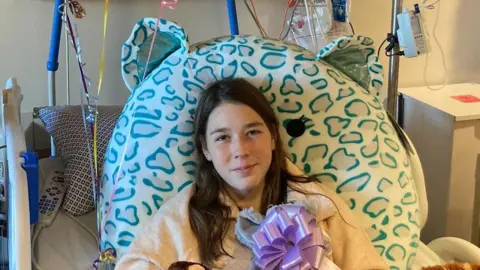
Indi Powell, 18, from Windsor, Berkshire, was 14 when she began experiencing severe headaches while living in the US in 2021.
An MRI scan revealed an aggressive a grade four glioblastoma – a fast growing type of brain tumour – on the right side of her brain.
Ms Powell said she felt “so lucky” that her tumour had been found and removed in time but added that “more awareness and more research” into the disease were needed.
 Brain Tumour Research
Following her diagnosis, doctors warned her there was a significant risk she would lose mobility and may need to learn to walk and read again.
After her emergency surgery at UNC Chapel Hill in North Carolina she said she could talk but could not control her body very well.
“It was confusing and frustrating, I knew how to read but when I looked at words, I had no idea what they meant,” she said.
Ms Powell permanently lost her periphery vision and spent three weeks in hospital.
She required extensive therapy to regain her mobility and reading skills.
Later, she underwent a second surgery to remove what remained of the tumour and had 32 rounds of radiotherapy, and multiple cycles of chemotherapy over six weeks.
During the height of the Covid-19 pandemic, she could only have one parent at a time with her during treatment.
Her mother Lori said it had been “heartbreaking” but said her daughter had shown “unbelievable strength”.
Ms Powell was later accepted on to a clinical trial in Washington DC for T-cell infusion therapy, which uses a patient’s own immune cells to fight cancer.
“That trial gave me hope, my cells produced the most T cells out of everyone that took part, so I was able to keep going,” she said.
 Brain Tumour Research
Ms Powell is now back in the UK completing her secondary education in Windsor and is working with Brain Tumour Research to raise awareness of the disease.
“I feel so lucky my tumour was found in time and that surgeons were able to remove it.
“But not everyone is as lucky. We need more awareness and more research.
“I’m living proof that research saves lives.”
According to Brain Tumour Research, about 12,000 people are diagnosed with a primary brain tumour each year and the disease kills “more children than leukaemia”.
The charity’s community development manager Louise Aubrey said Ms Powell’s story was “a reminder of how suddenly and drastically brain tumours can change a young person’s life”.
“Brain tumours kill more children and adults under the age of 40 than any other cancer yet, historically, just 1% of the national spend on cancer research has been allocated to this devastating disease.
“We urgently need more funding to improve outcomes for patients like Indi.”
The charity is the driving force behind a call for a national annual spend of £35m in order to improve survival rates and patient outcomes in line with other cancers, such as breast cancer and leukaemia.
BBC News

Khamrah by Lattafa for Men - 3.4 oz EDP Spray
4% Off
Ghost Sweetheart Eau de Toilette | Pineapple, Jasmine and Sandalwood | Perfume for Women 50 ml
50% Off
Marc Jacobs Dot Eau De Parfum for Women, 100 ml
42% Off
Ted Baker W Eau de Toilette for Her, Fig Leaf, White Peony and Violet Top Notes, Pink Orchid and Raspberry Middle Notes, 75ml
£11.77 (£15.69 / 100 ml) (as of 21/10/2026 06:36 GMT +01:00 - More infoProduct prices and availability are accurate as of the date/time indicated and are subject to change. Any price and availability information displayed on [relevant Amazon Site(s), as applicable] at the time of purchase will apply to the purchase of this product.)
Ted Baker Woman Pink Eau de Toilette Spray Floral Green Feminine Fragrance, Opening Notes are Fresh Peach, Bergamot and Tangerine with Warm Musk, Vanilla and Vetiver Base, 100ml
11% Off
Vera Wang Princess Eau de Toilette - 30 ml

Choco Musk 50ml Eau De Parfum for men and women | Chocolate Musk by Jannat Aromas
17% Off
Christina Aguilera Signature Eau de Parfum (50ml) Floral, Fruity & Exotic Scent, Luxury Fragrance for Women
9% Off
Calvin Klein - Eau De Toilette CKIN2U - Calvin Klein Women, Ladies Perfume, Women's Perfume, Calvin Klein Perfume, Calvin Klein One - 150 ml
5% Off
Jimmy Choo Flash Eau de Parfum, 60 ml (Pack of 1)
3% Off
Fruit of the Loom Men's Heavy T Shirt, White, XL UK
28% Off
ATNKE LED Lighted Beanie Cap,USB Rechargeable Running Hat Ultra Bright 4 LED Waterproof Light Winter Warm Gifts for Men and Women/Pink
17% Off
Men's 1/4 Zip Pullover UK Sale Clearance, Fleece Sweatshirt Casual Jumper Long Sleeve T-shirt Top Stand Collar Sweater Plain Pullover Sports Leisure Workwear Quarter Zip Sweater Lightweight Jumpers
£5.88 (as of 12/11/2025 00:52 GMT +01:00 - More infoProduct prices and availability are accurate as of the date/time indicated and are subject to change. Any price and availability information displayed on [relevant Amazon Site(s), as applicable] at the time of purchase will apply to the purchase of this product.)
Crevice Cleaning Brush, Bathroom Tile Groove Gap Cleaning Brush,Premium Crevice Cleaning Tool Aluminum Support with 15° Angle Magic Brush, Thin Brush for Home Kitchen
19% Off
Wireless Earbuds, Bluetooth 5.3 Headphones in Ear with HiFi Stereo Deep Bass, 4 ENC Noise Cancelling Mic Wireless Earphones 40H Playtime, Bluetooth Earbuds Dual LED Display, IP7 Waterproof, USB-C
42% Off