 [
[

One of the most widely used chemotherapeutic agents for colorectal cancer is 5-fluorouracil (5-FU), a cornerstone treatment that has improved outcomes for countless patients. However, repeated treatment often leads to drug resistance, allowing cancer cells to adapt and gradually evade the effects of therapy.
In many patients, tumors initially respond well to treatment but later acquire resistance, ultimately resulting in treatment failure and disease recurrence. Despite its clinical importance, the molecular mechanisms that enable cancer cells to withstand 5-FU therapy have remained poorly understood.
A research team led by Dr. Hyun-Soo Cho at the Stem Cell Convergence Research Center of the Korea Research Institute of Bioscience and Biotechnology (KRIBB), in collaboration with Professor Geun Heo of Kyungpook National University, has identified a key mechanism underlying 5-FU resistance in colorectal cancer and proposed a new therapeutic strategy to restore tumor sensitivity to treatment.
To investigate how resistance develops, the researchers generated colorectal cancer cells that survived repeated exposure to 5-FU and compared them with nonresistant cancer cells. The paper is published in the journal Signal Transduction and Targeted Therapy.
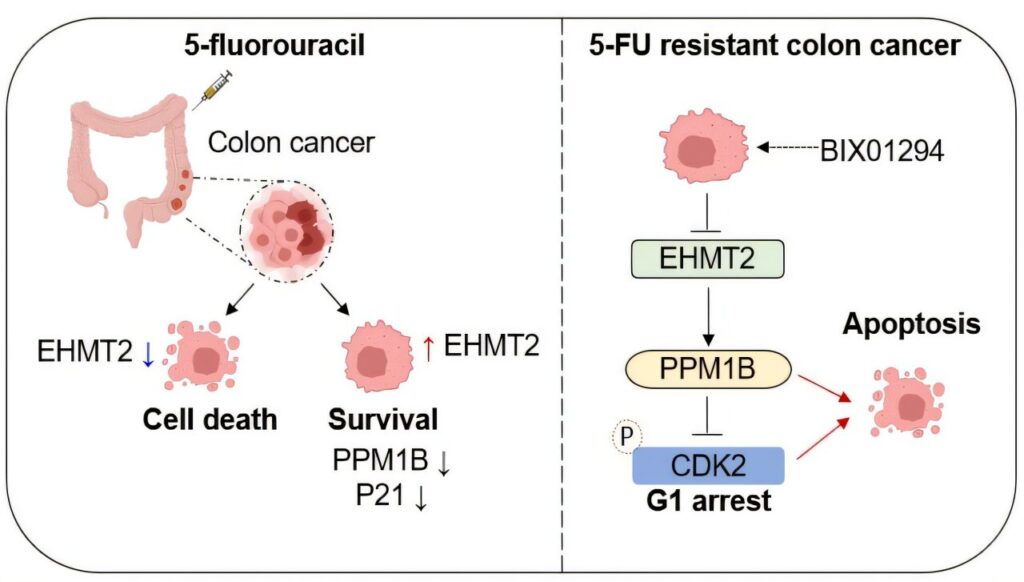
Their analysis revealed a marked increase in the activity of EHMT2, a protein involved in regulating gene expression through epigenetic mechanisms. The team hypothesized that EHMT2 could play a central role in chemotherapy resistance.
Analysis of patient data sets supported this conclusion. Patients with elevated EHMT2 activity showed poorer responses to 5-FU treatment and lower overall survival rates, indicating a strong association between EHMT2 activation and unfavorable clinical outcomes.
The researchers next investigated whether suppressing EHMT2 could reverse resistance. When EHMT2 activity was inhibited, previously resistant cancer cells regained sensitivity to 5-FU, leading to increased cancer cell death and significantly reduced tumor cell proliferation. In contrast, artificially increasing EHMT2 expression in nonresistant cells enhanced their resistance to chemotherapy.
These findings demonstrate that EHMT2 functions as a critical regulator of chemotherapy resistance and that targeting this protein can potentially return resistant cancer cells to a treatment-responsive state.
To determine whether this strategy would also be effective in clinically relevant settings, the team conducted additional validation studies using patient-derived colorectal cancer organoids and animal models. When 5-FU was combined with an EHMT2 inhibitor, the growth of previously treatment-resistant colorectal tumors was significantly suppressed.
The results suggest that improving the effectiveness of existing therapies may be possible without developing entirely new anticancer drugs. Instead, reducing cancer cell resistance could restore the therapeutic benefits of established treatments and provide a new strategy for overcoming chemotherapy resistance.
The study is significant because it reveals a previously unrecognized mechanism by which cancer cells adapt to chemotherapy and identifies a promising therapeutic target capable of reversing that process. The findings may have implications beyond colorectal cancer, potentially extending to other cancers commonly treated with 5-FU, including gastric, pancreatic and breast cancers.
“This study demonstrates that the epigenetic regulatory protein EHMT2 plays a critical role in the process by which cancer cells adapt to chemotherapy,” said Dr. Hyun-Soo Cho, the study’s lead investigator.
“Targeting EHMT2 may provide a new therapeutic approach to overcoming drug resistance and enhancing the efficacy of existing anticancer treatments.”
More information
In Hwan Tae et al, Targeting EHMT2 overcomes 5-fluorouracil resistance in colorectal cancer by modulating cell cycle and apoptosis, Signal Transduction and Targeted Therapy (2026). DOI: 10.1038/s41392-026-02692-7
Clinical categories


Citation:
Key protein behind chemotherapy resistance in colorectal cancer identified (2026, June 9)
retrieved 9 June 2026
from https://medicalxpress.com/news/2026-06-key-protein-chemotherapy-resistance-colorectal.html
This document is subject to copyright. Apart from any fair dealing for the purpose of private study or research, no
part may be reproduced without the written permission. The content is provided for information purposes only.

Khamrah by Lattafa for Men - 3.4 oz EDP Spray
4% Off
Ghost Sweetheart Eau de Toilette | Pineapple, Jasmine and Sandalwood | Perfume for Women 50 ml
50% Off
Marc Jacobs Dot Eau De Parfum for Women, 100 ml
42% Off
Ted Baker W Eau de Toilette for Her, Fig Leaf, White Peony and Violet Top Notes, Pink Orchid and Raspberry Middle Notes, 75ml
£11.77 (£15.69 / 100 ml) (as of 10/06/2026 03:31 GMT +01:00 - More infoProduct prices and availability are accurate as of the date/time indicated and are subject to change. Any price and availability information displayed on [relevant Amazon Site(s), as applicable] at the time of purchase will apply to the purchase of this product.)
Ted Baker Woman Pink Eau de Toilette Spray Floral Green Feminine Fragrance, Opening Notes are Fresh Peach, Bergamot and Tangerine with Warm Musk, Vanilla and Vetiver Base, 100ml
11% Off
Vera Wang Princess Eau de Toilette - 30 ml

Choco Musk 50ml Eau De Parfum for men and women | Chocolate Musk by Jannat Aromas
17% Off
Christina Aguilera Signature Eau de Parfum (50ml) Floral, Fruity & Exotic Scent, Luxury Fragrance for Women
9% Off
Calvin Klein - Eau De Toilette CKIN2U - Calvin Klein Women, Ladies Perfume, Women's Perfume, Calvin Klein Perfume, Calvin Klein One - 150 ml
5% Off
Jimmy Choo Flash Eau de Parfum, 60 ml (Pack of 1)
3% Off
Fruit of the Loom Men's Heavy T Shirt, White, XL UK
28% Off
ATNKE LED Lighted Beanie Cap,USB Rechargeable Running Hat Ultra Bright 4 LED Waterproof Light Winter Warm Gifts for Men and Women/Pink
17% Off
Men's 1/4 Zip Pullover UK Sale Clearance, Fleece Sweatshirt Casual Jumper Long Sleeve T-shirt Top Stand Collar Sweater Plain Pullover Sports Leisure Workwear Quarter Zip Sweater Lightweight Jumpers
£5.88 (as of 12/11/2025 00:52 GMT +01:00 - More infoProduct prices and availability are accurate as of the date/time indicated and are subject to change. Any price and availability information displayed on [relevant Amazon Site(s), as applicable] at the time of purchase will apply to the purchase of this product.)
Crevice Cleaning Brush, Bathroom Tile Groove Gap Cleaning Brush,Premium Crevice Cleaning Tool Aluminum Support with 15° Angle Magic Brush, Thin Brush for Home Kitchen
19% Off
Wireless Earbuds, Bluetooth 5.3 Headphones in Ear with HiFi Stereo Deep Bass, 4 ENC Noise Cancelling Mic Wireless Earphones 40H Playtime, Bluetooth Earbuds Dual LED Display, IP7 Waterproof, USB-C
42% Off