 [
[
Humans continuously adapt their actions and behaviors in response to changes in their surrounding environment. Past neuroscience studies suggest that this adaptation process relies on the brain’s ability to translate abstract goals or rules into specific physical actions or behaviors, yet its neural underpinnings have not yet been clearly elucidated.
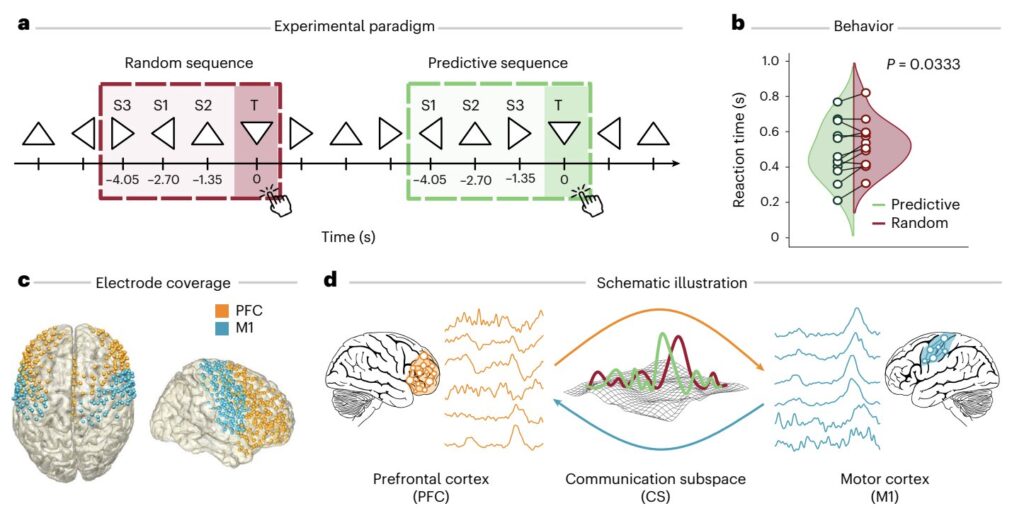
Researchers at University Medical Center Tübingen and University of Tübingen recently carried out a study aimed at better understanding how context-related mental representations in a region of the brain known as the prefrontal cortex (PFC) are transformed into movement plans, which are processed in the primary motor cortex (M1). Their findings, published in Nature Neuroscience, led to the identification of a distinct communication subspace that links the PFC and M1, through which contextual information that can inform the planning of actions is transmitted.
“Adaptive behavior relies on the ability to translate abstract rules and goals into actions suited to the current context,” wrote Neha Binish, Jonas Terlau and their colleagues in their paper. “Neural population activity in the PFC has been proposed to support such flexible computations through high-dimensional dynamics, whereas activity in the M1 is related more directly to movement execution. How contextual representations in PFC are transformed into ensuing action plans within M1 remains unknown.”
Converting abstract contextual information into action plans
As part of their study, Binish, Terlau and their colleagues recorded neural activity in the brains of 12 patients with drug-resistant epilepsy, who had electrodes implanted in their brain as part of their treatment. They particularly focused on activity in the PFC and M1, as earlier works suggested that these regions play a key role in the flexible planning of future actions or behaviors.
“Previous work suggests that low-dimensional coding subspaces might organize interareal communication, but direct evidence for such population-level communication mechanisms in humans is lacking,” wrote the authors. “We use intracranial recordings from human PFC and M1 to identify a communication subspace embedded within high-dimensional PFC activity, that selectively relays behaviorally relevant information at the single-trial level.”
The study participants were asked to complete a task that required them to detect a specific target as quickly as possible, using contextual cues as guidance. When they analyzed the brain activity recorded while the participants were completing this task, using computational and statistical tools, the researchers uncovered a simplified neural signaling pathway (i.e., a communication subspace) via which contextual information appeared to be transmitted from the PFC to the M1.
“Activity in this subspace predicts context-dependent action more strongly than either region, revealing a fundamental coding principle by which coordinated interareal population dynamics filter and relay predictive information to guide context-dependent actions,” wrote Binish, Terlau and their colleagues.
Informing future research and new tech development
The recent work by Binish, Terlau and their colleagues identifies a new communication subspace between the PFC and M1 that appears to selectively transmit behaviorally relevant contextual information that can help to plan movements. As their study only involved 12 participants, further research is needed to validate their observations.
Overall, the team’s preliminary findings appear to support the idea that the brain relies on simplified communication pathways to efficiently transfer information that can inform the planning of future behaviors. If these results are confirmed in further studies, they could potentially improve the understanding of neurological or psychiatric conditions characterized by difficulties with planning future actions, including Parkinson’s disease and schizophrenia.
In the future, the researchers’ efforts might also inform the development of new technologies, including neuro-prosthetic devices and other devices that can interface with the human brain, translating people’s intentions into specific commands. Concurrently, they could also inspire the creation of new brain-inspired algorithms that plan the actions of robots, adapting to changes in their surrounding environment.
Written for you by our author Ingrid Fadelli, edited by Gaby Clark, and fact-checked and reviewed by Robert Egan—this article is the result of careful human work. We rely on readers like you to keep independent science journalism alive.
If this reporting matters to you, please consider a donation (especially monthly). You’ll get an ad-free account as a thank-you.
Publication details
Neha Binish et al, A communication subspace relays context-dependent actions from human prefrontal to motor cortex, Nature Neuroscience (2026). DOI: 10.1038/s41593-026-02290-4.
Journal information:
Nature Neuroscience
Clinical categories


© 2026 Science X Network
Citation:
How a distinct communication subspace in the brain turns goals into actions (2026, May 24)
retrieved 25 May 2026
from https://medicalxpress.com/news/2026-05-distinct-communication-subspace-brain-goals.html
This document is subject to copyright. Apart from any fair dealing for the purpose of private study or research, no
part may be reproduced without the written permission. The content is provided for information purposes only.

Khamrah by Lattafa for Men - 3.4 oz EDP Spray
4% Off
Ghost Sweetheart Eau de Toilette | Pineapple, Jasmine and Sandalwood | Perfume for Women 50 ml
50% Off
Marc Jacobs Dot Eau De Parfum for Women, 100 ml
42% Off
Ted Baker W Eau de Toilette for Her, Fig Leaf, White Peony and Violet Top Notes, Pink Orchid and Raspberry Middle Notes, 75ml
£11.77 (£15.69 / 100 ml) (as of 25/05/2026 03:21 GMT +01:00 - More infoProduct prices and availability are accurate as of the date/time indicated and are subject to change. Any price and availability information displayed on [relevant Amazon Site(s), as applicable] at the time of purchase will apply to the purchase of this product.)
Ted Baker Woman Pink Eau de Toilette Spray Floral Green Feminine Fragrance, Opening Notes are Fresh Peach, Bergamot and Tangerine with Warm Musk, Vanilla and Vetiver Base, 100ml
11% Off
Vera Wang Princess Eau de Toilette - 30 ml

Choco Musk 50ml Eau De Parfum for men and women | Chocolate Musk by Jannat Aromas
17% Off
Christina Aguilera Signature Eau de Parfum (50ml) Floral, Fruity & Exotic Scent, Luxury Fragrance for Women
9% Off
Calvin Klein - Eau De Toilette CKIN2U - Calvin Klein Women, Ladies Perfume, Women's Perfume, Calvin Klein Perfume, Calvin Klein One - 150 ml
5% Off
Jimmy Choo Flash Eau de Parfum, 60 ml (Pack of 1)
3% Off
Fruit of the Loom Men's Heavy T Shirt, White, XL UK
28% Off
ATNKE LED Lighted Beanie Cap,USB Rechargeable Running Hat Ultra Bright 4 LED Waterproof Light Winter Warm Gifts for Men and Women/Pink
17% Off
Men's 1/4 Zip Pullover UK Sale Clearance, Fleece Sweatshirt Casual Jumper Long Sleeve T-shirt Top Stand Collar Sweater Plain Pullover Sports Leisure Workwear Quarter Zip Sweater Lightweight Jumpers
£5.88 (as of 12/11/2025 00:52 GMT +01:00 - More infoProduct prices and availability are accurate as of the date/time indicated and are subject to change. Any price and availability information displayed on [relevant Amazon Site(s), as applicable] at the time of purchase will apply to the purchase of this product.)
Crevice Cleaning Brush, Bathroom Tile Groove Gap Cleaning Brush,Premium Crevice Cleaning Tool Aluminum Support with 15° Angle Magic Brush, Thin Brush for Home Kitchen
19% Off
Wireless Earbuds, Bluetooth 5.3 Headphones in Ear with HiFi Stereo Deep Bass, 4 ENC Noise Cancelling Mic Wireless Earphones 40H Playtime, Bluetooth Earbuds Dual LED Display, IP7 Waterproof, USB-C
42% Off