 [
[

Before her cancer diagnosis in early 2017, 48-year-old Caitlin Delaney, who is based in Australia, had been struggling with a troubling mix of symptoms comprising extreme fatigue, chronic sinusitis, and appetite changes including a sudden aversion to foods such as chocolate and alcohol. Detailed tests and scans eventually revealed the cause—an advanced stage of clear cell ovarian cancer. For another patient, Michelle (not her real name), aged 49, the road to diagnosis came in late 2022 after months of persistent acid reflux, bloating, and ongoing indigestion, which similarly pointed to the same cancer—clear cell carcinoma of the ovary.
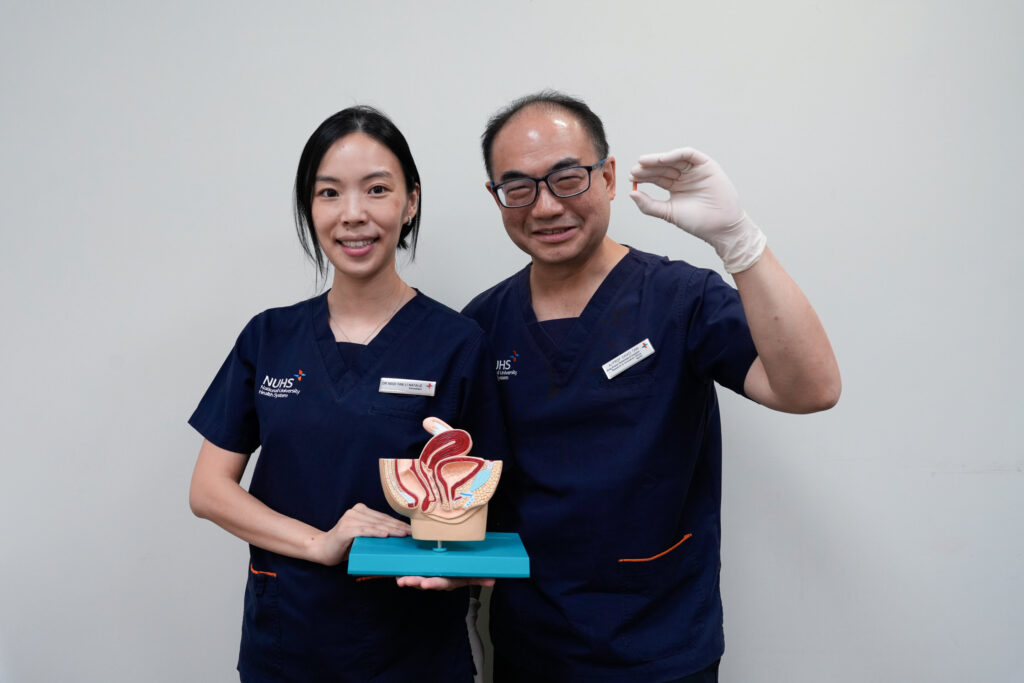
Both women underwent the conventional course of treatment involving surgery and chemotherapy, but their cancers later returned and spread to areas including the lymph nodes. Their conditions began to stabilize only after turning to a newer treatment approach that combines two medicines, pembrolizumab and lenvatinib. Caitlin accessed the treatment in Australia on the recommendation of Associate Professor David Tan, Senior Consultant, Department of Haematology-Oncology, National University Cancer Institute, Singapore (NCIS). Michelle received it as part of a new international clinical trial led by clinicians and scientists from Singapore and South Korea, for which Assoc Prof Tan was the corresponding author.
The trial, known as the LARA trial, was initiated through the Asia Pacific Gynecologic Oncology Trials Group (APGOT) that was founded by Assoc Prof Tan, and Professor Byoung Gie Kim of Chung-Ang University Gwang-myeong Hospital, one of the study’s lead investigators from South Korea. Assoc Prof Tan is also Associate Professor in the Department of Medicine at the Yong Loo Lin School of Medicine (NUS Medicine) and Principal Investigator at the Cancer Science Institute of Singapore (CSI Singapore) at NUS.
The other lead investigators included Professor Jung Yun Lee of Yonsei Cancer Centre and Severance Hospital, Professor Jae-Weon Kim of Seoul National University College of Medicine, and Professor Chel Hun Choi of Samsung Medical Centre.
Besides NCIS, the Singapore institutions involved in this study included the National University Hospital, the National Cancer Centre Singapore, and the National University of Singapore (NUS) through CSI Singapore at NUS, NUS Saw Swee Hock School of Public Health and NUS Medicine.
Advancing new options for clear cell gynecological cancer treatment
Published in The Lancet Oncology, the multicentre, single‑arm Phase 2 trial (LARA) found that combining pembrolizumab with lenvatinib shows promise for patients with recurrent clear cell endometrial (womb) and ovarian cancers who had previously developed resistance to standard ovarian cancer treatments. While similar drug combinations have been studied in other parts of the world, LARA provides the first Asia‑led, multicentre data set showing that pembrolizumab plus lenvatinib can achieve encouraging responses in this rare and difficult‑to‑treat cancer subtype.

Clear cell cancers of the ovary and endometrium are widely recognized as clinically challenging, with many patients showing poor responses to standard chemotherapy. In a previous APGOT study in recurrent ovarian clear cell carcinoma, the MOCCA trial, response rates to immunotherapy alone were only 9.7%, and responses to chemotherapy were only 18.8% with 50% of patients progressing by 1.7 months and 3.5 months respectively.
Although clear cell cancer makes up an estimated one to 12 percent of epithelial ovarian cancers in North America and Europe, the proportion is noticeably higher in Singapore and South Korea, reaching up to nearly 30% in Japan. This underscores the need for more effective treatment strategies for ovarian clear cell cancer patients in this region.
One reason these cancers are difficult to treat is their unique biology. Clear cell tumors often have unusual cell features, abnormal blood vessel growth and a tumor environment that helps them evade the immune system. To tackle this, the LARA trial explored a dual‑pathway approach. Lenvatinib was used to block signals that support tumor growth and blood‑vessel formation, while also helping to make the tumor environment more accessible to immune cells. Pembrolizumab then boosted the body’s immune response to recognize and attack cancer cells. This combination is already approved for use in patients with recurrent clear cell endometrial cancer, but not for patients with clear cell ovarian cancers, which represent 30% of all new patients diagnosed with ovarian cancer in Singapore.
Conducted between March 2021 and October 2023 in Singapore and South Korea, the study enrolled patients with either ovarian or endometrial clear cell cancers. Each patient received pembrolizumab as an intravenous infusion every three weeks, together with a daily oral dose of lenvatinib. Among the 25 patients, only three were diagnosed with endometrial cancers and the majority of patients had recurrent clear cell ovarian cancer.
When assessed for the primary outcome, 40% experienced confirmed tumor response (shrinkage of 30% or more) within the first 24 weeks of treatment, with median progression free survival of 6.4 months (meaning an estimated 50% of patients survived beyond 6.4 months without disease progression). Side effects were manageable, and importantly, no treatment‑related deaths were reported. Supporting these clinical findings, the bioinformatic analyses for the LARA trial were conducted at CSI Singapore. These included RNA sequencing, molecular subtyping, pathway interrogation and statistical modeling to correlate tumor biology with patient outcomes.
Assoc Prof David Tan said, “Our study points to the potential for immunotherapy plus targeted therapy to provide benefit in this hard-to-treat disease, and reinforces the need to explore this regimen further for patients with clear cell cancers of the ovary whose disease has progressed after previous treatment. Ovarian clear cell cancers are a clinically aggressive subtype that is rare in western countries but relatively common in Singapore, where currently approved treatments often fall short. That is why exploring this combination matters, as it could offer a much‑needed option to better outcomes.
“The response rates from the LARA trial far exceeded historical data in this disease. Furthermore, a US study also recently presented similar results with this combination in recurrent clear cell ovarian cancers, hence providing further validation of our results.
“Currently approved therapeutic options have only shown limited activity in this tumor type, and we, as a scientific community, have a duty to advocate for our patients and adopt the treatments that provide the best available evidence for efficacy. We are currently working to try to get this combination into the US National Comprehensive Cancer Network (NCCN) guidelines, which would then guide our subsequent efforts to make this treatment available for patients in Singapore.”
Both Caitlin and Michelle experienced meaningful gains from this new therapy, even though it did not remove cancer from their lives. For Caitlin, the nearly two and a half years on the therapy brought some of the most stable and fulfilling moments of her journey, allowing her to continue social activities, exercise, and patient advocacy before she had to stop the treatment as her cancer progressed. For Michelle, despite discontinuing the trial after just a month due to rising liver enzymes, the tumors in her neck and pelvic lymph nodes continued to shrink even after stopping treatment. In different ways, the therapy helped each woman achieve better disease control, improved energy, and the ability to continue doing the things that mattered most to them.
Dr. Natalie Ngoi, Consultant, Department of Haematology-Oncology, NCIS, who was the first author of the study, said, “We must not forget to credit our patients who believed in this idea. At the end of the day, it is all about the patients. Trials like ours are small but mean a lot for patients with rare cancer subtypes who are often excluded from larger randomized trials that focus on the common cancer subtypes. Rare cancers like clear cell gynecological cancers are an area of urgent unmet clinical need where more trials should be dedicated to their study, in order to improve clinical outcomes for our patients.”
Publication details
Natalie Y L Ngoi et al, Pembrolizumab plus lenvatinib in recurrent gynaecological clear cell carcinoma (LARA): a multicentre, single-arm, phase 2 trial, The Lancet Oncology (2026). DOI: 10.1016/s1470-2045(25)00662-x
Journal information:
Lancet Oncology
Clinical categories
Citation:
Dual-pathway blockade therapy offers hope for rare, hard-to-treat gynecological clear cell cancers (2026, April 23)
retrieved 23 April 2026
from https://medicalxpress.com/news/2026-04-dual-pathway-blockade-therapy-rare.html
This document is subject to copyright. Apart from any fair dealing for the purpose of private study or research, no
part may be reproduced without the written permission. The content is provided for information purposes only.

Khamrah by Lattafa for Men - 3.4 oz EDP Spray
4% Off
Ghost Sweetheart Eau de Toilette | Pineapple, Jasmine and Sandalwood | Perfume for Women 50 ml
50% Off
Marc Jacobs Dot Eau De Parfum for Women, 100 ml
42% Off
Ted Baker W Eau de Toilette for Her, Fig Leaf, White Peony and Violet Top Notes, Pink Orchid and Raspberry Middle Notes, 75ml
£11.77 (£15.69 / 100 ml) (as of 11/07/2026 03:56 GMT +01:00 - More infoProduct prices and availability are accurate as of the date/time indicated and are subject to change. Any price and availability information displayed on [relevant Amazon Site(s), as applicable] at the time of purchase will apply to the purchase of this product.)
Ted Baker Woman Pink Eau de Toilette Spray Floral Green Feminine Fragrance, Opening Notes are Fresh Peach, Bergamot and Tangerine with Warm Musk, Vanilla and Vetiver Base, 100ml
11% Off
Vera Wang Princess Eau de Toilette - 30 ml

Choco Musk 50ml Eau De Parfum for men and women | Chocolate Musk by Jannat Aromas
17% Off
Christina Aguilera Signature Eau de Parfum (50ml) Floral, Fruity & Exotic Scent, Luxury Fragrance for Women
9% Off
Calvin Klein - Eau De Toilette CKIN2U - Calvin Klein Women, Ladies Perfume, Women's Perfume, Calvin Klein Perfume, Calvin Klein One - 150 ml
5% Off
Jimmy Choo Flash Eau de Parfum, 60 ml (Pack of 1)
3% Off
Fruit of the Loom Men's Heavy T Shirt, White, XL UK
28% Off
ATNKE LED Lighted Beanie Cap,USB Rechargeable Running Hat Ultra Bright 4 LED Waterproof Light Winter Warm Gifts for Men and Women/Pink
17% Off
Men's 1/4 Zip Pullover UK Sale Clearance, Fleece Sweatshirt Casual Jumper Long Sleeve T-shirt Top Stand Collar Sweater Plain Pullover Sports Leisure Workwear Quarter Zip Sweater Lightweight Jumpers
£5.88 (as of 12/11/2025 00:52 GMT +01:00 - More infoProduct prices and availability are accurate as of the date/time indicated and are subject to change. Any price and availability information displayed on [relevant Amazon Site(s), as applicable] at the time of purchase will apply to the purchase of this product.)
Crevice Cleaning Brush, Bathroom Tile Groove Gap Cleaning Brush,Premium Crevice Cleaning Tool Aluminum Support with 15° Angle Magic Brush, Thin Brush for Home Kitchen
19% Off
Wireless Earbuds, Bluetooth 5.3 Headphones in Ear with HiFi Stereo Deep Bass, 4 ENC Noise Cancelling Mic Wireless Earphones 40H Playtime, Bluetooth Earbuds Dual LED Display, IP7 Waterproof, USB-C
42% Off