
 BBC
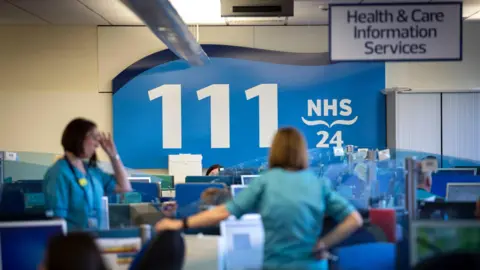
BBCThe average wait for an NHS 24 call in Scotland has risen from nine seconds to more than 22 minutes since 2014, a report has found.
The review was carried out by Mike McKirdy, the former president of the Royal College of Physicians and Surgeons of Glasgow, and commissioned by Scottish Labour.
Mr McKirdy criticised the “astonishing” increase in wait times for NHS 24 and said that the health service was “failing to deliver” for Scots.
Health Secretary Neil Gray insisted the health service was “turning a corner”.
The statistic Mr McKirdy identified for NHS 24 calls was the median waiting time – which is the middle figure in a range of values.

Mr McKirdy told BBC Radio Scotland Breakfast that he had identified a “central puzzle” in the health service.
He said: “We have more staff then ever before, there is more funding, there are more policy initiatives than ever before, demand is actually fairly static … but our activity is less than it was in 2018.”
Mr McKirdy, a retired consultant surgeon, said that the issue could not all be blamed on the Covid-19 pandemic, telling the BBC: “We’re really failing to deliver for people.”
He said that NHS staff had become “demoralised”, evidenced by higher rates of absences and younger workers leaving the health service.
Mr McKirdy said that the Scottish government needed to have a “relentless focus on delivery”, calling for more spending on GPs, community care, planning and workforce training.
He also said there should be a better use of technology, highlighting that the full roll-out of the NHS Scotland app has been delayed until 2030.
Mr McKirdy’s findings included:
- One in five Scots take anti-depressants and nearly half self-report living with at least one long-term condition
- The median wait time for an NHS 24 call rose from nine seconds in 2014 to more than five minutes in 2020, before jumping to 22.5 minutes this year
- A rise in wait times in areas such as radiology, which was 88% higher than in 2017 and endoscopy, which was 36% higher
- In 2013 almost all inpatients were treated within 12 weeks of the decision to treat, but by since September 2022 about 57% have met that target, on average
- A “structural paradox” in NHS Scotland, which “has more staff, more funding, and more policy initiatives than ever before, yet patient outcomes and experiences are stagnating or even declining”
- Since 2007, more than 130 major health strategies have been published – the equivalent of one every seven weeks
- Challenges in the NHS “were not caused” by the pandemic, which “exposed and enhanced” existing weaknesses
- Pressures on the NHS are having a substantial impact on health staff, who are around 50% more likely than the general population to experience chronic stress
- Workers are “at risk of burnout” and at times dealing with “problematic cultures that actively discourage the raising of issues or shut down concerns even when regarding patient safety”
- “Small tweaks” have been made to delivery of care, such as NHS111 and Pharmacy First, but changes have been “bolted on”, meaning capacity has been “failed to relieve pressure elsewhere”
Plan to ‘fix the NHS’
Scottish Labour deputy leader Jackie Baillie said: “We cannot allow the people of Scotland and those who work in our NHS to continue to pay the price of SNP failure.
“This is why the analysis provided by this vital report will play a major role in informing the policy and direction of Scottish Labour’s plan to fix our NHS.”
The Scottish Conservatives, meanwhile, launched plans to tackle delays in people leaving hospital.
Under the party’s proposals, patients in eligible areas with care home capacity would be placed temporarily in a care home within 48 hours of being declared fit for discharge.
Tory MSP Craig Hoy told BBC Radio Scotland Breakfast: “The problem that many people experience at the front door of a hospital, trying to get into A&E for example or trying to get in for an operation, is due to delayed discharge, which the government said would be a priority to reduce but they’re simply not doing that.”
Gray said: “The evidence is clear that our NHS is turning a corner, with downward trends across nearly all waiting list indicators.
“Long waits over a year have reduced for five consecutive months, diagnostic tests have increased significantly, GP numbers are rising, and operations are at their highest level since January 2020.
“To suggest otherwise does a huge disservice to our outstanding NHS staff who are delivering thousands more appointments and procedures this year, supported by our record £21.7bn investment.”
BBC News

Khamrah by Lattafa for Men - 3.4 oz EDP Spray
4% Off
Ghost Sweetheart Eau de Toilette | Pineapple, Jasmine and Sandalwood | Perfume for Women 50 ml
50% Off
Marc Jacobs Dot Eau De Parfum for Women, 100 ml
42% Off
Ted Baker W Eau de Toilette for Her, Fig Leaf, White Peony and Violet Top Notes, Pink Orchid and Raspberry Middle Notes, 75ml
£11.77 (£15.69 / 100 ml) (as of 11/05/2026 03:13 GMT +01:00 - More infoProduct prices and availability are accurate as of the date/time indicated and are subject to change. Any price and availability information displayed on [relevant Amazon Site(s), as applicable] at the time of purchase will apply to the purchase of this product.)
Ted Baker Woman Pink Eau de Toilette Spray Floral Green Feminine Fragrance, Opening Notes are Fresh Peach, Bergamot and Tangerine with Warm Musk, Vanilla and Vetiver Base, 100ml
11% Off
Vera Wang Princess Eau de Toilette - 30 ml

Choco Musk 50ml Eau De Parfum for men and women | Chocolate Musk by Jannat Aromas
17% Off
Christina Aguilera Signature Eau de Parfum (50ml) Floral, Fruity & Exotic Scent, Luxury Fragrance for Women
9% Off
Calvin Klein - Eau De Toilette CKIN2U - Calvin Klein Women, Ladies Perfume, Women's Perfume, Calvin Klein Perfume, Calvin Klein One - 150 ml
5% Off
Jimmy Choo Flash Eau de Parfum, 60 ml (Pack of 1)
3% Off
Fruit of the Loom Men's Heavy T Shirt, White, XL UK
28% Off
ATNKE LED Lighted Beanie Cap,USB Rechargeable Running Hat Ultra Bright 4 LED Waterproof Light Winter Warm Gifts for Men and Women/Pink
17% Off
Men's 1/4 Zip Pullover UK Sale Clearance, Fleece Sweatshirt Casual Jumper Long Sleeve T-shirt Top Stand Collar Sweater Plain Pullover Sports Leisure Workwear Quarter Zip Sweater Lightweight Jumpers
£5.88 (as of 12/11/2025 00:52 GMT +01:00 - More infoProduct prices and availability are accurate as of the date/time indicated and are subject to change. Any price and availability information displayed on [relevant Amazon Site(s), as applicable] at the time of purchase will apply to the purchase of this product.)
Crevice Cleaning Brush, Bathroom Tile Groove Gap Cleaning Brush,Premium Crevice Cleaning Tool Aluminum Support with 15° Angle Magic Brush, Thin Brush for Home Kitchen
19% Off
Wireless Earbuds, Bluetooth 5.3 Headphones in Ear with HiFi Stereo Deep Bass, 4 ENC Noise Cancelling Mic Wireless Earphones 40H Playtime, Bluetooth Earbuds Dual LED Display, IP7 Waterproof, USB-C
42% Off