
Researchers have unveiled an advancement in liver failure care: the CATCH-LIFE-MELD score (Chinese Acute-on-Chronic Liver Failure Consortium (CATCH-LIFE)-MELD score). This innovative tool, developed by an international team led by Xia Yu and colleagues, enhances the accuracy of predicting short-term survival outcomes for patients suffering from acute-on-chronic liver failure (ACLF).
The study, published in eGastroenterology, promises to improve patient management and treatment planning for this life-threatening condition.
“ACLF presents unique challenges due to its rapid progression and high mortality rates,” said Dr. Yu Shi, senior researcher at Zhejiang University and one of the study’s lead authors. “Our goal was to create a model that addresses the limitations of existing prognostic tools, providing clinicians with a more reliable method to assess risk and tailor interventions.”
What is the CATCH-LIFE-MELD score?
The Model for End-Stage Liver Disease (MELD) score has long been used to prioritize organ transplants and assess liver disease severity. However, its effectiveness in predicting ACLF outcomes is limited. The CATCH-LIFE-MELD score improves on this by incorporating three additional parameters—patient age, neutrophil count (an indicator of inflammation), and hepatic encephalopathy grade (a measure of brain dysfunction).
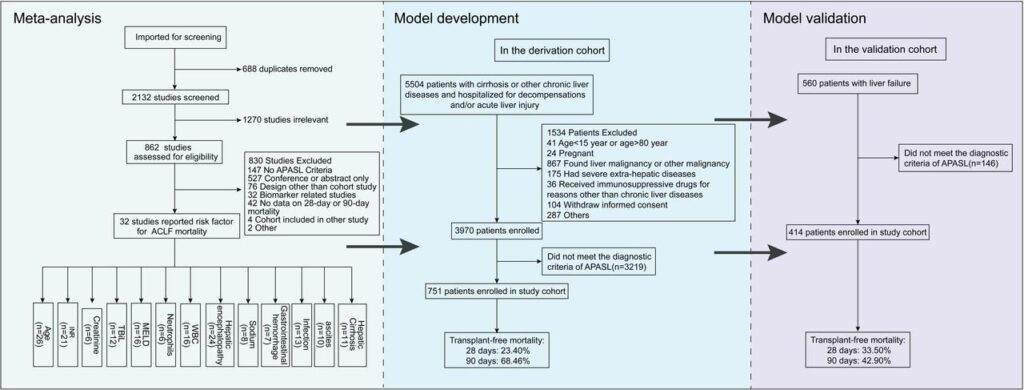
This refined tool was tested in over 750 patients across two large cohorts, demonstrating superior predictive accuracy for 28- and 90-day mortality compared to traditional models. It also remained robust across subgroups, including patients with hepatitis B, cirrhosis, and varying degrees of organ failure.
“Our findings show that the CATCH-LIFE-MELD score has the potential to not only predict survival more accurately but also assist clinicians in identifying high-risk patients who may benefit most from urgent interventions, such as liver transplantation,” explained Dr. Jifang Sheng, another senior co-author.
-

ACLF, acute-on-chronic liver failure; CATCH-LIFE-MELDs, Chinese Acute-on-Chronic Liver Failure Consortium-MELD score; CLIF-C ACLFs, Chronic Liver Failure Consortium ACLF score; COSSH ACLFs, Chinese Group on the Study of Severe Hepatitis B ACLF score; COSSH-ACLF IIs, COSSH-ACLF II score; MELDs, model for end-stage liver disease score; MELD-Nas, MELD with sodium score. Credit: Xia Yu, Ruoqi Zhou, Wenting Tan, et al.
-

(A) Derivation cohort. (B) Validation cohort. The cumulative incidence of death at 28/90 days was stratified according to the CATCH-LIFE-MELDs classification rule (low risk/intermediate risk/high risk: CATCH-LIFE-MELDs <3.09/3.09–5.04/>5.04). P<0.001 (log-rank test) for comparisons of survival probability among the three risk strata. Credit: Xia Yu, Ruoqi Zhou, Wenting Tan, et al.
Why it matters
ACLF is a severe complication of chronic liver disease, marked by rapid organ failure and a high risk of death. While liver transplantation is a potential lifesaver, the shortage of donor organs necessitates accurate risk stratification to prioritize care. The CATCH-LIFE-MELD score’s enhanced precision could improve patient outcomes and resource allocation.
The model also has implications for global health. “Since the parameters we used are commonly measured in clinical settings, the CATCH-LIFE-MELD score can be easily implemented worldwide, including in low-resource areas,” said Dr. Ruoqi Zhou, another lead researcher.
While this model has been validated in Asian populations, predominantly those with hepatitis B-related liver failure, further studies are planned to test its applicability to Western cohorts, where alcohol-related liver disease is more prevalent.
“Our work represents a critical step forward in personalized medicine for ACLF,” said Dr. Xia Yu. “We hope this model will guide new therapeutic approaches and ultimately save lives.”
More information:
Xia Yu et al, Evidence-based incorporation of key parameters into MELD score for acute-on-chronic liver failure, eGastroenterology (2024). DOI: 10.1136/egastro-2024-100101
Provided by
First Hospital of Jilin University
Citation:
New prognostic model enhances survival prediction in liver failure (2024, November 26)
retrieved 27 November 2024
from https://medicalxpress.com/news/2024-11-prognostic-survival-liver-failure.html
This document is subject to copyright. Apart from any fair dealing for the purpose of private study or research, no
part may be reproduced without the written permission. The content is provided for information purposes only.

Khamrah by Lattafa for Men - 3.4 oz EDP Spray
4% Off
Ghost Sweetheart Eau de Toilette | Pineapple, Jasmine and Sandalwood | Perfume for Women 50 ml
50% Off
Marc Jacobs Dot Eau De Parfum for Women, 100 ml
42% Off
Ted Baker W Eau de Toilette for Her, Fig Leaf, White Peony and Violet Top Notes, Pink Orchid and Raspberry Middle Notes, 75ml
£11.77 (£15.69 / 100 ml) (as of 08/06/2026 03:30 GMT +01:00 - More infoProduct prices and availability are accurate as of the date/time indicated and are subject to change. Any price and availability information displayed on [relevant Amazon Site(s), as applicable] at the time of purchase will apply to the purchase of this product.)
Ted Baker Woman Pink Eau de Toilette Spray Floral Green Feminine Fragrance, Opening Notes are Fresh Peach, Bergamot and Tangerine with Warm Musk, Vanilla and Vetiver Base, 100ml
11% Off
Vera Wang Princess Eau de Toilette - 30 ml

Choco Musk 50ml Eau De Parfum for men and women | Chocolate Musk by Jannat Aromas
17% Off
Christina Aguilera Signature Eau de Parfum (50ml) Floral, Fruity & Exotic Scent, Luxury Fragrance for Women
9% Off
Calvin Klein - Eau De Toilette CKIN2U - Calvin Klein Women, Ladies Perfume, Women's Perfume, Calvin Klein Perfume, Calvin Klein One - 150 ml
5% Off
Jimmy Choo Flash Eau de Parfum, 60 ml (Pack of 1)
3% Off
Fruit of the Loom Men's Heavy T Shirt, White, XL UK
28% Off
ATNKE LED Lighted Beanie Cap,USB Rechargeable Running Hat Ultra Bright 4 LED Waterproof Light Winter Warm Gifts for Men and Women/Pink
17% Off
Men's 1/4 Zip Pullover UK Sale Clearance, Fleece Sweatshirt Casual Jumper Long Sleeve T-shirt Top Stand Collar Sweater Plain Pullover Sports Leisure Workwear Quarter Zip Sweater Lightweight Jumpers
£5.88 (as of 12/11/2025 00:52 GMT +01:00 - More infoProduct prices and availability are accurate as of the date/time indicated and are subject to change. Any price and availability information displayed on [relevant Amazon Site(s), as applicable] at the time of purchase will apply to the purchase of this product.)
Crevice Cleaning Brush, Bathroom Tile Groove Gap Cleaning Brush,Premium Crevice Cleaning Tool Aluminum Support with 15° Angle Magic Brush, Thin Brush for Home Kitchen
19% Off
Wireless Earbuds, Bluetooth 5.3 Headphones in Ear with HiFi Stereo Deep Bass, 4 ENC Noise Cancelling Mic Wireless Earphones 40H Playtime, Bluetooth Earbuds Dual LED Display, IP7 Waterproof, USB-C
42% Off