 [
[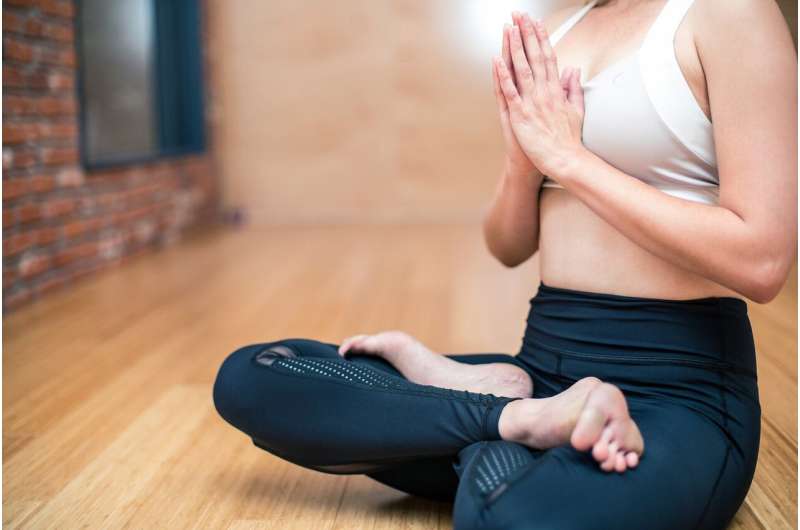
Yoga may help support individuals recovering from substance use disorders, according to researchers at Penn State Brandywine. The team includes Kendall Taylor, a fourth-year psychology student at Penn State Brandywine, who recently presented the work at the Eastern Psychological Association’s annual conference in Boston and at the campus’s Student Engagement Expo.
Led by Associate Professor of Psychology Daniela Martin and Associate Teaching Professor of Kinesiology Andrea Randolph and supported by a Commonwealth Campus Undergraduate Community-Engaged Research Award (UCERA), the researchers partnered with local organizations to evaluate yoga as a complementary approach to enhance traditional recovery programs.
“I’m coming up on 10 and a half years sober, so this topic really holds a special place in my heart,” Taylor said. “After being told about the opportunity in my ‘PSYCH 243: Introduction to Well-Being and Positive Psychology’ course, I told Drs. Martin and Randolph that I would be honored to participate in research with them.”
The idea for the study emerged through collaboration between Brandywine faculty and alumna Cheryl Spera, who operates Higher Ground Yoga, a trauma-sensitive yoga studio in Aston. Spera, who studied human development and family studies, works closely with individuals in recovery and partners with local agencies.
“I met Cheryl in the community at her yoga studio, and I learned that she works in partnership with a wide range of recovery agencies,” Martin said. “When we met, we talked about the possibility of doing research to evaluate the effectiveness of yoga as an alternative enhancement modality to treat addiction and substance use.”
Through the UCERA grant, Taylor, Martin and Randolph connected with R&D Recovery, a local recovery organization, to design, deliver and evaluate a six-week yoga program for participants, in addition to their regular treatment. The program enrolled seven participants and taught them to use a combination of deep breathing, physical postures and meditation—techniques the researchers said have been shown to activate the parasympathetic nervous system, lowering cortisol and calming the mind.
The researchers surveyed the participants and collected physiological data, such as heart rate and blood pressure, throughout the six-week program and compared the results to those of a control recovery treatment group not participating in the yoga program. They also conducted pre- and post-program interviews before and after the six-week program.
Participants reported improvements in several psychological measures, including increased mindfulness, reduced stress and greater emotional awareness, as well as feeling better both physically and mentally than before the program.
“We found that people were a lot more cognizant of their breathing,” Taylor said. “We also found that stress management, and the awareness of stressful situations, had changed. Participants were still experiencing stress in their lives, but the way they handled it or the way they viewed it changed positively.”
Randolph explained that they found significant differences across psychological measurements.
“The results show that mindfulness increased over all facets of the questions we gave in the surveys—this includes absence of self-critique, ability to observe inner events, non-reactivity and the ability to describe emotion,” Randolph said. “Participants also reported improvement in post-traumatic growth.”
The benefits extended beyond individual results, the researchers said, with participants reporting an increased sense of connection with one another.
“The participants also noted a sense of connectedness after being in the program,” Taylor said. “These participants knew each other through the recovery treatment program, but some of them had never talked to each other. Being able to be in the same room and have a common goal allowed them to bond and focus on bettering themselves.”
The project spanned approximately two years, beginning in 2024, with one round of the six-week yoga program and one round of the control group. The remainder of the two years consisted of prepping the program, analyzing the results and compiling it into a final project.
Reflecting on her experience, Taylor encouraged other students to pursue research opportunities during their time at Brandywine.
“Doing this research was the most amazing experience I’ve had in my collegiate career. It brought me so much joy to participate in something like this because I’d never done research before, and to be a part of a project that had meaning and purpose was so meaningful to me,” Taylor said. “My advice is if you get the opportunity to do research, take it and push yourself to go outside your comfort zone.”
Citation:
Yoga may enhance traditional recovery programs, researchers find (2026, April 19)
retrieved 19 April 2026
from https://medicalxpress.com/news/2026-04-yoga-traditional-recovery.html
This document is subject to copyright. Apart from any fair dealing for the purpose of private study or research, no
part may be reproduced without the written permission. The content is provided for information purposes only.

Khamrah by Lattafa for Men - 3.4 oz EDP Spray
4% Off
Ghost Sweetheart Eau de Toilette | Pineapple, Jasmine and Sandalwood | Perfume for Women 50 ml
50% Off
Marc Jacobs Dot Eau De Parfum for Women, 100 ml
42% Off
Ted Baker W Eau de Toilette for Her, Fig Leaf, White Peony and Violet Top Notes, Pink Orchid and Raspberry Middle Notes, 75ml
£11.77 (£15.69 / 100 ml) (as of 20/04/2026 02:59 GMT +01:00 - More infoProduct prices and availability are accurate as of the date/time indicated and are subject to change. Any price and availability information displayed on [relevant Amazon Site(s), as applicable] at the time of purchase will apply to the purchase of this product.)
Ted Baker Woman Pink Eau de Toilette Spray Floral Green Feminine Fragrance, Opening Notes are Fresh Peach, Bergamot and Tangerine with Warm Musk, Vanilla and Vetiver Base, 100ml
11% Off
Vera Wang Princess Eau de Toilette - 30 ml

Choco Musk 50ml Eau De Parfum for men and women | Chocolate Musk by Jannat Aromas
17% Off
Christina Aguilera Signature Eau de Parfum (50ml) Floral, Fruity & Exotic Scent, Luxury Fragrance for Women
9% Off
Calvin Klein - Eau De Toilette CKIN2U - Calvin Klein Women, Ladies Perfume, Women's Perfume, Calvin Klein Perfume, Calvin Klein One - 150 ml
5% Off
Jimmy Choo Flash Eau de Parfum, 60 ml (Pack of 1)
3% Off
Fruit of the Loom Men's Heavy T Shirt, White, XL UK
28% Off
ATNKE LED Lighted Beanie Cap,USB Rechargeable Running Hat Ultra Bright 4 LED Waterproof Light Winter Warm Gifts for Men and Women/Pink
17% Off
Men's 1/4 Zip Pullover UK Sale Clearance, Fleece Sweatshirt Casual Jumper Long Sleeve T-shirt Top Stand Collar Sweater Plain Pullover Sports Leisure Workwear Quarter Zip Sweater Lightweight Jumpers
£5.88 (as of 12/11/2025 00:52 GMT +01:00 - More infoProduct prices and availability are accurate as of the date/time indicated and are subject to change. Any price and availability information displayed on [relevant Amazon Site(s), as applicable] at the time of purchase will apply to the purchase of this product.)
Crevice Cleaning Brush, Bathroom Tile Groove Gap Cleaning Brush,Premium Crevice Cleaning Tool Aluminum Support with 15° Angle Magic Brush, Thin Brush for Home Kitchen
19% Off
Wireless Earbuds, Bluetooth 5.3 Headphones in Ear with HiFi Stereo Deep Bass, 4 ENC Noise Cancelling Mic Wireless Earphones 40H Playtime, Bluetooth Earbuds Dual LED Display, IP7 Waterproof, USB-C
42% Off