
 [


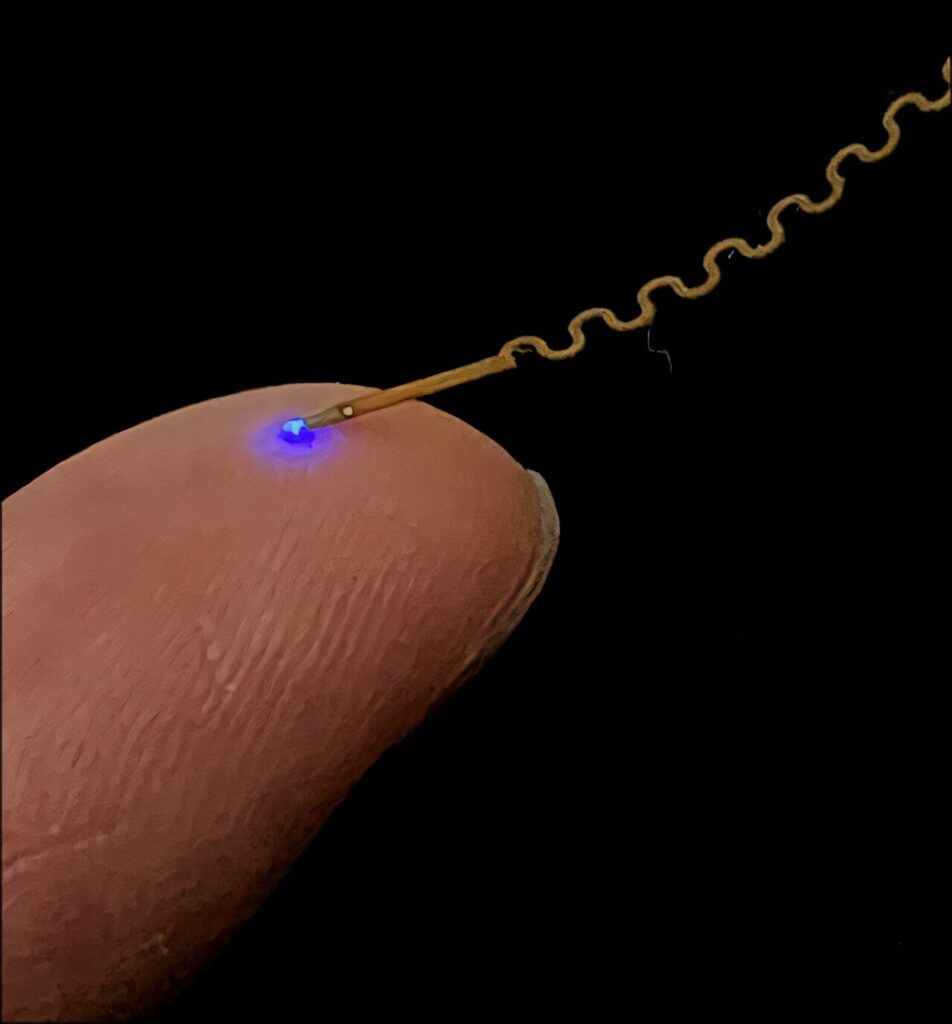
A joint research team led by KAIST has used a small, implantable neural chip to wirelessly monitor real-time changes in a neurotransmitter involved in memory and learning after an Alzheimer’s drug has been administered. In miniature pigs (minipigs), the team observed an increase in the neurotransmitter signal following drug administration, followed by a gradual return to baseline. The technology could help researchers assess how drugs act in the brain and develop stimulation methods that adapt to the brain’s response.
The research team was led by Professor Kyung-In Jang from the Department of Mechanical Engineering, in collaboration with researchers from the Daegu Gyeongbuk Institute of Science and Technology (DGIST), the Korea Brain Research Institute (KBRI) and the Korea Research Institute of Bioscience and Biotechnology (KRIBB). Their implantable neural chip integrates a sensor for detecting the neurotransmitter acetylcholine, a light-stimulation component and miniaturized wireless measurement technology.
Tracking donepezil’s effects in minipigs
Acetylcholine transmits signals between nerve cells and plays an important role in memory and learning. Donepezil, a drug used to treat Alzheimer’s disease, inhibits acetylcholinesterase, the enzyme that breaks down acetylcholine, allowing the neurotransmitter to remain active for longer periods of time. Tracking changes in acetylcholine in specific brain regions after drug administration can help researchers better understand the drug’s action.
The research team implanted the neural chip in the prefrontal cortex of minipigs, administered donepezil and wirelessly measured acetylcholine signals. The prefrontal cortex is involved in cognitive functions such as judgment, attention and memory. Following drug administration, the acetylcholine signal increased and then gradually returned to baseline. The findings, published in the journal Device, demonstrate that chemical responses in a specific brain region can be continuously monitored using an external device.

Combining chemical sensing and light stimulation
At the heart of the sensing technology is a layer that converts changes in neurotransmitter levels into electrical signals. The researchers combined porous chitosan with ultrathin silver–platinum (Ag@Pt) nanowires. The porous structure provides a large surface area for attaching the enzymes used to detect acetylcholine. The nanowires convert hydrogen peroxide produced by the enzymatic reaction into electrical signals.
The team also designed the chip to minimize interference from other molecules. The researchers placed an enzyme-coated electrode on one side of the thin probe inserted into the brain and an electrode without enzymes on the other. By comparing the two signals, the system reduces interference detected by both electrodes and isolates changes associated with acetylcholine. The measurements are processed by a miniaturized circuit and transmitted to an external device via Bluetooth.
In addition to sensing changes in the brain, the neural chip can stimulate nerve cells with light. In a separate experiment involving transgenic mice, the team confirmed that acetylcholine signals increased in response to light stimulation delivered by a micro-light-emitting diode (μLED) integrated into the chip.
The animal experiments drew on the expertise of the partner institutions. KRIBB provided the minipigs and support for surgical procedures, while KBRI supported mouse surgeries and experiments.
Toward response-guided brain stimulation
The technology could help researchers investigate how drugs for brain diseases act in the brain. In particular, it could enable comparisons of neurotransmitter responses across different drug doses and dosing intervals.
The study also lays the groundwork for research into closed-loop neural interfaces, which adjust stimulation based on ongoing measurements of the brain’s response. In such systems, a sensor detects changes following stimulation, and the intensity or timing of subsequent stimulation is adjusted accordingly. By integrating sensing and light stimulation into a single chip, the study provides a foundation for developing these systems.
Further validation needed before human use
However, the study measured neurotransmitter changes in animal brains and did not demonstrate therapeutic effects on Alzheimer’s disease or improvements in memory. Further validation is needed before the technology can be used in humans, including assessments of its long-term safety and the stability of its measurement performance after implantation.
“This study lays the groundwork for technologies that monitor changes in the brain and adjust stimulation based on its response,” said Jang. He added that the technology could help researchers investigate how drugs act in the brain and identify stimulation methods tailored to the brain’s condition.
The research team plans to commercialize the technology through N-Side Inc. (CEO Jang), a faculty-founded startup.
Publication details
Jieun Son et al., Implantable neural chip with electrochemical sensing and optogenetic stimulation for monitoring of cholinergic pharmacological responses, Device (2026). DOI: 10.1016/j.device.2026.101329
Journal information:
Device
Key medical concepts
Clinical categories


Citation:
Wireless neural chip tracks brain changes in real time after Alzheimer’s drug administration (2026, October 26)
retrieved 26 October 2026
from https://medicalxpress.com/news/2026-10-wireless-neural-chip-tracks-brain.html
This document is subject to copyright. Apart from any fair dealing for the purpose of private study or research, no
part may be reproduced without the written permission. The content is provided for information purposes only.

Khamrah by Lattafa for Men - 3.4 oz EDP Spray
4% Off
Ghost Sweetheart Eau de Toilette | Pineapple, Jasmine and Sandalwood | Perfume for Women 50 ml
50% Off
Marc Jacobs Dot Eau De Parfum for Women, 100 ml
42% Off
Ted Baker W Eau de Toilette for Her, Fig Leaf, White Peony and Violet Top Notes, Pink Orchid and Raspberry Middle Notes, 75ml
£11.77 (£15.69 / 100 ml) (as of 26/10/2026 05:37 GMT +00:00 - More infoProduct prices and availability are accurate as of the date/time indicated and are subject to change. Any price and availability information displayed on [relevant Amazon Site(s), as applicable] at the time of purchase will apply to the purchase of this product.)
Ted Baker Woman Pink Eau de Toilette Spray Floral Green Feminine Fragrance, Opening Notes are Fresh Peach, Bergamot and Tangerine with Warm Musk, Vanilla and Vetiver Base, 100ml
11% Off
Vera Wang Princess Eau de Toilette - 30 ml

Choco Musk 50ml Eau De Parfum for men and women | Chocolate Musk by Jannat Aromas
17% Off
Christina Aguilera Signature Eau de Parfum (50ml) Floral, Fruity & Exotic Scent, Luxury Fragrance for Women
9% Off
Calvin Klein - Eau De Toilette CKIN2U - Calvin Klein Women, Ladies Perfume, Women's Perfume, Calvin Klein Perfume, Calvin Klein One - 150 ml
5% Off
Jimmy Choo Flash Eau de Parfum, 60 ml (Pack of 1)
3% Off
Fruit of the Loom Men's Heavy T Shirt, White, XL UK
28% Off
ATNKE LED Lighted Beanie Cap,USB Rechargeable Running Hat Ultra Bright 4 LED Waterproof Light Winter Warm Gifts for Men and Women/Pink
17% Off
Men's 1/4 Zip Pullover UK Sale Clearance, Fleece Sweatshirt Casual Jumper Long Sleeve T-shirt Top Stand Collar Sweater Plain Pullover Sports Leisure Workwear Quarter Zip Sweater Lightweight Jumpers
£5.88 (as of 11/11/2025 23:52 GMT +00:00 - More infoProduct prices and availability are accurate as of the date/time indicated and are subject to change. Any price and availability information displayed on [relevant Amazon Site(s), as applicable] at the time of purchase will apply to the purchase of this product.)
Crevice Cleaning Brush, Bathroom Tile Groove Gap Cleaning Brush,Premium Crevice Cleaning Tool Aluminum Support with 15° Angle Magic Brush, Thin Brush for Home Kitchen
19% Off
Wireless Earbuds, Bluetooth 5.3 Headphones in Ear with HiFi Stereo Deep Bass, 4 ENC Noise Cancelling Mic Wireless Earphones 40H Playtime, Bluetooth Earbuds Dual LED Display, IP7 Waterproof, USB-C
42% Off