 [
[

A new study from the University of Portsmouth’s Research Group in Breast Health (RGBH), in collaboration with and funded by the Army Recruit Health and Performance Research Team, is the first to systematically evaluate and address breast support needs for female tactical athletes. The findings are published in the journal Sports Medicine.
In 2020, the British Army introduced a professional sports bra fitting and issue service (BraFIS) for female recruits, following scientific evidence that highlighted widespread breast health and bra-related challenges during Basic Training. Since its implementation, bra-related issues have fallen from 75% to 61%, marking a significant step forward in improving comfort, health and performance for women in demanding roles.
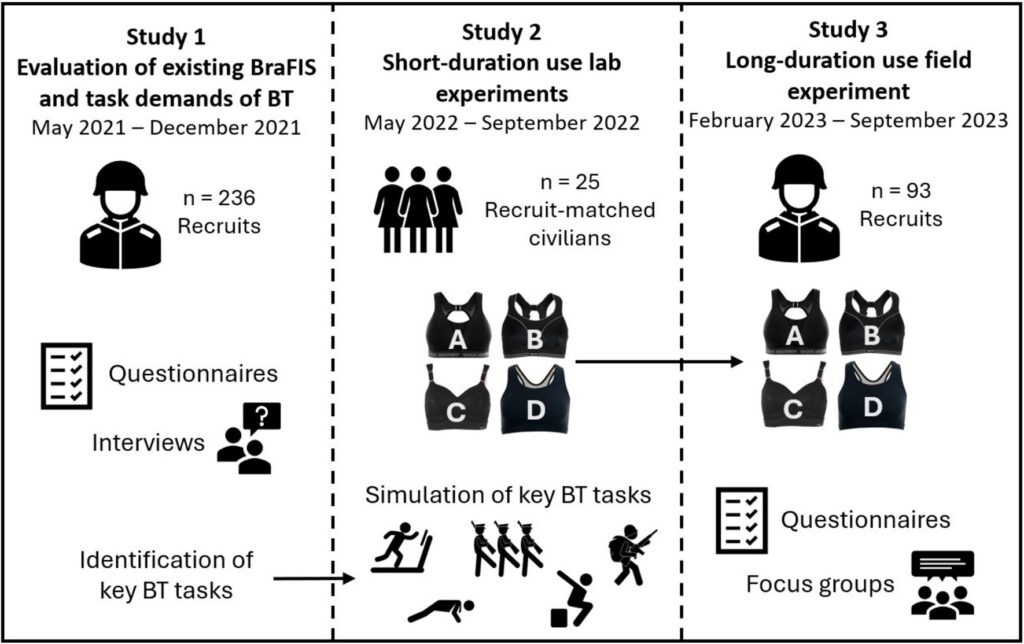
While progress is clear, research analyzing data from over 300 British Army Basic Training recruits shows that over half still experience at least one bra or breast-related issue, highlighting the need for purpose-designed bras that can meet the unique demands of military training.
The research, conducted between May 2021 and September 2023, delivered the first comprehensive evaluation of sports bras in military training. While current designs did not meet every demand, the study identified key design characteristics for bras in tactical roles, paving the way for future bra provision to enhance operational performance, comfort and, reduce breast-related issues.

While 38% of recruits preferred to wear their own sports bra, the majority engaged with the issued bras. Over 96% wore at least one during training, and nearly half used them five or more days a week. The large uptake demonstrates the value of the BraFIS, as the research highlights opportunities to improve comfort, sizing and task-specific suitability.
Due to the physical demands of roles in the Armed Forces and other arduous occupations (for example policing), this study emphasizes the critical role of research in optimizing clothing and equipment for effective performance. By identifying key design features and influencing policy, this work is setting a benchmark for female-specific kit across multiple sectors.
This research has already produced recommendations that have resulted in policy changes within the BraFIS, including the introduction of second bra fittings to accommodate changes in breast size during initial training and the provision of additional bras to appropriately equip female recruits.
Dr. Jenny Burbage, Associate Professor in Applied Biomechanics & Women’s Health from the University of Portsmouth’s Faculty of Science and Health, said, “Too many female recruits were starting training in poorly fitting bras, impacting comfort and confidence during demanding tasks.
“Our research takes the next step by identifying what basic training really requires, defining the bra characteristics that work, and evaluating whether current British Army kit meets those operational demands.”
Demand for tailored equipment is growing, particularly with the desired aim of achieving 30% female representation in the British Army by 2030.
Lead researcher, Dr. Emily Paines, said, “Currently the issued bras don’t meet the needs of recruits in basic training. The variation of tasks undertaken creates challenges for a singular bra design, so a selection of bras is recommended until a fit-for-purpose option is developed for demanding roles. Despite strong evidence linking proper breast support to improved posture, performance, and reduced discomfort, bras have not been treated as essential equipment.
“This research highlights the operational importance of proper support and driving positive change.”
It also follows previous research exploring breast health and bra considerations for female police officers by the University’s RGBH, emphasizing how important correct equipment is to reduce pain reduction, minimize sick days and providing future recommendations to best support essential workers.
Dr. Alex Rawcliffe, Senior Army Occupational Health Researcher and Technical Supervisor, said, “The strength of this research lies in its scalability. By providing a robust empirical foundation, it moves Defence beyond ad hoc solutions to women’s equipment needs.
“Evidence generated in recruits is now shaping the development of structured, evidence-based approaches for trained female soldiers, ensuring policy evolves in line with operational realities.”
“Initiatives like this help female soldiers feel valued, especially given their low numbers in the British Army,” added Dr. Burbage. “The Armed Forces recognize its importance and are investing in it—things are improving, but there is still more work to be done.”
Dr. Andy Roberts, Head of Army Recruit Health & Performance Research, added, “This research demonstrates our commitment to evidence-based improvements that enhance health, comfort and operational performance for female recruits. By addressing equipment needs such as bra support, we’re ensuring that every soldier has the right tools to succeed in demanding environments.”
Following the introduction of the BraFIS and evidence-based recommendations, the British Army now provides trained personnel with an annual £50 allowance for sports bras. The Royal Navy has adopted a BraFIS and voucher model, and the Royal Air Force offers a dedicated voucher scheme.
The study not only highlights the importance of sex-specific clothing and equipment but also aims to shape policy and offer a framework for other sectors, including emergency services.
More information
Emily Paines et al, Establishing Suitable Bra Characteristics for Tactical Athletes: A Mixed-Method Multi-Study Approach, Sports Medicine (2025). DOI: 10.1007/s40279-025-02375-3
Citation:
Why functional bra support is essential in the British armed forces (2026, January 5)
retrieved 5 January 2026
from https://medicalxpress.com/news/2026-01-functional-bra-essential-british-armed.html
This document is subject to copyright. Apart from any fair dealing for the purpose of private study or research, no
part may be reproduced without the written permission. The content is provided for information purposes only.

Khamrah by Lattafa for Men - 3.4 oz EDP Spray
4% Off
Ghost Sweetheart Eau de Toilette | Pineapple, Jasmine and Sandalwood | Perfume for Women 50 ml
50% Off
Marc Jacobs Dot Eau De Parfum for Women, 100 ml
42% Off
Ted Baker W Eau de Toilette for Her, Fig Leaf, White Peony and Violet Top Notes, Pink Orchid and Raspberry Middle Notes, 75ml
£11.77 (£15.69 / 100 ml) (as of 15/05/2026 03:14 GMT +01:00 - More infoProduct prices and availability are accurate as of the date/time indicated and are subject to change. Any price and availability information displayed on [relevant Amazon Site(s), as applicable] at the time of purchase will apply to the purchase of this product.)
Ted Baker Woman Pink Eau de Toilette Spray Floral Green Feminine Fragrance, Opening Notes are Fresh Peach, Bergamot and Tangerine with Warm Musk, Vanilla and Vetiver Base, 100ml
11% Off
Vera Wang Princess Eau de Toilette - 30 ml

Choco Musk 50ml Eau De Parfum for men and women | Chocolate Musk by Jannat Aromas
17% Off
Christina Aguilera Signature Eau de Parfum (50ml) Floral, Fruity & Exotic Scent, Luxury Fragrance for Women
9% Off
Calvin Klein - Eau De Toilette CKIN2U - Calvin Klein Women, Ladies Perfume, Women's Perfume, Calvin Klein Perfume, Calvin Klein One - 150 ml
5% Off
Jimmy Choo Flash Eau de Parfum, 60 ml (Pack of 1)
3% Off
Fruit of the Loom Men's Heavy T Shirt, White, XL UK
28% Off
ATNKE LED Lighted Beanie Cap,USB Rechargeable Running Hat Ultra Bright 4 LED Waterproof Light Winter Warm Gifts for Men and Women/Pink
17% Off
Men's 1/4 Zip Pullover UK Sale Clearance, Fleece Sweatshirt Casual Jumper Long Sleeve T-shirt Top Stand Collar Sweater Plain Pullover Sports Leisure Workwear Quarter Zip Sweater Lightweight Jumpers
£5.88 (as of 12/11/2025 00:52 GMT +01:00 - More infoProduct prices and availability are accurate as of the date/time indicated and are subject to change. Any price and availability information displayed on [relevant Amazon Site(s), as applicable] at the time of purchase will apply to the purchase of this product.)
Crevice Cleaning Brush, Bathroom Tile Groove Gap Cleaning Brush,Premium Crevice Cleaning Tool Aluminum Support with 15° Angle Magic Brush, Thin Brush for Home Kitchen
19% Off
Wireless Earbuds, Bluetooth 5.3 Headphones in Ear with HiFi Stereo Deep Bass, 4 ENC Noise Cancelling Mic Wireless Earphones 40H Playtime, Bluetooth Earbuds Dual LED Display, IP7 Waterproof, USB-C
42% Off