Michelle RobertsDigital health editor

 Getty Images
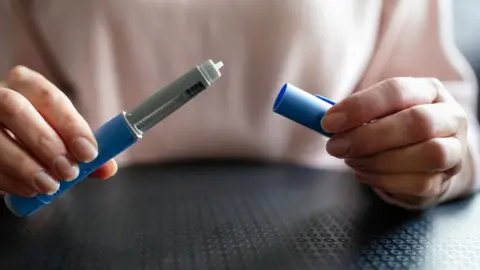
Fewer than one in 10 people who could benefit from obesity jabs like Wegovy are able to get them, warns the World Health Organization as it releases its first guidance on the drugs.
With more than one billion people worldwide now obese, it is calling for more widespread and fairer access to GLP-1 medication.
According to projections, more than two billion will be obese by 2030 unless action is taken.
High costs, limited production capacity, and supply-chain constraints are major barriers to universal access to the injections that can help people shift significant weight, says WHO.
It has already added them to its “essential” medicines list that countries are advised to provide.
WHO director-general Tedros Adhanom Ghebreyesus said: “Our new guidance recognises that obesity is a chronic disease that can be treated with comprehensive and lifelong care.
“While medication alone won’t solve this global health crisis, GLP-1 therapies can help millions overcome obesity and reduce its associated harms.”
WHO says these drugs, sometime called skinny jabs, represent a new chapter in the gradual conceptual shift in how society approaches obesity, from a “lifestyle condition” to a complex, preventable, and treatable chronic disease.
It says the drugs can be taken long-term – for six months or more – but must be prescribed along with advice on diet and exercise, so that people can keep the weight off.
Too few people around the world can access them, says WHO. “Our greatest concern is equitable access,” said Tedros.
Skinny jab shortage
Even under the current best projected scenario, the production of GLP-1 therapies could only cover around 100 million people – less than 10% of those who need them, according to the WHO.
The guideline calls on countries and companies to expand access, through strategies such as voluntary licensing – where a pharmaceutical company grants permission for others to make affordable non-brand versions of its patented drug.
A patent on semaglutide – the core ingredient of Novo Nordisk’s Wegovy – is due to expire in several countries in 2026, meaning other drug-makers will soon be free to produce and sell cheap versions in places like India, Canada, China, Brazil and Turkey.
WHO says countries must also create healthier environments to promote good health and prevent obesity.
How obesity jabs work
GLP-1 drugs mimick a natural hormone to slow digestion, curb appetite and increase feelings of fullness so people eat less.
In the UK, the injections are prescription only medicines, which means they can only be prescribed by a healthcare professional for a person who clinically needs it.
Some are available on the NHS, but more are sold privately.
There is a black market and to be safe people should avoid buying from unregulated sellers such as beauty salons or via social media.
People typically start to lose weight within a few weeks of starting on the weekly injections.
Research suggests people may put most of the weight back on within a year of stopping the medication though, as their normal food cravings return.
Being overweight or obese increases your risk for developing health problems, such as diabetes, heart disease, stroke, and certain cancers.
Obesity affects people in every country and was associated with 3.7 million deaths worldwide in 2024, according to the WHO.
BBC News

Khamrah by Lattafa for Men - 3.4 oz EDP Spray
4% Off
Ghost Sweetheart Eau de Toilette | Pineapple, Jasmine and Sandalwood | Perfume for Women 50 ml
50% Off
Marc Jacobs Dot Eau De Parfum for Women, 100 ml
42% Off
Ted Baker W Eau de Toilette for Her, Fig Leaf, White Peony and Violet Top Notes, Pink Orchid and Raspberry Middle Notes, 75ml
£11.77 (£15.69 / 100 ml) (as of 14/08/2026 04:10 GMT +01:00 - More infoProduct prices and availability are accurate as of the date/time indicated and are subject to change. Any price and availability information displayed on [relevant Amazon Site(s), as applicable] at the time of purchase will apply to the purchase of this product.)
Ted Baker Woman Pink Eau de Toilette Spray Floral Green Feminine Fragrance, Opening Notes are Fresh Peach, Bergamot and Tangerine with Warm Musk, Vanilla and Vetiver Base, 100ml
11% Off
Vera Wang Princess Eau de Toilette - 30 ml

Choco Musk 50ml Eau De Parfum for men and women | Chocolate Musk by Jannat Aromas
17% Off
Christina Aguilera Signature Eau de Parfum (50ml) Floral, Fruity & Exotic Scent, Luxury Fragrance for Women
9% Off
Calvin Klein - Eau De Toilette CKIN2U - Calvin Klein Women, Ladies Perfume, Women's Perfume, Calvin Klein Perfume, Calvin Klein One - 150 ml
5% Off
Jimmy Choo Flash Eau de Parfum, 60 ml (Pack of 1)
3% Off
Fruit of the Loom Men's Heavy T Shirt, White, XL UK
28% Off
ATNKE LED Lighted Beanie Cap,USB Rechargeable Running Hat Ultra Bright 4 LED Waterproof Light Winter Warm Gifts for Men and Women/Pink
17% Off
Men's 1/4 Zip Pullover UK Sale Clearance, Fleece Sweatshirt Casual Jumper Long Sleeve T-shirt Top Stand Collar Sweater Plain Pullover Sports Leisure Workwear Quarter Zip Sweater Lightweight Jumpers
£5.88 (as of 12/11/2025 00:52 GMT +01:00 - More infoProduct prices and availability are accurate as of the date/time indicated and are subject to change. Any price and availability information displayed on [relevant Amazon Site(s), as applicable] at the time of purchase will apply to the purchase of this product.)
Crevice Cleaning Brush, Bathroom Tile Groove Gap Cleaning Brush,Premium Crevice Cleaning Tool Aluminum Support with 15° Angle Magic Brush, Thin Brush for Home Kitchen
19% Off
Wireless Earbuds, Bluetooth 5.3 Headphones in Ear with HiFi Stereo Deep Bass, 4 ENC Noise Cancelling Mic Wireless Earphones 40H Playtime, Bluetooth Earbuds Dual LED Display, IP7 Waterproof, USB-C
42% Off