A multi-institutional team of specialists is using artificial intelligence to diagnose parasitic infections in patients by scanning stool samples. Their study is published in the open-access journal PLOS Neglected Tropical Diseases.
Currently, the job of looking for parasitic worm eggs in stool samples falls to highly trained lab technicians. However, people living in places with no nearby labs or who do not have the money to pay for such tests tend to go untested. In this new study, the researchers wondered if an AI application could fill the void.
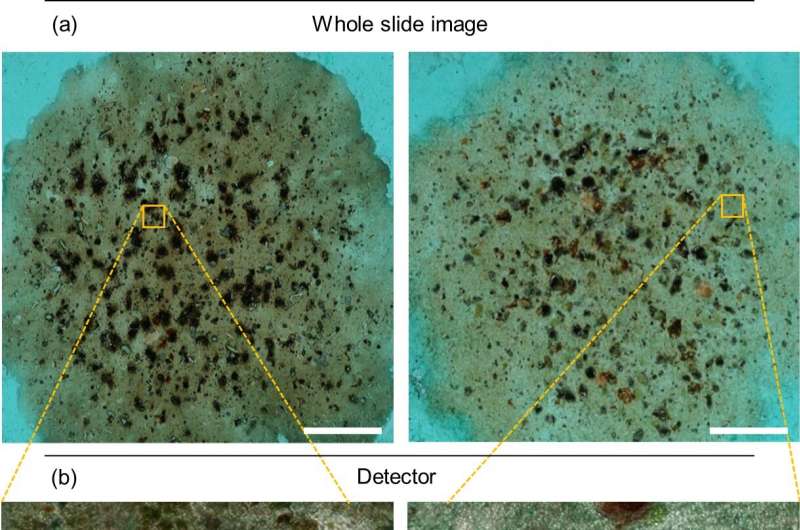
To that end, they trained and tested an AI application using 1,300 stool samples from children in Kenya. After local processing, the samples were digitally scanned using microscope cameras. The resulting scans were then uploaded to the cloud, where they were accessible for use by the AI app.
In their study, the research team focused exclusively on three types of parasitic infections, hookworms, roundworms and whipworms. Infections were diagnosed by the discovery of worm eggs in processed fecal samples.

The researchers found that the AI app was able to detect the presence of eggs in 76% to 96% of infections—the results varied due to the types of eggs involved. They also found that the app was not prone to finding eggs that were not there—it produced false identifications only 1% to 2% of the time. The team suggests the results are good enough for use in field testing.
The research team also noted that the AI analysis of a sample took just five minutes, though some results could take up to a half-hour when factoring in upload speed. They state that the AI app could be used anywhere there is network access and would be much cheaper than using lab technicians.
More information:
Johan Lundin et al, Diagnosis of soil-transmitted helminth infections with digital mobile microscopy and artificial intelligence in a resource-limited setting, PLOS Neglected Tropical Diseases (2024). DOI: 10.1371/journal.pntd.0012041
© 2024 Science X Network
Citation:
Using AI to spot parasites in stool samples (2024, April 12)
retrieved 12 April 2024
from https://medicalxpress.com/news/2024-04-ai-parasites-stool-samples.html
This document is subject to copyright. Apart from any fair dealing for the purpose of private study or research, no
part may be reproduced without the written permission. The content is provided for information purposes only.

Khamrah by Lattafa for Men - 3.4 oz EDP Spray
4% Off
Ghost Sweetheart Eau de Toilette | Pineapple, Jasmine and Sandalwood | Perfume for Women 50 ml
50% Off
Marc Jacobs Dot Eau De Parfum for Women, 100 ml
42% Off
Ted Baker W Eau de Toilette for Her, Fig Leaf, White Peony and Violet Top Notes, Pink Orchid and Raspberry Middle Notes, 75ml
£11.77 (£15.69 / 100 ml) (as of 19/08/2026 04:23 GMT +01:00 - More infoProduct prices and availability are accurate as of the date/time indicated and are subject to change. Any price and availability information displayed on [relevant Amazon Site(s), as applicable] at the time of purchase will apply to the purchase of this product.)
Ted Baker Woman Pink Eau de Toilette Spray Floral Green Feminine Fragrance, Opening Notes are Fresh Peach, Bergamot and Tangerine with Warm Musk, Vanilla and Vetiver Base, 100ml
11% Off
Vera Wang Princess Eau de Toilette - 30 ml

Choco Musk 50ml Eau De Parfum for men and women | Chocolate Musk by Jannat Aromas
17% Off
Christina Aguilera Signature Eau de Parfum (50ml) Floral, Fruity & Exotic Scent, Luxury Fragrance for Women
9% Off
Calvin Klein - Eau De Toilette CKIN2U - Calvin Klein Women, Ladies Perfume, Women's Perfume, Calvin Klein Perfume, Calvin Klein One - 150 ml
5% Off
Jimmy Choo Flash Eau de Parfum, 60 ml (Pack of 1)
3% Off
Fruit of the Loom Men's Heavy T Shirt, White, XL UK
28% Off
ATNKE LED Lighted Beanie Cap,USB Rechargeable Running Hat Ultra Bright 4 LED Waterproof Light Winter Warm Gifts for Men and Women/Pink
17% Off
Men's 1/4 Zip Pullover UK Sale Clearance, Fleece Sweatshirt Casual Jumper Long Sleeve T-shirt Top Stand Collar Sweater Plain Pullover Sports Leisure Workwear Quarter Zip Sweater Lightweight Jumpers
£5.88 (as of 12/11/2025 00:52 GMT +01:00 - More infoProduct prices and availability are accurate as of the date/time indicated and are subject to change. Any price and availability information displayed on [relevant Amazon Site(s), as applicable] at the time of purchase will apply to the purchase of this product.)
Crevice Cleaning Brush, Bathroom Tile Groove Gap Cleaning Brush,Premium Crevice Cleaning Tool Aluminum Support with 15° Angle Magic Brush, Thin Brush for Home Kitchen
19% Off
Wireless Earbuds, Bluetooth 5.3 Headphones in Ear with HiFi Stereo Deep Bass, 4 ENC Noise Cancelling Mic Wireless Earphones 40H Playtime, Bluetooth Earbuds Dual LED Display, IP7 Waterproof, USB-C
42% Off