BBC News, London and Kyiv

 Getty Images
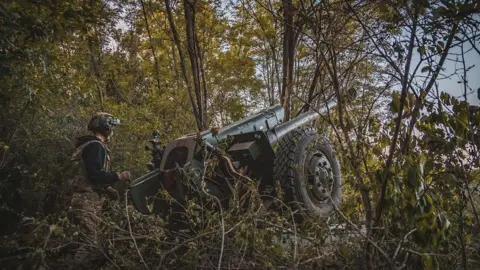
The head of Ukraine’s army, Gen Oleksandr Syrskyi, has said his troops have stopped Russian advances in the northeastern border region of Sumy.
During a visit to the front on Thursday, Syrskyi said the line of combat had been “stabilised” and that the Russian summer offensive in the area had been “choked off”.
However, Syrskyi also added that he had personally gone to check on fortifications in the region and that more were urgently needed.
Syrskyi’s comments on the successes of the Ukrainian troops in Sumy back recent statements by Ukrainian officials that Russia’s pressure on the region was declining.
However, the situation remained “volatile”, Border Guard spokesperson Andriy Demchenko said earlier this week.
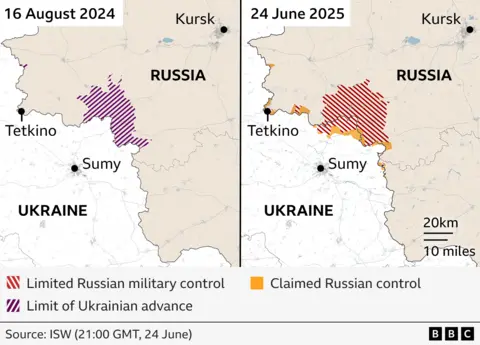
Sumy borders the Russian region of Kursk, parts of which were seized and occupied last year by Ukrainian forces in a surprise offensive before being almost totally driven out months later.
The Kursk incursion was an embarrassment for Russia and in April President Vladimir Putin announced a plan to create “security buffer zones” along the border to provide “additional support” to areas in Russia which border Ukraine’s Kharkiv, Sumy and Chernihiv regions.
Moscow has been pushing in the Sumy area with renewed effort since then. In late May Ukraine’s Volodymyr Zelensky said 50,000 of Russia’s “largest, strongest” troops were concentrated along the border and were planning to create a 10km (6-mile) buffer zone.
There has been criticism about the lack of fortifications in some areas of the Sumy region – and in his statement on Thursday Syrskyi tried to quell growing public concerns over delays in their construction.
“Additional fortifications, the establishment of ‘kill zones’, the construction of anti-drone corridors to protect our soldiers and ensure more reliable logistics for our troops are obvious tasks that are being carried out,” he said.
However, Syrskyi acknowledged that these improvements had to be done better and more efficiently.
In the early days of the Russian invasion of Ukraine, the lack of fortifications in certain parts of Ukraine allowed Moscow to make advances across the country – from its northern borders and from the illegally annexed Crimean peninsula.
The window of opportunity to build fortifications in Sumy safely and quickly was in autumn 2024, when Ukrainian troops were still advancing in the Russia’s border Kursk region and Sumy remained relatively unscathed.
Now may be too late, as Russia is undoubtedly well aware of the sections of the front line that lack strong fortifications.
In the last several months Moscow has claimed to have captured several villages while pummelling the city of Sumy with heavy missile strikes, killing dozens. A single ballistic missile attack on 13 April killed at least 34 people and injured 117.
DeepState, a group that monitors the latest frontline developments in Ukraine, has quoted sources as confirming that combat is raging in various unfortified areas of Sumy. The delays with erecting “much-needed fortifications” or the “low quality of some of the dugouts” could no longer be ignored, DeepState analysts said.
Asked about the summer offensive at a forum in St Petersburg last week, Putin said Russia did not “have the goal of capturing Sumy, but I don’t rule it out”. He said Russian forces had already established a buffer zone of 8-12km in depth.
Russia’s full-scale invasion of Ukraine, launched in February 2022, is now well into its fourth year.
Large-scale Russian drone attacks on Ukrainian cities are on the rise. In recent weeks the capital Kyiv was targeted with record numbers of drones that overwhelm air defences and cause deadly explosions.
Recent rounds of talks between Ukraine and Russia resulted in large prisoner exchanges but have so far failed to produce any tangible progress towards a ceasefire.
Earlier this week Nato Secretary General Mark Rutte said that European and Canadian allies had pledged €35bn (£30bn; $41bn) to Ukraine.
But there remains nervousness in Kyiv over the level of US President Donald Trump’s commitment to the Ukrainian cause and his volatile relationship with Zelensky.
However, Trump said on Wednesday a meeting he held with Zelensky on the sidelines of the Nato summit in The Hague “couldn’t have been nicer”.
He told BBC Ukraine’s Myroslava Petsa at a press conference afterwards that he was considering supplying Kyiv with US Patriot air defence missiles to defend itself against Russian strikes.
“We’re going to see if we could make some available. You know, they’re very hard to get,” he said.
BBC News

Khamrah by Lattafa for Men - 3.4 oz EDP Spray
4% Off
Ghost Sweetheart Eau de Toilette | Pineapple, Jasmine and Sandalwood | Perfume for Women 50 ml
50% Off
Marc Jacobs Dot Eau De Parfum for Women, 100 ml
42% Off
Ted Baker W Eau de Toilette for Her, Fig Leaf, White Peony and Violet Top Notes, Pink Orchid and Raspberry Middle Notes, 75ml
£11.77 (£15.69 / 100 ml) (as of 29/04/2026 03:08 GMT +01:00 - More infoProduct prices and availability are accurate as of the date/time indicated and are subject to change. Any price and availability information displayed on [relevant Amazon Site(s), as applicable] at the time of purchase will apply to the purchase of this product.)
Ted Baker Woman Pink Eau de Toilette Spray Floral Green Feminine Fragrance, Opening Notes are Fresh Peach, Bergamot and Tangerine with Warm Musk, Vanilla and Vetiver Base, 100ml
11% Off
Vera Wang Princess Eau de Toilette - 30 ml

Choco Musk 50ml Eau De Parfum for men and women | Chocolate Musk by Jannat Aromas
17% Off
Christina Aguilera Signature Eau de Parfum (50ml) Floral, Fruity & Exotic Scent, Luxury Fragrance for Women
9% Off
Calvin Klein - Eau De Toilette CKIN2U - Calvin Klein Women, Ladies Perfume, Women's Perfume, Calvin Klein Perfume, Calvin Klein One - 150 ml
5% Off
Jimmy Choo Flash Eau de Parfum, 60 ml (Pack of 1)
3% Off
Fruit of the Loom Men's Heavy T Shirt, White, XL UK
28% Off
ATNKE LED Lighted Beanie Cap,USB Rechargeable Running Hat Ultra Bright 4 LED Waterproof Light Winter Warm Gifts for Men and Women/Pink
17% Off
Men's 1/4 Zip Pullover UK Sale Clearance, Fleece Sweatshirt Casual Jumper Long Sleeve T-shirt Top Stand Collar Sweater Plain Pullover Sports Leisure Workwear Quarter Zip Sweater Lightweight Jumpers
£5.88 (as of 12/11/2025 00:52 GMT +01:00 - More infoProduct prices and availability are accurate as of the date/time indicated and are subject to change. Any price and availability information displayed on [relevant Amazon Site(s), as applicable] at the time of purchase will apply to the purchase of this product.)
Crevice Cleaning Brush, Bathroom Tile Groove Gap Cleaning Brush,Premium Crevice Cleaning Tool Aluminum Support with 15° Angle Magic Brush, Thin Brush for Home Kitchen
19% Off
Wireless Earbuds, Bluetooth 5.3 Headphones in Ear with HiFi Stereo Deep Bass, 4 ENC Noise Cancelling Mic Wireless Earphones 40H Playtime, Bluetooth Earbuds Dual LED Display, IP7 Waterproof, USB-C
42% Off