Holly Fleck & Jessica LawrenceBBC News NI

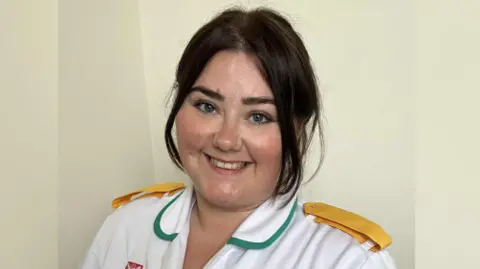 Kellie-Ann Winchester
Nursing students at Queen’s University Belfast (QUB) are set to receive “groundbreaking” training to help them spot signs of domestic abuse – the first of its kind in the UK.
The Unlock Safety Initiative hopes to equip 600 prospective nurses a year with the skills to recognise abuse, respond to disclosures and connect patients with the appropriate support services.
It comes as police recorded almost 30,000 domestic abuse incidents in Northern Ireland between June 2024 and 2025 – accounting for about 20% of reported crime.
Student nurse Kellie-Ann Winchester said the training will enable nurses to recognise the signs and be “better equipped to speak about domestic violence”.
The initiative was developed between QUB and the Women’s Aid Federation Northern Ireland, the Royal College of Nursing (RCN) and the Executive Office’s Change Fund.
The training will be delivered annually, and will be built into the degree programme as a way of tackling violence against women and girls in Northern Ireland.
Nurses who complete the programme will receive a badge to let patients know they can confide in them.
Ms Winchester, a second year adult nursing student, will not receive the training as part of her studies but will attend a launch event for the programme on Wednesday.
She said the training, which will be available from this academic year, will give student nurses “the awareness of domestic abuse”, in particular the signs that “aren’t always visible to the eye”.
Ms Winchester said that will “then obviously lead on to how we communicate as nurses to the public”.
“I think it’s going to be great for early intervention. You know, getting in early, breaking the cycle and then we can better inform our care as well.
“We could intentionally change in lives from the very start which is incredible.”

QUB student nurse Louise Bradford said the introduction of this training is “absolutely fantastic” as it will “make a change and maybe even save a life”.
As Ms Bradford is a third year learning disability nurse she will not receive the training, but will attend the launch day.
“If we are being supported to see the signs and be informed of domestic abuse and violence that can happen to the individuals that we care for, it supports us to support them, make a change and maybe even save a life,” she told BBC News NI.
She explained as part of her work as a learning disability nurse it is “extremely important” to have this training to “be able to recognise the signs in an individual that could not be communicated verbally”.
‘Sad reality’
Johanna McMullan, the director of education at QUB’s School of Nursing and Midwifery, said what students will learn as part of the programme will leave a “profound and lasting impact”.
“Part of our job is to have extremely difficult and challenging conversations with patients in our care, and sometimes we are their first port of call,” she said.
“The sad reality is that most of our students who receive this fundamental training will inevitably have to utilise these skills in some capacity throughout their career.”
Sarah Mason from Women’s Aid NI said the launch of the training on Wednesday marks a “good day on the road to prevention”.
In the past year, the charity has supported more than 7,600 women, as well as 5,200 children, she added.
“We also know that pregnancy can be a trigger for domestic abuse and in the last year Women’s Aid supported 266 women who were pregnant and 10 babies were born whilst their mother was in refuge,” she said.
 Women’s Aid NI
Prof Rita Devlin, the RCN’s director in Northern Ireland, said this was the first step in ensuring that all healthcare workers are equipped to identify abuse, knowing who may be at risk, and how to start difficult conversations.
“With women making up nearly 90% of the nursing workforce, this initiative will prepare nursing students to address domestic abuse from the start of their careers,” she said.
If you have been affected by any of the issues raised in this story, information and support can be found at the BBC’s Action Line.
Source link

Khamrah by Lattafa for Men - 3.4 oz EDP Spray
4% Off
Ghost Sweetheart Eau de Toilette | Pineapple, Jasmine and Sandalwood | Perfume for Women 50 ml
50% Off
Marc Jacobs Dot Eau De Parfum for Women, 100 ml
42% Off
Ted Baker W Eau de Toilette for Her, Fig Leaf, White Peony and Violet Top Notes, Pink Orchid and Raspberry Middle Notes, 75ml
£11.77 (£15.69 / 100 ml) (as of 31/05/2026 03:24 GMT +01:00 - More infoProduct prices and availability are accurate as of the date/time indicated and are subject to change. Any price and availability information displayed on [relevant Amazon Site(s), as applicable] at the time of purchase will apply to the purchase of this product.)
Ted Baker Woman Pink Eau de Toilette Spray Floral Green Feminine Fragrance, Opening Notes are Fresh Peach, Bergamot and Tangerine with Warm Musk, Vanilla and Vetiver Base, 100ml
11% Off
Vera Wang Princess Eau de Toilette - 30 ml

Choco Musk 50ml Eau De Parfum for men and women | Chocolate Musk by Jannat Aromas
17% Off
Christina Aguilera Signature Eau de Parfum (50ml) Floral, Fruity & Exotic Scent, Luxury Fragrance for Women
9% Off
Calvin Klein - Eau De Toilette CKIN2U - Calvin Klein Women, Ladies Perfume, Women's Perfume, Calvin Klein Perfume, Calvin Klein One - 150 ml
5% Off
Jimmy Choo Flash Eau de Parfum, 60 ml (Pack of 1)
3% Off
Fruit of the Loom Men's Heavy T Shirt, White, XL UK
28% Off
ATNKE LED Lighted Beanie Cap,USB Rechargeable Running Hat Ultra Bright 4 LED Waterproof Light Winter Warm Gifts for Men and Women/Pink
17% Off
Men's 1/4 Zip Pullover UK Sale Clearance, Fleece Sweatshirt Casual Jumper Long Sleeve T-shirt Top Stand Collar Sweater Plain Pullover Sports Leisure Workwear Quarter Zip Sweater Lightweight Jumpers

Crevice Cleaning Brush, Bathroom Tile Groove Gap Cleaning Brush,Premium Crevice Cleaning Tool Aluminum Support with 15° Angle Magic Brush, Thin Brush for Home Kitchen
19% Off
Wireless Earbuds, Bluetooth 5.3 Headphones in Ear with HiFi Stereo Deep Bass, 4 ENC Noise Cancelling Mic Wireless Earphones 40H Playtime, Bluetooth Earbuds Dual LED Display, IP7 Waterproof, USB-C
42% Off