
 [
[


Certain white blood cells in the immune system, known as neutrophils, can make cancer immunotherapy less effective, according to a new study from Karolinska Institutet published in the journal Immunity. The results show that a signaling molecule in the tumor affects neutrophils, reducing the effect of treatment.
Immunotherapy is used to activate the body’s own immune system against cancer, but not all patients respond to the treatment. In the new study, researchers investigated how neutrophils influence different forms of immunotherapy in two mouse models of melanoma and breast cancer. Neutrophils play an important role in fighting infections, but can have different functions in tumors.
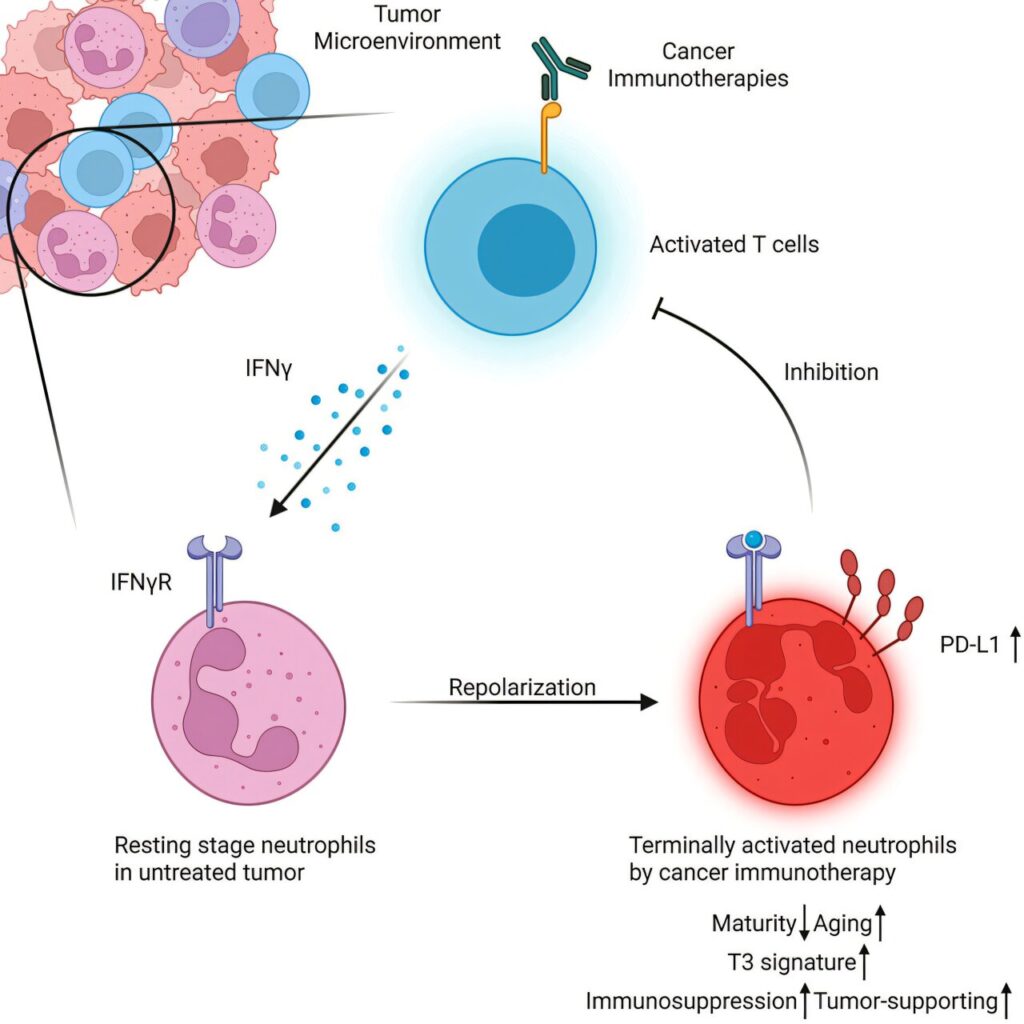
The researchers compared mice with normal neutrophil levels with mice that completely lacked these cells. When neutrophils were absent, several immunotherapies were more effective. Tumors shrank more, and higher numbers of T cells, immune cells that can kill cancer cells, entered the tumor and became activated.
“We see that neutrophils can dampen the effect of immunotherapy by influencing T-cell activity,” says Shengduo Pei, former doctoral student at the Department of Microbiology, Tumor and Cell Biology, Karolinska Institutet, and the study’s first author.
Tumor signals influence treatment
The study also shows that neutrophils themselves change in response to treatment. When immunotherapy is initiated, neutrophils begin to express PD-L1, a protein that inhibits T-cell activity. This change is driven by the signaling molecule interferon-gamma, produced by activated immune cells within the tumor. When the researchers specifically removed PD-L1 or the interferon-gamma receptor from neutrophils, the treatment became more effective.
“This means that the neutrophil response to immunotherapy is not static but governed by signals in the tumor environment. It also shows the importance of studying blocking mechanisms that arise once treatment begins. The results may contribute to the development of treatments that combine several therapies to counteract these inhibitory effects,” says Mikael Karlsson, professor at the same department.
The researchers also found indications that the same mechanisms are present in humans, including analyses of tumor samples from lung cancer patients who had received immunotherapy.
Publication details
Shengduo Pei et al, Neutrophil regulation of immunotherapy for cancer is controlled by type II interferon, Immunity (2026). DOI: 10.1016/j.immuni.2026.05.014. www.cell.com/immunity/fulltext … 1074-7613(26)00225-6
Journal information:
Immunity
Clinical categories


Citation:
Why some immunotherapy fails: Tumor-triggered neutrophils can shut down cancer-killing T cells (2026, June 15)
retrieved 15 June 2026
from https://medicalxpress.com/news/2026-06-immunotherapy-tumor-triggered-neutrophils-cancer.html
This document is subject to copyright. Apart from any fair dealing for the purpose of private study or research, no
part may be reproduced without the written permission. The content is provided for information purposes only.

Khamrah by Lattafa for Men - 3.4 oz EDP Spray
4% Off
Ghost Sweetheart Eau de Toilette | Pineapple, Jasmine and Sandalwood | Perfume for Women 50 ml
50% Off
Marc Jacobs Dot Eau De Parfum for Women, 100 ml
42% Off
Ted Baker W Eau de Toilette for Her, Fig Leaf, White Peony and Violet Top Notes, Pink Orchid and Raspberry Middle Notes, 75ml
£11.77 (£15.69 / 100 ml) (as of 16/10/2026 06:35 GMT +01:00 - More infoProduct prices and availability are accurate as of the date/time indicated and are subject to change. Any price and availability information displayed on [relevant Amazon Site(s), as applicable] at the time of purchase will apply to the purchase of this product.)
Ted Baker Woman Pink Eau de Toilette Spray Floral Green Feminine Fragrance, Opening Notes are Fresh Peach, Bergamot and Tangerine with Warm Musk, Vanilla and Vetiver Base, 100ml
11% Off
Vera Wang Princess Eau de Toilette - 30 ml

Choco Musk 50ml Eau De Parfum for men and women | Chocolate Musk by Jannat Aromas
17% Off
Christina Aguilera Signature Eau de Parfum (50ml) Floral, Fruity & Exotic Scent, Luxury Fragrance for Women
9% Off
Calvin Klein - Eau De Toilette CKIN2U - Calvin Klein Women, Ladies Perfume, Women's Perfume, Calvin Klein Perfume, Calvin Klein One - 150 ml
5% Off
Jimmy Choo Flash Eau de Parfum, 60 ml (Pack of 1)
3% Off
Fruit of the Loom Men's Heavy T Shirt, White, XL UK
28% Off
ATNKE LED Lighted Beanie Cap,USB Rechargeable Running Hat Ultra Bright 4 LED Waterproof Light Winter Warm Gifts for Men and Women/Pink
17% Off
Men's 1/4 Zip Pullover UK Sale Clearance, Fleece Sweatshirt Casual Jumper Long Sleeve T-shirt Top Stand Collar Sweater Plain Pullover Sports Leisure Workwear Quarter Zip Sweater Lightweight Jumpers
£5.88 (as of 12/11/2025 00:52 GMT +01:00 - More infoProduct prices and availability are accurate as of the date/time indicated and are subject to change. Any price and availability information displayed on [relevant Amazon Site(s), as applicable] at the time of purchase will apply to the purchase of this product.)
Crevice Cleaning Brush, Bathroom Tile Groove Gap Cleaning Brush,Premium Crevice Cleaning Tool Aluminum Support with 15° Angle Magic Brush, Thin Brush for Home Kitchen
19% Off
Wireless Earbuds, Bluetooth 5.3 Headphones in Ear with HiFi Stereo Deep Bass, 4 ENC Noise Cancelling Mic Wireless Earphones 40H Playtime, Bluetooth Earbuds Dual LED Display, IP7 Waterproof, USB-C
42% Off