
 [
[

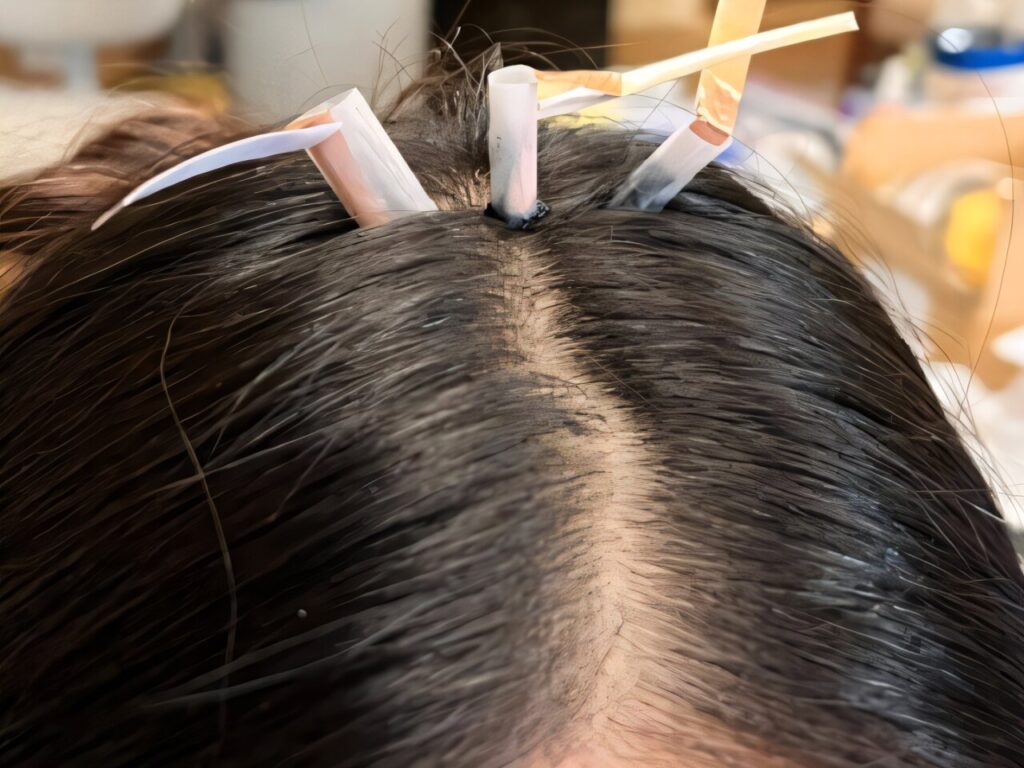
A vital tool for health care practitioners, electroencephalography (EEG) systems measure electrical activity in the brain through electrodes placed on the scalp, but getting reliable readings can be surprisingly difficult. Hair interferes with contact between the electrodes and skin, and the gels used to improve those connections often dry out over time, weakening signal quality.
Researchers at Penn State have developed a reusable material designed to solve both problems at once. The material is a thermoreversible semiconducting ionic biogel, meaning it becomes liquid when gently heated so it can move through hair and reach the scalp, then returns to a stable gel as it cools, keeping its conducting and semiconducting character. The researchers said the technology could improve wearable brain-monitoring systems and eventually help create more natural touch experiences in virtual reality, prosthetic limbs and other human-computer interfaces. They published their work in Science Advances.
Testing the biogel in brain recordings
The team demonstrated that the biogel maintained stable performance across different hair types for multiple days, outperforming conventional EEG gels that degrade more quickly as they dry out. The team also showed that the material could support brain recordings during both natural touch sensations and electrically stimulated artificial touch.

“We asked two fundamental questions,” said Ankan Dutta, doctoral student in mechanical engineering and lead author of the study. “Can we make an electrically conducting or semiconducting hydrogel that becomes liquid with mild heating and returns to a stable gel when it is cool? And can we use this material to understand a field called neurohaptics?”
Neurohaptics focuses on how the nervous system experiences touch, both natural and artificial. Understanding this could lead to more immersive virtual and augmented reality systems, improved prosthetic limbs and new forms of human-computer interaction, Dutta said.
Today’s haptic technologies, such as vibrations in gaming controllers or smartphones, rely largely on subjective feedback from users. People can describe sensations as strong or weak, natural or artificial, but researchers want more objective ways to measure how the brain responds to touch.
“We need a more objective way of understanding how their nervous system responds to haptics,” Dutta said. “If we can make this projected touch feel more like natural touch, we can bring a huge revolution in the augmented reality and virtual reality community, but to do so, first we need to have an objective measurement rather than subjective.”
Why a new gel was needed
To study how the artificial touch is perceived across multiple days, the team needed EEG recordings that remained stable over long periods of time. That requirement led them to design a new kind of gel that could both conduct signals and maintain contact with the scalp for long term.
The challenge came from balancing two competing properties. Softer gels are better at conforming to the skin and moving through hair, but adding conductive materials usually makes them stiffer.
“If you increase the conductivity, the material becomes more rigid,” Dutta said. “So, we wondered can we have an ultrasoft, even forming liquid, yet showing conductive or semiconductive property.”
Inside the biogel’s unique recipe
The researchers solved the problem by carefully changing how the material was assembled. The gel combines gelatin, glycerol, ionic liquids and PEDOT:PSS. Gelatin provides the soft, flexible structure and allows the material to switch between liquid and gel states when heated or cooled. Glycerol, a thick liquid often used to retain moisture, helps keep the gel soft and prevents it from drying out too quickly. Ionic liquids, which are salts that remain liquid at room temperature, help the material conduct ionic signals while resisting evaporation. PEDOT:PSS, a conductive polymer commonly used in bioelectronics, gives the gel its ability to carry electronic signals between the body and external devices.
By changing when the conductive material was added during the mixing process, the researchers were able to dramatically alter the gel’s internal structure and how it behaved. When mixed in one sequence, the conductive regions formed isolated droplets, producing a highly reversible gel that behaved more like a liquid. In another sequence, the conductive regions formed interconnected networks that allowed electronic charge to move through the material more efficiently, creating semiconducting behavior while still preserving some ability to melt with mild heating and then solidify again.
“At first, I used to make the material in one go, which resulted in isolated droplets—good thermoreversibility but bad conductivity. One night, I was trying to prepare more samples and accidentally mixed in a different sequence,” Dutta said. “To my surprise, it turns out to be completely different in conductivity and modulus than what I was previously making. That made me realize that how you mix the materials completely changes the properties of the gel.”
That seemingly simple change produced a major difference, according to Dutta. Conductivity increased by roughly three orders of magnitude while maintaining the material’s ability to soften and flow with heat.
A platform for future touch technologies
Larry Cheng, the James L. Henderson Jr. Memorial Associate Professor of Engineering Science and Mechanics at Penn State and corresponding author on the paper, said the findings may extend beyond a single material system.
“This is not a single material, but rather a platform,” Cheng said. “The mixing strategy can change the resulting material just by altering the sequence of ingredients, demonstrating that this approach could be potentially translatable into other material components as well.”
The long-term vision is to create systems that better connect humans and digital technologies, the researchers said.
“Today, most of the digital systems have a very weak connection with the human touch,” Dutta said. “But if we can personalize touch and understand how an individual person is perceiving any given touch sensation, we could create a new form of artificial touch—creating the next generation human-computer interface, even extending into human-centric physical AI or robotics.”
Publication details
Ankan Dutta et al, Controlling thermoreversibility and hole conductivity in thermoresponsive ionic biogels using phase morphology for neurohaptics, Science Advances (2026). DOI: 10.1126/sciadv.aee0777
Journal information:
Science Advances
Key medical concepts
Clinical categories


Citation:
Thermoreversible biogel may solve a hairy problem for wearable brain-monitoring systems (2026, May 23)
retrieved 23 May 2026
from https://medicalxpress.com/news/2026-05-thermoreversible-biogel-hairy-problem-wearable.html
This document is subject to copyright. Apart from any fair dealing for the purpose of private study or research, no
part may be reproduced without the written permission. The content is provided for information purposes only.

Khamrah by Lattafa for Men - 3.4 oz EDP Spray
4% Off
Ghost Sweetheart Eau de Toilette | Pineapple, Jasmine and Sandalwood | Perfume for Women 50 ml
50% Off
Marc Jacobs Dot Eau De Parfum for Women, 100 ml
42% Off
Ted Baker W Eau de Toilette for Her, Fig Leaf, White Peony and Violet Top Notes, Pink Orchid and Raspberry Middle Notes, 75ml
£11.77 (£15.69 / 100 ml) (as of 29/08/2026 04:41 GMT +01:00 - More infoProduct prices and availability are accurate as of the date/time indicated and are subject to change. Any price and availability information displayed on [relevant Amazon Site(s), as applicable] at the time of purchase will apply to the purchase of this product.)
Ted Baker Woman Pink Eau de Toilette Spray Floral Green Feminine Fragrance, Opening Notes are Fresh Peach, Bergamot and Tangerine with Warm Musk, Vanilla and Vetiver Base, 100ml
11% Off
Vera Wang Princess Eau de Toilette - 30 ml

Choco Musk 50ml Eau De Parfum for men and women | Chocolate Musk by Jannat Aromas
17% Off
Christina Aguilera Signature Eau de Parfum (50ml) Floral, Fruity & Exotic Scent, Luxury Fragrance for Women
9% Off
Calvin Klein - Eau De Toilette CKIN2U - Calvin Klein Women, Ladies Perfume, Women's Perfume, Calvin Klein Perfume, Calvin Klein One - 150 ml
5% Off
Jimmy Choo Flash Eau de Parfum, 60 ml (Pack of 1)
3% Off
Fruit of the Loom Men's Heavy T Shirt, White, XL UK
28% Off
ATNKE LED Lighted Beanie Cap,USB Rechargeable Running Hat Ultra Bright 4 LED Waterproof Light Winter Warm Gifts for Men and Women/Pink
17% Off
Men's 1/4 Zip Pullover UK Sale Clearance, Fleece Sweatshirt Casual Jumper Long Sleeve T-shirt Top Stand Collar Sweater Plain Pullover Sports Leisure Workwear Quarter Zip Sweater Lightweight Jumpers
£5.88 (as of 12/11/2025 00:52 GMT +01:00 - More infoProduct prices and availability are accurate as of the date/time indicated and are subject to change. Any price and availability information displayed on [relevant Amazon Site(s), as applicable] at the time of purchase will apply to the purchase of this product.)
Crevice Cleaning Brush, Bathroom Tile Groove Gap Cleaning Brush,Premium Crevice Cleaning Tool Aluminum Support with 15° Angle Magic Brush, Thin Brush for Home Kitchen
19% Off
Wireless Earbuds, Bluetooth 5.3 Headphones in Ear with HiFi Stereo Deep Bass, 4 ENC Noise Cancelling Mic Wireless Earphones 40H Playtime, Bluetooth Earbuds Dual LED Display, IP7 Waterproof, USB-C
42% Off


