It would be an understatement to say that the Earth’s magnetic field is important. It’s one of the reasons we’re able to live on this rock tumbling through space, and it also gives us the gorgeous aurora borealis. So it’s a pretty big deal when it changes — and such a change is occurring right now in the South Atlantic Ocean, where the magnetic field’s weakest point appears to be growing.
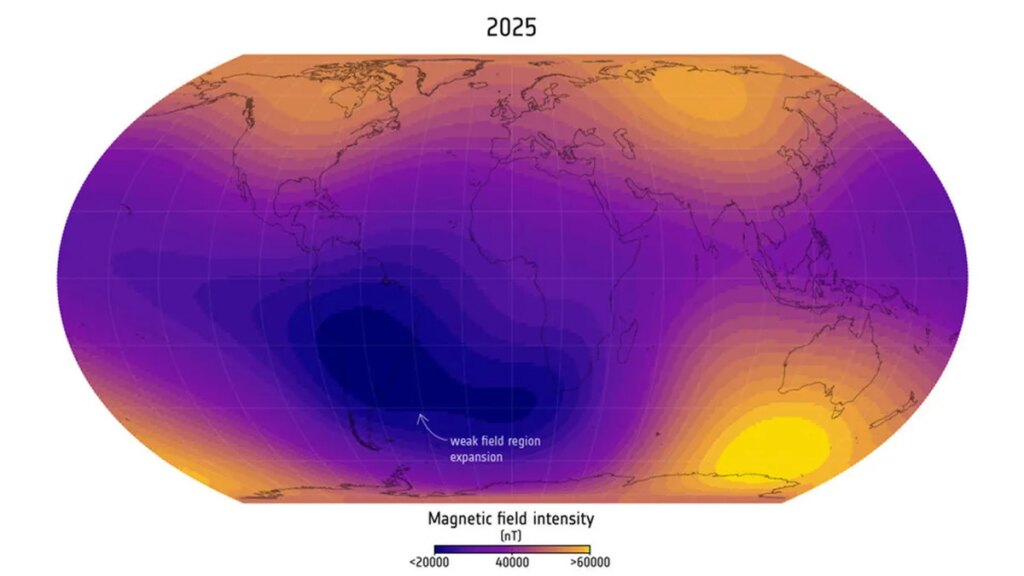
The European Space Agency spent 11 years studying the magnetic field via the agency’s Swarm operation. Part of the mission was to measure and observe the South Atlantic Anomaly, a pronounced weak spot in the Earth’s magnetic field that sits over South America. This was originally discovered in 1958 when satellites first started measuring radiation around the Earth, so its existence is nothing new.
However, data from the Swarm mission shows that the weak spot has been rapidly growing, extending its presence across the Atlantic Ocean toward Africa.
Don’t miss any of our unbiased tech content and lab-based reviews. Add CNET as a preferred Google source.
Why is the weak spot growing?
Per the ESA, this phenomenon can be best explained by strange behaviors far within the Earth at the boundary where the Earth’s liquid outer core meets the rocky mantle layer. This boundary, referred to as reverse flux patches, is acting funny and causing the magnetic field to weaken in that one spot.
“Normally, we’d expect to see magnetic field lines coming out of the core in the southern hemisphere,” says C.C. Finlay, lead author of the study and professor of geomagnetism at the Technical University of Denmark. “But beneath the South Atlantic Anomaly, we see unexpected areas where the magnetic field, instead of coming out of the core, goes back into the core. Thanks to the Swarm data, we can see one of these areas moving westward over Africa, which contributes to the weakening of the South Atlantic Anomaly in this region.”
In addition to the South Atlantic Anomaly, the Swarm mission also showed that a stronger section of the magnetic field over Canada was also getting weaker, while the one over Siberia was getting stronger.
A danger to satellites everywhere
The weakened zone won’t have a significant impact on humans, as the atmosphere primarily deals with the elements that affect the Earth’s surface. As NASA says, the weakening is still within what scientists consider “normal variation,” so daily life isn’t affected.
However, things in low Earth orbit aren’t so lucky. Per the ESA, satellites and other spacecraft passing through the region will face higher radiation exposure that “can lead to malfunctions or damage to critical hardware, and even blackouts.”
As Finlay notes in the study, space agencies take the SAA into consideration when building modern spacecraft, satellites and other space-worthy technology, so not only are existing satellites at risk of damage, but the expanding weak spot will also affect how future satellites and spacecraft are designed.
The ESA says that the Swarm mission will continue to gather data about the Earth’s magnetic field into the foreseeable future.
“It’s really wonderful to see the big picture of our dynamic Earth thanks to Swarm’s extended timeseries,” says ESA Swarm Mission Manager Anja Stromme. “The satellites are all healthy and providing excellent data, so we can hopefully extend that record beyond 2030, when the solar minimum will allow more unprecedented insights into our planet.”

Khamrah by Lattafa for Men - 3.4 oz EDP Spray
4% Off
Ghost Sweetheart Eau de Toilette | Pineapple, Jasmine and Sandalwood | Perfume for Women 50 ml
50% Off
Marc Jacobs Dot Eau De Parfum for Women, 100 ml
42% Off
Ted Baker W Eau de Toilette for Her, Fig Leaf, White Peony and Violet Top Notes, Pink Orchid and Raspberry Middle Notes, 75ml
£11.77 (£15.69 / 100 ml) (as of 09/06/2026 03:31 GMT +01:00 - More infoProduct prices and availability are accurate as of the date/time indicated and are subject to change. Any price and availability information displayed on [relevant Amazon Site(s), as applicable] at the time of purchase will apply to the purchase of this product.)
Ted Baker Woman Pink Eau de Toilette Spray Floral Green Feminine Fragrance, Opening Notes are Fresh Peach, Bergamot and Tangerine with Warm Musk, Vanilla and Vetiver Base, 100ml
11% Off
Vera Wang Princess Eau de Toilette - 30 ml

Choco Musk 50ml Eau De Parfum for men and women | Chocolate Musk by Jannat Aromas
17% Off
Christina Aguilera Signature Eau de Parfum (50ml) Floral, Fruity & Exotic Scent, Luxury Fragrance for Women
9% Off
Calvin Klein - Eau De Toilette CKIN2U - Calvin Klein Women, Ladies Perfume, Women's Perfume, Calvin Klein Perfume, Calvin Klein One - 150 ml
5% Off
Jimmy Choo Flash Eau de Parfum, 60 ml (Pack of 1)
3% Off
Fruit of the Loom Men's Heavy T Shirt, White, XL UK
28% Off
ATNKE LED Lighted Beanie Cap,USB Rechargeable Running Hat Ultra Bright 4 LED Waterproof Light Winter Warm Gifts for Men and Women/Pink
17% Off
Men's 1/4 Zip Pullover UK Sale Clearance, Fleece Sweatshirt Casual Jumper Long Sleeve T-shirt Top Stand Collar Sweater Plain Pullover Sports Leisure Workwear Quarter Zip Sweater Lightweight Jumpers
£5.88 (as of 12/11/2025 00:52 GMT +01:00 - More infoProduct prices and availability are accurate as of the date/time indicated and are subject to change. Any price and availability information displayed on [relevant Amazon Site(s), as applicable] at the time of purchase will apply to the purchase of this product.)
Crevice Cleaning Brush, Bathroom Tile Groove Gap Cleaning Brush,Premium Crevice Cleaning Tool Aluminum Support with 15° Angle Magic Brush, Thin Brush for Home Kitchen
19% Off
Wireless Earbuds, Bluetooth 5.3 Headphones in Ear with HiFi Stereo Deep Bass, 4 ENC Noise Cancelling Mic Wireless Earphones 40H Playtime, Bluetooth Earbuds Dual LED Display, IP7 Waterproof, USB-C
42% Off