
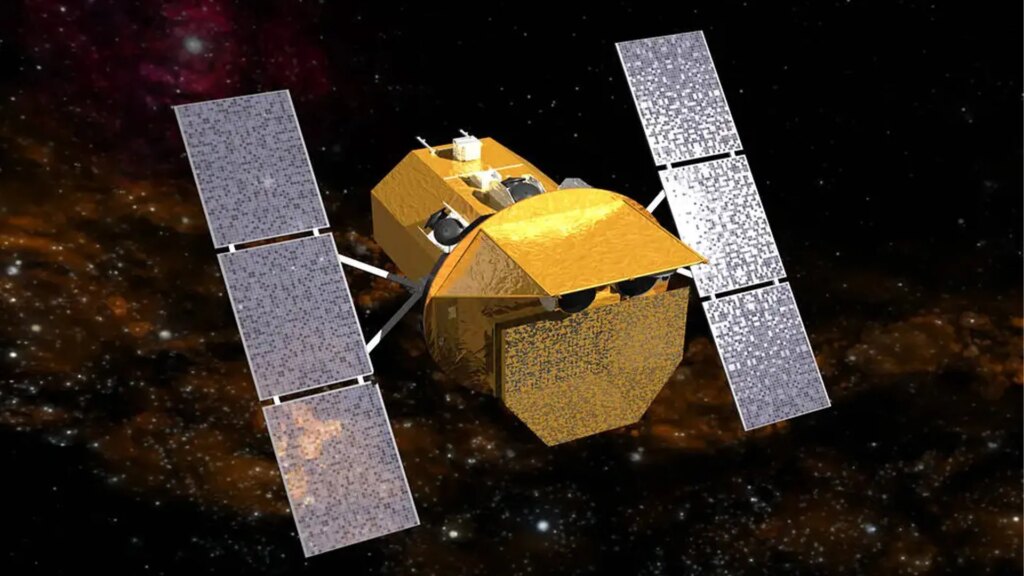

The Neil Gehrels Swift Observatory — formerly known as the Swift Gamma-Ray Burst Explorer — is in its final days. The space telescope was launched into orbit on Nov. 20, 2004. Almost 22 years to the day, it’s expected to come crashing back down on Wednesday.
“Swift delivered an incredible, lasting return on investment for the nation, designed for a two-year primary mission but productive for more than 10 times as long,” Shawn Domagal-Goldman, director of the Astrophysics Division at NASA, said in a statement last month.
NASA says the telescope should hit the atmosphere on Nov. 4 at around 3:30 a.m. ET, but the agency acknowledges an 11-hour window during which reentry is possible. That means it could come down in the middle of the night or the middle of the day. Most of the telescope is likely to burn up in orbit, with only a few components expected to reach Earth.
The location where those components splash down depends entirely on when Swift reenters the atmosphere. However, NASA says that the surviving fragments are “limited between 20.6 degrees south latitude and 20.6 degrees north latitude.” On a map, that would create a band around the middle of the Earth terminating just above and just below the equator.

“The risk of harm coming to anyone on Earth is unlikely — approximately 1 in 2,100,” NASA said in a statement. “NASA and Space Force will continue to monitor the re-entry and update predictions.”
In preparation for Swift’s reentry, NASA shut down operations in late October after conducting its final observation on Oct. 20. It was orbiting at just 171 miles above Earth’s surface at that point, and the increased atmospheric drag prevented Swift from doing any further work. It was a bittersweet moment for those who worked on the project.
Swift had a lifetime to remember
Swift’s initial mission was a runaway success and helped advance science’s understanding of gamma-ray bursts and their role in phenomena such as the birth of black holes and the history of the early universe.
That initial mission ended on Nov. 4, 2004, but the observatory was doing so well that NASA left it up there to continue collecting data. Its name changed to the Neil Gehrels Swift Observatory on Jan. 10, 2018, in honor of pioneering NASA astrophysicist Neil Gehrels, who served as the agency’s chief of the Astroparticle Physics Laboratory from 1995 until his death in 2017.
The space telescope was designed to help solve the mystery of gamma-ray bursts by rapidly detecting them, determining their sources and then further analyzing them for study back on Earth. It also enabled unique sampling to observe newly discovered objects only minutes after their light reached Earth, said Nousek.
The amount of science conducted using Swift’s data cannot be overstated. According to NASA, it scanned over 2,000 gamma-ray bursts, took 1.5 million images from its ultraviolet/optical telescope and sent home 12 TB of data. That data is showcased in an estimated 7,000 research papers, which averages out to just under one study per day over its 22-year run.
“We hope Swift has set the standard for time domain astrophysics,” Nousek said. The space telescope also helped pioneer many policies that ultimately shaped those discoveries, such as making data immediately accessible and providing over 1,000 guest investigators with the opportunity to use Swift throughout its long life, according to Nousek.
It’s only a stroke of bad luck that kept the observatory from floating for even longer. NASA attempted a rescue of Swift over the summer of 2026. However, after a series of engineering difficulties and control issues, the attempt was abandoned, sealing Swift’s fate. NASA turned the instruments back on and kept recording data as long as possible.

Source link

Khamrah by Lattafa for Men - 3.4 oz EDP Spray
4% Off
Ghost Sweetheart Eau de Toilette | Pineapple, Jasmine and Sandalwood | Perfume for Women 50 ml
50% Off
Marc Jacobs Dot Eau De Parfum for Women, 100 ml
42% Off
Ted Baker W Eau de Toilette for Her, Fig Leaf, White Peony and Violet Top Notes, Pink Orchid and Raspberry Middle Notes, 75ml
£11.77 (£15.69 / 100 ml) (as of 04/11/2026 05:40 GMT +00:00 - More infoProduct prices and availability are accurate as of the date/time indicated and are subject to change. Any price and availability information displayed on [relevant Amazon Site(s), as applicable] at the time of purchase will apply to the purchase of this product.)
Ted Baker Woman Pink Eau de Toilette Spray Floral Green Feminine Fragrance, Opening Notes are Fresh Peach, Bergamot and Tangerine with Warm Musk, Vanilla and Vetiver Base, 100ml
11% Off
Vera Wang Princess Eau de Toilette - 30 ml

Choco Musk 50ml Eau De Parfum for men and women | Chocolate Musk by Jannat Aromas
17% Off
Christina Aguilera Signature Eau de Parfum (50ml) Floral, Fruity & Exotic Scent, Luxury Fragrance for Women
9% Off
Calvin Klein - Eau De Toilette CKIN2U - Calvin Klein Women, Ladies Perfume, Women's Perfume, Calvin Klein Perfume, Calvin Klein One - 150 ml
5% Off
Jimmy Choo Flash Eau de Parfum, 60 ml (Pack of 1)
3% Off
Fruit of the Loom Men's Heavy T Shirt, White, XL UK
28% Off
ATNKE LED Lighted Beanie Cap,USB Rechargeable Running Hat Ultra Bright 4 LED Waterproof Light Winter Warm Gifts for Men and Women/Pink
17% Off
Men's 1/4 Zip Pullover UK Sale Clearance, Fleece Sweatshirt Casual Jumper Long Sleeve T-shirt Top Stand Collar Sweater Plain Pullover Sports Leisure Workwear Quarter Zip Sweater Lightweight Jumpers
£5.88 (as of 11/11/2025 23:52 GMT +00:00 - More infoProduct prices and availability are accurate as of the date/time indicated and are subject to change. Any price and availability information displayed on [relevant Amazon Site(s), as applicable] at the time of purchase will apply to the purchase of this product.)
Crevice Cleaning Brush, Bathroom Tile Groove Gap Cleaning Brush,Premium Crevice Cleaning Tool Aluminum Support with 15° Angle Magic Brush, Thin Brush for Home Kitchen
19% Off
Wireless Earbuds, Bluetooth 5.3 Headphones in Ear with HiFi Stereo Deep Bass, 4 ENC Noise Cancelling Mic Wireless Earphones 40H Playtime, Bluetooth Earbuds Dual LED Display, IP7 Waterproof, USB-C
42% Off