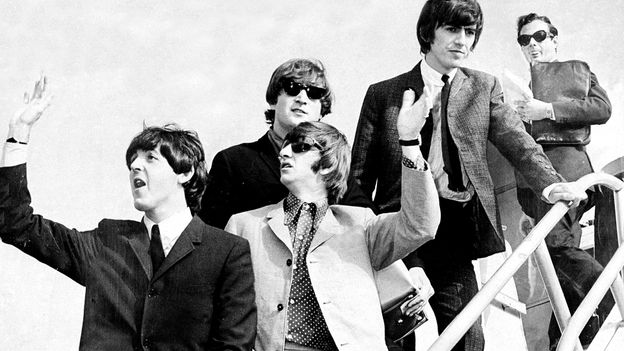

But Epstein had taken a curious route to the world of pop, and Charlton noted that he still seemed to be something of an outsider. “He himself doesn’t seem part of this world, and yet he’s genuinely absorbed by young people and young enthusiasms,” Charlton said.
Born in 1934, Epstein was the eldest son of a Jewish family that ran a successful retail business in Liverpool. He hoped to pursue a career in something creative, but his family had other plans for him. “When I left school, at the age of 16, I had ambitions to be a dress designer, and also to be an actor, but my family weren’t very keen on this, and I allowed myself to be swayed into going into the business,” Epstein told Bill Grundy in a BBC radio interview in 1964. “I think I was more anxious to leave school than anything else, which I didn’t enjoy very much.”
While working at the family business in 1952, he was called up for his mandatory National Service, becoming a clerk in the Royal Army Service Corps. But the regimentation of military life made him miserable. After seeing an army psychiatrist, who recommended him for an early medical discharge, he left to rejoin the family firm. However, he hadn’t given up on his acting aspirations, and persuaded his parents to let him enrol as a student at London’s renowned Royal Academy of Dramatic Art (Rada) in 1956.
Cleaning up The Beatles’ image
It was during this time that Epstein would acknowledge that he was gay. In the UK in the 1950s, homosexuality was illegal, and his life as a closeted gay man would leave him vulnerable to violent attacks, blackmail and the constant threat of imprisonment. In 1957, he was arrested by a plain-clothes policeman for “persistent importuning” outside the men’s toilet at a London Underground station. He received a suspended two-year sentence, dropped out of Rada, and returned to Liverpool. This time, when his father put him in charge of the record department at the family’s North End Music Stores (NEMS), he found his niche. His knack for predicting what would be a pop hit and his flair for creating eye-catching displays quickly turned the store into a magnet for Liverpool’s teenagers.
When a boy came into NEMS requesting a record by the Beatles, My Bonnie, he decided to seek them out, Epstein told Grundy in 1964. John Lennon, Paul McCartney, George Harrison and their then drummer, Pete Best, had recorded the track as a backing band for singer Tony Sheridan while they were in Hamburg in 1961 – leading Epstein to believe that they were German. The Beatles had now returned to Liverpool, and Epstein went to see them play a lunchtime session at the nearby Cavern Club, primarily with the intention of finding out how to order their My Bonnie record.
BBC News

Khamrah by Lattafa for Men - 3.4 oz EDP Spray
4% Off
Ghost Sweetheart Eau de Toilette | Pineapple, Jasmine and Sandalwood | Perfume for Women 50 ml
50% Off
Marc Jacobs Dot Eau De Parfum for Women, 100 ml
42% Off
Ted Baker W Eau de Toilette for Her, Fig Leaf, White Peony and Violet Top Notes, Pink Orchid and Raspberry Middle Notes, 75ml
£11.77 (£15.69 / 100 ml) (as of 11/10/2026 06:34 GMT +01:00 - More infoProduct prices and availability are accurate as of the date/time indicated and are subject to change. Any price and availability information displayed on [relevant Amazon Site(s), as applicable] at the time of purchase will apply to the purchase of this product.)
Ted Baker Woman Pink Eau de Toilette Spray Floral Green Feminine Fragrance, Opening Notes are Fresh Peach, Bergamot and Tangerine with Warm Musk, Vanilla and Vetiver Base, 100ml
11% Off
Vera Wang Princess Eau de Toilette - 30 ml

Choco Musk 50ml Eau De Parfum for men and women | Chocolate Musk by Jannat Aromas
17% Off
Christina Aguilera Signature Eau de Parfum (50ml) Floral, Fruity & Exotic Scent, Luxury Fragrance for Women
9% Off
Calvin Klein - Eau De Toilette CKIN2U - Calvin Klein Women, Ladies Perfume, Women's Perfume, Calvin Klein Perfume, Calvin Klein One - 150 ml
5% Off
Jimmy Choo Flash Eau de Parfum, 60 ml (Pack of 1)
3% Off
Fruit of the Loom Men's Heavy T Shirt, White, XL UK
28% Off
ATNKE LED Lighted Beanie Cap,USB Rechargeable Running Hat Ultra Bright 4 LED Waterproof Light Winter Warm Gifts for Men and Women/Pink
17% Off
Men's 1/4 Zip Pullover UK Sale Clearance, Fleece Sweatshirt Casual Jumper Long Sleeve T-shirt Top Stand Collar Sweater Plain Pullover Sports Leisure Workwear Quarter Zip Sweater Lightweight Jumpers
£5.88 (as of 12/11/2025 00:52 GMT +01:00 - More infoProduct prices and availability are accurate as of the date/time indicated and are subject to change. Any price and availability information displayed on [relevant Amazon Site(s), as applicable] at the time of purchase will apply to the purchase of this product.)
Crevice Cleaning Brush, Bathroom Tile Groove Gap Cleaning Brush,Premium Crevice Cleaning Tool Aluminum Support with 15° Angle Magic Brush, Thin Brush for Home Kitchen
19% Off
Wireless Earbuds, Bluetooth 5.3 Headphones in Ear with HiFi Stereo Deep Bass, 4 ENC Noise Cancelling Mic Wireless Earphones 40H Playtime, Bluetooth Earbuds Dual LED Display, IP7 Waterproof, USB-C
42% Off