google-site-verification: googlec7193c3de77668c9.html

Tag Archives: These

Biopsy-derived cryo-EM structures reveal patient-specific amyloid fibrils
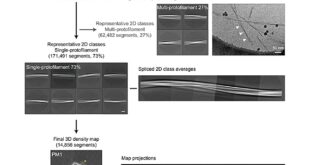
[ Schematic diagram of data processing workflow of heart-derived fibrils dataset. White arrows indicate multi-protofilament fibrils. Yellow arrows indicate extra densities. Credit: Proceedings of the National Academy of Sciences (2026). DOI: 10.1073/pnas.2515454123 Prof. Liu Cong from the Shanghai Institute of Organic Chemistry of the Chinese Academy of Sciences, along with …

Read More »

What if ADHD risk isn’t fixed at birth, but shaped by how early environments interact with a child’s sensitivity?

[ Simple slopes and Johnson–Neyman plot for the interaction between infant surgency and early home environment. Panel A presents the simple slopes pattern of the interaction between neonatal surgency and the home environment. Panel B shows the Johnson–Neyman region of significance analysis for the slope of the early home environment, …

Read More »

Deep learning creates virtual multiplexed immunostaining to improve cancer diagnosis

[ Deep learning-enabled virtual multiplexed immunostaining of label-free tissue for vascular invasion assessment. Credit: UCLA Engineering Institute for Technology Advancement Researchers at the University of California, Los Angeles (UCLA), in collaboration with pathologists from Hadassah Hebrew University Medical Center and the University of Southern California, have developed a deep learning–based …

Read More »

Illness is more than just biological. Medical sociology shows how social factors get under the skin and cause disease

[ Health and medicine is more than just biological—societal forces can get under your skin and cause illness. Medical sociologists like me study these forces by treating society itself as our laboratory. Health and illness are our experiments in uncovering meaning, power and inequality, and how it affects all parts …

Read More »

Odds of infant mortality higher among US-born than non-US-born individuals

[ U.S.-born individuals have higher odds of infant mortality than non-U.S.-born individuals, according to a study published online Jan. 6 in JAMA Network Open. Nicolette Christodoulakis and Giulia M. Muraca, M.P.H., Ph.D., from McMaster University in Hamilton, Ontario, Canada, examined the associations between maternal nativity status and infant mortality by …

Read More »

Recent Comments