 [
[


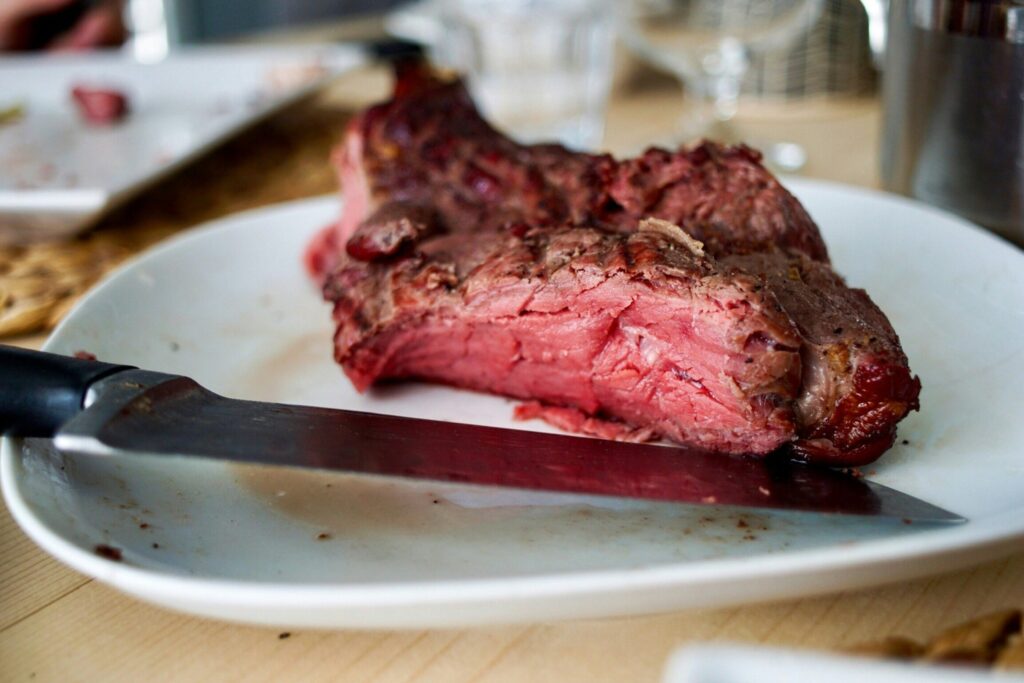
Preliminary results of an observational study presented at the annual meeting of the European Association for the Study of Diabetes (EASD) in Milan, Italy, Sept. 28–Oct. 2, show that high consumption of a sugar called dietary N-glycolylneuraminic acid (Neu5Gc), which is common in red meat, is associated with a 63% higher risk of developing type 2 diabetes (T2D). The association held after researchers accounted for other T2D risk factors, including physical activity, overall diet, smoking status and other health conditions.
The association was weaker but remained significant after researchers also accounted for body mass index (BMI).
“Our findings support chronic inflammation as a specific mechanism linking red meat consumption with T2D, partly beyond the amount of red meat a person eats and partly independent of body fat,” said lead author Dr. Leopold Fezeu of Université Sorbonne Paris Nord in Bobigny, France.
The analysis found that the higher the intake of Neu5Gc, the greater the risk of developing T2D. As Fezeu explained, “Although we do not know exactly what levels of Neu5Gc trigger an immune response, our data suggest that higher intakes of meat-derived Neu5Gc are associated with a progressively higher risk of T2D.”
Most mammals naturally produce a sugar known as Neu5Gc, but humans lost this ability because of an ancient genetic mutation in the CMAH gene. This carbohydrate is found in red meat (particularly beef and lamb) and, to a lesser extent, in dairy products.
When people consume these foods, animal Neu5Gc is absorbed and incorporated into human tissues, where it acts as a foreign molecule, a so-called xeno-autoantigen. The immune system produces antibodies against it, and the resulting chronic immune activation (xenosialitis) has previously been linked to cardiovascular diseases and cancer.
But until now, no large-scale prospective study has examined whether Neu5Gc may trigger chronic inflammation and promote T2D.
To address this, researchers investigated the association between dietary Neu5Gc found in red meat and dairy and new cases of T2D among 89,953 adults from the NutriNet-Santé study—a large, long-term French prospective observational cohort study investigating relationships between diet, lifestyle and health. The average age was 42, 79% were female, and participants did not have T2D or cancer at the start of the study.
Participants completed three 24-hour dietary records, which researchers used to estimate their daily intake of Neu5Gc using a validated database showing the Neu5Gc content of different foods.
The analysis covered all red meat, including beef, lamb, pork, rabbit, goat and game meats. Processed meat products (such as bacon, sausages and cured meats) were recorded as a separate food group. Dairy products were analyzed separately.
The researchers estimated each participant’s Neu5Gc intake from all foods eaten, using the measured Neu5Gc content of each food. Participants were then divided into five equal groups (quintiles) according to their intake of meat-derived Neu5Gc, separately for men and women, and the risk of T2D in each group was compared with the lowest group.
Over a median follow-up of 7.2 years, 966 T2D cases were identified.
Higher intake of meat-derived Neu5Gc linked to greater risk
The researchers found a statistically significant association between meat-derived Neu5Gc and T2D risk, with the risk increasing steeply at higher exposure levels. This suggests that a threshold mechanism may be at play, in which the immune system is overwhelmed once tissue incorporation of Neu5Gc exceeds a certain level.
The analysis found that people in the highest meat-derived Neu5Gc quintile had a 63% higher risk of developing T2D compared with those in the lowest quintile, even after adjusting for potential confounding factors, including age, sex, physical activity, dietary quality, smoking status and underlying health conditions.
The association was observed in both men and women, with no statistical evidence that it differed between the sexes.
For example, people in the highest quintile had a 63% higher risk, and those in the second-highest quintile a 41% higher risk, of developing T2D compared with those in the lowest quintile (men and women combined).
In the highest quintile, men ate a median of 97 g (3.4 ounces) of red meat per day (136 g, or 4.8 ounces, including processed meat) and women 73 g (2.6 ounces) of red meat per day (96 g, or 3.4 ounces, including processed meat). In the lowest quintile, the corresponding amounts were 5 g (0.2 ounces) of red meat and 21 g (0.7 ounces) including processed meat for men, and 0 g of red meat and 9 g (0.3 ounces) including processed meat for women.
Importantly, the results were consistent regardless of energy intake. After accounting for total red meat intake, the association weakened and was no longer statistically significant, although it remained in the same direction. This suggests that Neu5Gc itself (rather than other components of red meat) may explain part, but not all, of the link between red meat and T2D.
Moreover, the researchers estimated that obesity accounted for around 13% of the association between red meat–derived Neu5Gc and T2D, suggesting that most of the association operates through biological mechanisms independent of weight gain, most likely direct inflammatory effects on insulin-producing cells and insulin-sensitive tissues. More research will be needed to work out the exact mechanisms.
Importantly, the analysis found no association between dairy-derived Neu5Gc and T2D, a finding consistent with the lower Neu5Gc content of cow’s milk compared with red meat such as beef and lamb, and with the smaller serving sizes typically consumed.
However, people in the highest quintile of total dietary Neu5Gc intake had a 37% higher risk of developing T2D compared with those in the lowest quintile—an association largely driven by the red meat component.
“Together, these findings suggest that the association between Neu5Gc and T2D may depend on its dietary source, with meat-derived Neu5Gc showing a stronger association with T2D risk than total dietary Neu5Gc,” Fezeu said. “There may be differences between sources, or other components of red meat may contribute.”
He added, “Given how common red meat is in Western diets, the strong association between meat-derived Neu5Gc and T2D risk is an important finding. Future research should explore whether reducing exposure to meat-derived Neu5Gc, for example by favoring poultry or plant-based proteins over beef and lamb, which have the highest Neu5Gc content, could help prevent T2D.
“Studies directly measuring anti-Neu5Gc antibodies in large cohorts would also help to directly test the xenosialitis mechanism in humans.”
In future research, the authors aim to investigate how Neu5Gc and other red meat components, such as heme iron (a form of dietary iron), together relate to T2D risk, and to measure anti-Neu5Gc antibodies to directly test the proposed mechanism.
The authors point out that the results are preliminary and have not yet been validated, and note that the estimates may change once the analysis is finalized. Additionally, because this is an observational study, the research cannot determine what specifically caused the higher risk of T2D.
Although the analysis adjusted for several important risk factors, the researchers could not rule out the influence of other lifestyle and social factors that were not measured. Estimating Neu5Gc intake from dietary records and not examining changes in dietary intake during follow-up may also have introduced some measurement error.
Key medical concepts
Provided by
European Association for the Study of Diabetes


Citation:
Sugar molecule in red meat linked to higher risk of developing type 2 diabetes (2026, September 27)
retrieved 27 September 2026
from https://medicalxpress.com/news/2026-09-sugar-molecule-red-meat-linked.html
This document is subject to copyright. Apart from any fair dealing for the purpose of private study or research, no
part may be reproduced without the written permission. The content is provided for information purposes only.

Khamrah by Lattafa for Men - 3.4 oz EDP Spray
4% Off
Ghost Sweetheart Eau de Toilette | Pineapple, Jasmine and Sandalwood | Perfume for Women 50 ml
50% Off
Marc Jacobs Dot Eau De Parfum for Women, 100 ml
42% Off
Ted Baker W Eau de Toilette for Her, Fig Leaf, White Peony and Violet Top Notes, Pink Orchid and Raspberry Middle Notes, 75ml
£11.77 (£15.69 / 100 ml) (as of 27/09/2026 05:07 GMT +01:00 - More infoProduct prices and availability are accurate as of the date/time indicated and are subject to change. Any price and availability information displayed on [relevant Amazon Site(s), as applicable] at the time of purchase will apply to the purchase of this product.)
Ted Baker Woman Pink Eau de Toilette Spray Floral Green Feminine Fragrance, Opening Notes are Fresh Peach, Bergamot and Tangerine with Warm Musk, Vanilla and Vetiver Base, 100ml
11% Off
Vera Wang Princess Eau de Toilette - 30 ml

Choco Musk 50ml Eau De Parfum for men and women | Chocolate Musk by Jannat Aromas
17% Off
Christina Aguilera Signature Eau de Parfum (50ml) Floral, Fruity & Exotic Scent, Luxury Fragrance for Women
9% Off
Calvin Klein - Eau De Toilette CKIN2U - Calvin Klein Women, Ladies Perfume, Women's Perfume, Calvin Klein Perfume, Calvin Klein One - 150 ml
5% Off
Jimmy Choo Flash Eau de Parfum, 60 ml (Pack of 1)
3% Off
Fruit of the Loom Men's Heavy T Shirt, White, XL UK
28% Off
ATNKE LED Lighted Beanie Cap,USB Rechargeable Running Hat Ultra Bright 4 LED Waterproof Light Winter Warm Gifts for Men and Women/Pink
17% Off
Men's 1/4 Zip Pullover UK Sale Clearance, Fleece Sweatshirt Casual Jumper Long Sleeve T-shirt Top Stand Collar Sweater Plain Pullover Sports Leisure Workwear Quarter Zip Sweater Lightweight Jumpers
£5.88 (as of 12/11/2025 00:52 GMT +01:00 - More infoProduct prices and availability are accurate as of the date/time indicated and are subject to change. Any price and availability information displayed on [relevant Amazon Site(s), as applicable] at the time of purchase will apply to the purchase of this product.)
Crevice Cleaning Brush, Bathroom Tile Groove Gap Cleaning Brush,Premium Crevice Cleaning Tool Aluminum Support with 15° Angle Magic Brush, Thin Brush for Home Kitchen
19% Off
Wireless Earbuds, Bluetooth 5.3 Headphones in Ear with HiFi Stereo Deep Bass, 4 ENC Noise Cancelling Mic Wireless Earphones 40H Playtime, Bluetooth Earbuds Dual LED Display, IP7 Waterproof, USB-C
42% Off