 [
[

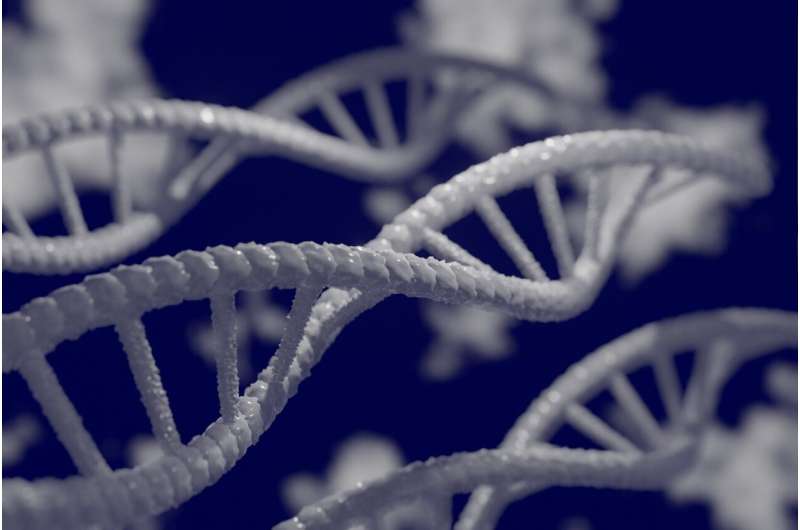
Enhancers are pieces of DNA that act like switches, regulating when genes are turned on and off and how strongly they are activated. Scientists know these switches play a critical role in cancer and other diseases, but they have yet to fully understand how enhancers work together to control gene expression.
A new study, which focused on the DNA switches of prostate cancer cells, reveals new insights into enhancers that become active during cancer development and turn on genes linked to the disease. The study found that enhancers work cooperatively in 3D networks, rather than as isolated switches. Some enhancers function as “central hubs” that control many genes, while others play a supporting role. The findings, just published in Genome Biology, a Springer Nature journal, could help with the development of targeted cancer therapies.
“How enhancers interact with one another is critical. What we’ve shown for the first time is that there is a hierarchy of enhancers—some act as master switches, playing a central role in regulating many enhancers and genes, while others are more compensatory,” said the study’s corresponding author, Suhn Kyong Rhie, Ph.D., assistant professor of cancer biology at the Keck School of Medicine of USC and a member of the USC Norris Comprehensive Cancer Center.
The findings also add to scientists’ understanding of noncoding DNA, which does not direct the synthesis of proteins and makes up about 99% of the human genome. Once dismissed as “junk DNA,” these regions are now known to play a critical role in regulating gene activity.
Enhancers are already the target of one FDA-approved gene-editing therapy, Casgevy, which treats sickle cell disease and transfusion-dependent β-thalassemia by targeting an enhancer to alter gene expression. The new study, which was supported in part by the National Institutes of Health, could lay the foundation for a similar approach to treating prostate cancer or other diseases.
“We think these findings will apply to many other cells, tissues and diseases. At this point, it’s basic science that shows the complexity of how the genome works, but it also has the potential to inform future therapies,” Rhie said.
Mapping 3D enhancer networks in prostate cancer
Rhie’s lab focuses on chromatin interactions, a specialized area of research that investigates how DNA folds and interacts to regulate gene expression. Using 201 datasets from both prostate tumor samples and healthy prostate tissue, her team identified 3,216 key enhancers specific to prostate cancer.
They then zoomed in on one region of the genome and used an advanced technique known as Region Capture Micro-C to map physical interactions between enhancers and genes at extremely high resolution. They found that in prostate cancer cells, enhancers formed an interconnected 3D network that did not exist in normal prostate cells.
Next, they used the gene-editing tool CRISPR to delete enhancers one at a time and observe how this affected enhancer activity, chromatin interactions, gene expression and cancer cell growth.
They found that not all enhancers were equivalent. Deleting some enhancers had little effect. Deleting other “central” enhancers disrupted the entire network, reducing the activity of other enhancers, switching off many cancer-promoting genes and slowing cancer cell growth.
Targeting central enhancers for future therapies
The discovery that some enhancers serve as key control points could inform future cancer therapies. Rather than targeting individual genes, gene-editing therapies could one day edit these master switches to control multiple cancer-promoting genes at the same time.
“But there are still important questions to answer before this approach can be translated into new therapies, including the potential side effects of targeting the wrong enhancer,” Rhie said.
Her lab is now studying how enhancer activity plays a role in resistance to existing cancer therapies. They are also working to understand how various enhancers work together in other types of cancer, including breast cancer.
Publication details
Decoding 3D chromatin architecture reveals distinct enhancer classes underlying hierarchical gene regulation in prostate cancer, Genome Biology (2026). DOI: 10.1186/s13059-026-04178-9.
Journal information:
Genome Biology
Who’s behind this story?


Citation:
Study reveals how networks of switches in DNA, which regulate gene expression, drive cancer growth (2026, July 23)
retrieved 23 July 2026
from https://medicalxpress.com/news/2026-07-reveals-networks-dna-gene-cancer.html
This document is subject to copyright. Apart from any fair dealing for the purpose of private study or research, no
part may be reproduced without the written permission. The content is provided for information purposes only.

Khamrah by Lattafa for Men - 3.4 oz EDP Spray
4% Off
Ghost Sweetheart Eau de Toilette | Pineapple, Jasmine and Sandalwood | Perfume for Women 50 ml
50% Off
Marc Jacobs Dot Eau De Parfum for Women, 100 ml
42% Off
Ted Baker W Eau de Toilette for Her, Fig Leaf, White Peony and Violet Top Notes, Pink Orchid and Raspberry Middle Notes, 75ml
£11.77 (£15.69 / 100 ml) (as of 28/09/2026 05:08 GMT +01:00 - More infoProduct prices and availability are accurate as of the date/time indicated and are subject to change. Any price and availability information displayed on [relevant Amazon Site(s), as applicable] at the time of purchase will apply to the purchase of this product.)
Ted Baker Woman Pink Eau de Toilette Spray Floral Green Feminine Fragrance, Opening Notes are Fresh Peach, Bergamot and Tangerine with Warm Musk, Vanilla and Vetiver Base, 100ml
11% Off
Vera Wang Princess Eau de Toilette - 30 ml

Choco Musk 50ml Eau De Parfum for men and women | Chocolate Musk by Jannat Aromas
17% Off
Christina Aguilera Signature Eau de Parfum (50ml) Floral, Fruity & Exotic Scent, Luxury Fragrance for Women
9% Off
Calvin Klein - Eau De Toilette CKIN2U - Calvin Klein Women, Ladies Perfume, Women's Perfume, Calvin Klein Perfume, Calvin Klein One - 150 ml
5% Off
Jimmy Choo Flash Eau de Parfum, 60 ml (Pack of 1)
3% Off
Fruit of the Loom Men's Heavy T Shirt, White, XL UK
28% Off
ATNKE LED Lighted Beanie Cap,USB Rechargeable Running Hat Ultra Bright 4 LED Waterproof Light Winter Warm Gifts for Men and Women/Pink
17% Off
Men's 1/4 Zip Pullover UK Sale Clearance, Fleece Sweatshirt Casual Jumper Long Sleeve T-shirt Top Stand Collar Sweater Plain Pullover Sports Leisure Workwear Quarter Zip Sweater Lightweight Jumpers
£5.88 (as of 12/11/2025 00:52 GMT +01:00 - More infoProduct prices and availability are accurate as of the date/time indicated and are subject to change. Any price and availability information displayed on [relevant Amazon Site(s), as applicable] at the time of purchase will apply to the purchase of this product.)
Crevice Cleaning Brush, Bathroom Tile Groove Gap Cleaning Brush,Premium Crevice Cleaning Tool Aluminum Support with 15° Angle Magic Brush, Thin Brush for Home Kitchen
19% Off
Wireless Earbuds, Bluetooth 5.3 Headphones in Ear with HiFi Stereo Deep Bass, 4 ENC Noise Cancelling Mic Wireless Earphones 40H Playtime, Bluetooth Earbuds Dual LED Display, IP7 Waterproof, USB-C
42% Off