 [
[


As aging populations drive rising global health care demands, finding scalable ways to prevent cognitive decline has become a public health priority. While intensive clinical trials have shown that multidomain lifestyle interventions can protect brain health, translating these resource-heavy protocols into everyday municipal practice remains challenging.
Addressing this gap, a collaborative research team led by Kumamoto University, in partnership with researchers from the National Center for Geriatrics and Gerontology (NCGG) and National Yang Ming Chiao Tung University (Taiwan), evaluated a community-adapted brain health program in Kikuyo Town, Kumamoto Prefecture.
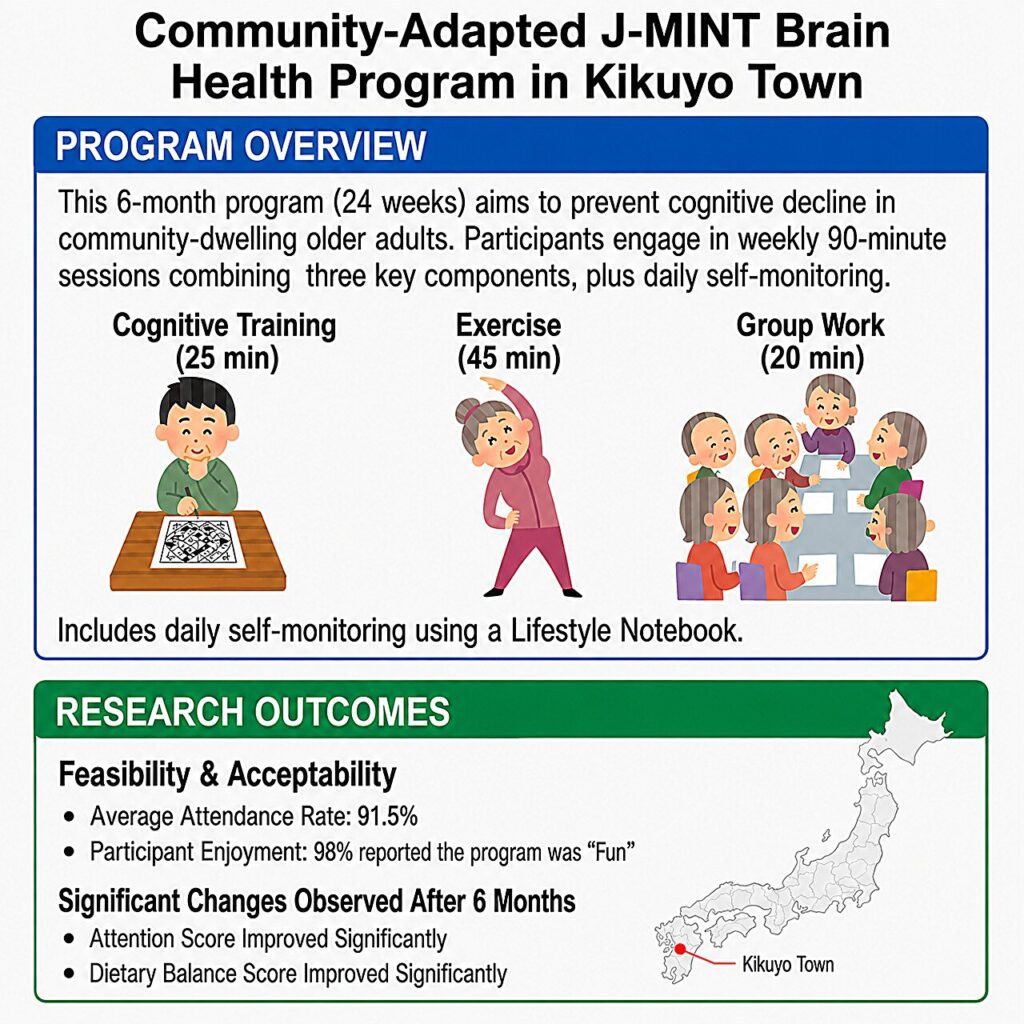
Published in the international journal Archives of Gerontology and Geriatrics, the study investigated 50 community-dwelling older adults participating in a 24-week municipal program.
The intervention combined aerobic exercise, resistance training, dual-task cognitive exercises, nutritional guidance and lifestyle self-monitoring via a dedicated daily notebook. The program achieved an average attendance rate of 91.5%, with 98% of participants reporting that they enjoyed the sessions.
Key finding: Following the six-month intervention, participants showed statistically significant improvements in attention and dietary balance scores, suggesting that attention may be a responsive cognitive outcome for community-based programs.
The evaluation revealed significant pre- and postintervention improvements in attention scores (p = 0.019), while general memory scores remained stable. Further exploratory analysis indicated that individuals with lower baseline attention showed the most pronounced short-term gains (p = 0.008).
In addition to cognitive improvements, participants exhibited significant improvements in dietary balance scores (p < 0.001), underscoring healthier lifestyle adoption.
While this study is a practical implementation evaluation rather than a confirmatory trial, the high participation rate and positive feedback demonstrate that evidence-based dementia prevention can move from clinical research into everyday municipal life.
By identifying attention and dietary habits as responsive outcomes, these findings offer an actionable blueprint for local governments seeking to build sustainable health programs that help older residents maintain daily independence.
More information
Naoto Kajitani et al, Attention as a potentially responsive cognitive outcome in a community-based multidomain dementia prevention program (the community-adapted J-MINT Brain Health Program in Kikuyo Town, Japan), Archives of Gerontology and Geriatrics (2026). DOI: 10.1016/j.archger.2026.106347
Key medical concepts


Citation:
Six-month community program improves attention and diet scores in older adults (2026, September 6)
retrieved 6 September 2026
from https://medicalxpress.com/news/2026-09-month-community-attention-diet-scores.html
This document is subject to copyright. Apart from any fair dealing for the purpose of private study or research, no
part may be reproduced without the written permission. The content is provided for information purposes only.

Khamrah by Lattafa for Men - 3.4 oz EDP Spray
4% Off
Ghost Sweetheart Eau de Toilette | Pineapple, Jasmine and Sandalwood | Perfume for Women 50 ml
50% Off
Marc Jacobs Dot Eau De Parfum for Women, 100 ml
42% Off
Ted Baker W Eau de Toilette for Her, Fig Leaf, White Peony and Violet Top Notes, Pink Orchid and Raspberry Middle Notes, 75ml
£11.77 (£15.69 / 100 ml) (as of 04/10/2026 05:09 GMT +01:00 - More infoProduct prices and availability are accurate as of the date/time indicated and are subject to change. Any price and availability information displayed on [relevant Amazon Site(s), as applicable] at the time of purchase will apply to the purchase of this product.)
Ted Baker Woman Pink Eau de Toilette Spray Floral Green Feminine Fragrance, Opening Notes are Fresh Peach, Bergamot and Tangerine with Warm Musk, Vanilla and Vetiver Base, 100ml
11% Off
Vera Wang Princess Eau de Toilette - 30 ml

Choco Musk 50ml Eau De Parfum for men and women | Chocolate Musk by Jannat Aromas
17% Off
Christina Aguilera Signature Eau de Parfum (50ml) Floral, Fruity & Exotic Scent, Luxury Fragrance for Women
9% Off
Calvin Klein - Eau De Toilette CKIN2U - Calvin Klein Women, Ladies Perfume, Women's Perfume, Calvin Klein Perfume, Calvin Klein One - 150 ml
5% Off
Jimmy Choo Flash Eau de Parfum, 60 ml (Pack of 1)
3% Off
Fruit of the Loom Men's Heavy T Shirt, White, XL UK
28% Off
ATNKE LED Lighted Beanie Cap,USB Rechargeable Running Hat Ultra Bright 4 LED Waterproof Light Winter Warm Gifts for Men and Women/Pink
17% Off
Men's 1/4 Zip Pullover UK Sale Clearance, Fleece Sweatshirt Casual Jumper Long Sleeve T-shirt Top Stand Collar Sweater Plain Pullover Sports Leisure Workwear Quarter Zip Sweater Lightweight Jumpers
£5.88 (as of 12/11/2025 00:52 GMT +01:00 - More infoProduct prices and availability are accurate as of the date/time indicated and are subject to change. Any price and availability information displayed on [relevant Amazon Site(s), as applicable] at the time of purchase will apply to the purchase of this product.)
Crevice Cleaning Brush, Bathroom Tile Groove Gap Cleaning Brush,Premium Crevice Cleaning Tool Aluminum Support with 15° Angle Magic Brush, Thin Brush for Home Kitchen
19% Off
Wireless Earbuds, Bluetooth 5.3 Headphones in Ear with HiFi Stereo Deep Bass, 4 ENC Noise Cancelling Mic Wireless Earphones 40H Playtime, Bluetooth Earbuds Dual LED Display, IP7 Waterproof, USB-C
42% Off