[
[
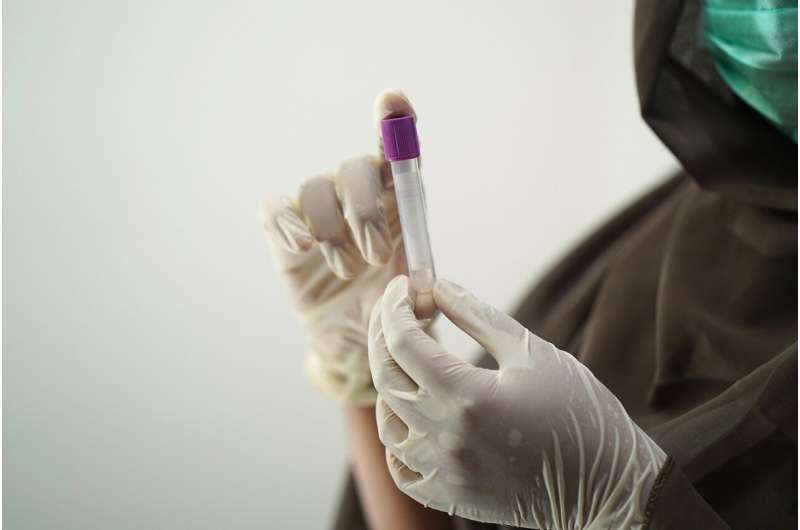
A new study from Karolinska Institutet, published in the journal The BMJ, shows how a simple blood analysis can predict the risk of developing severe liver disease. The method may already start to be applied in primary care to enable the earlier detection of cirrhosis and cancer of the liver.
“These are diseases that are growing increasingly common and that have a poor prognosis if detected late,” says Rickard Strandberg, affiliated researcher at Karolinska Institutet’s Department of Medicine in Huddinge, who has developed the test with his departmental colleague Hannes Hagström. “Our method can predict the risk of severe liver disease within 10 years and is based on three simple routine blood tests.”
For the study, the researchers at Karolinska Institutet in Sweden and their colleagues in Finland evaluated how well the method can estimate the risk of severe liver disease. The model, which is called CORE, was produced with advanced statistical methods and is based on five factors: age, sex and levels of three common liver enzymes (AST, ALT and GGT), which are commonly measured during regular health checks.
A web-based calculator
Their aim has been to produce a tool that is easy to use in primary care, where most patients first seek medical attention. A web-based calculator is already available for doctors and nurses.
“This is an important step toward being able to offer early screening for liver disease in primary care,” says principal investigator Hagström, adjunct professor at Karolinska Institutet’s Department of Medicine in Huddinge, and senior consultant at Karolinska University Hospital. “Drug treatment is now available, soon hopefully also in Sweden, for treating people at a high risk of developing liver diseases such as cirrhosis or liver cancer.”
The study is based on data from over 480,000 people in Stockholm who underwent health checks between 1985 and 1996. On following the participants for up to 30 years, the researchers could see that some 1.5% developed severe liver disease, such as liver cirrhosis and liver cancer, or required a liver transplant.
Highly accurate risk prediction
The CORE model proved highly accurate and was able to differentiate between people who either did or did not develop the disease in 88% of cases, which is an improvement on the currently recommended FIB-4 method.
“Primary care hasn’t had the tools to detect the risk of severe liver disease in time,” says Professor Hagström. “FIB-4 is not suited for the general population and is less effective at predicting the future risk of severe liver disease.”
The model was also tested on two other population groups in Finland and the UK, where it again demonstrated a high accuracy in predicting this risk. The researchers make the point, however, that it needs to be further tested on groups at especially high risk, such as people with type 2 diabetes or obesity. They also recognize a need to integrate the model into medical records systems to facilitate its clinical use.
The study was a collaboration between Karolinska Institutet, Helsinki University Hospital, Helsinki University and the Finnish Institute for Health and Welfare. Hannes Hagström is engaged in several collaborations with the pharmaceutical industry regarding liver disease prognosis, but none that is relevant to the current study.
More information:
Use of new CORE risk score to predict 10 year risk of liver cirrhosis in general population: population based cohort study, The BMJ (2025). DOI: 10.1136/bmj-2024-083182
Citation:
Simple blood test can predict risk of severe liver disease (2025, September 29)
retrieved 29 September 2025
from https://medicalxpress.com/news/2025-09-simple-blood-severe-liver-disease.html
This document is subject to copyright. Apart from any fair dealing for the purpose of private study or research, no
part may be reproduced without the written permission. The content is provided for information purposes only.

Khamrah by Lattafa for Men - 3.4 oz EDP Spray
4% Off
Ghost Sweetheart Eau de Toilette | Pineapple, Jasmine and Sandalwood | Perfume for Women 50 ml
50% Off
Marc Jacobs Dot Eau De Parfum for Women, 100 ml
42% Off
Ted Baker W Eau de Toilette for Her, Fig Leaf, White Peony and Violet Top Notes, Pink Orchid and Raspberry Middle Notes, 75ml
£11.77 (£15.69 / 100 ml) (as of 16/06/2026 03:32 GMT +01:00 - More infoProduct prices and availability are accurate as of the date/time indicated and are subject to change. Any price and availability information displayed on [relevant Amazon Site(s), as applicable] at the time of purchase will apply to the purchase of this product.)
Ted Baker Woman Pink Eau de Toilette Spray Floral Green Feminine Fragrance, Opening Notes are Fresh Peach, Bergamot and Tangerine with Warm Musk, Vanilla and Vetiver Base, 100ml
11% Off
Vera Wang Princess Eau de Toilette - 30 ml

Choco Musk 50ml Eau De Parfum for men and women | Chocolate Musk by Jannat Aromas
17% Off
Christina Aguilera Signature Eau de Parfum (50ml) Floral, Fruity & Exotic Scent, Luxury Fragrance for Women
9% Off
Calvin Klein - Eau De Toilette CKIN2U - Calvin Klein Women, Ladies Perfume, Women's Perfume, Calvin Klein Perfume, Calvin Klein One - 150 ml
5% Off
Jimmy Choo Flash Eau de Parfum, 60 ml (Pack of 1)
3% Off
Fruit of the Loom Men's Heavy T Shirt, White, XL UK
28% Off
ATNKE LED Lighted Beanie Cap,USB Rechargeable Running Hat Ultra Bright 4 LED Waterproof Light Winter Warm Gifts for Men and Women/Pink
17% Off
Men's 1/4 Zip Pullover UK Sale Clearance, Fleece Sweatshirt Casual Jumper Long Sleeve T-shirt Top Stand Collar Sweater Plain Pullover Sports Leisure Workwear Quarter Zip Sweater Lightweight Jumpers
£5.88 (as of 12/11/2025 00:52 GMT +01:00 - More infoProduct prices and availability are accurate as of the date/time indicated and are subject to change. Any price and availability information displayed on [relevant Amazon Site(s), as applicable] at the time of purchase will apply to the purchase of this product.)
Crevice Cleaning Brush, Bathroom Tile Groove Gap Cleaning Brush,Premium Crevice Cleaning Tool Aluminum Support with 15° Angle Magic Brush, Thin Brush for Home Kitchen
19% Off
Wireless Earbuds, Bluetooth 5.3 Headphones in Ear with HiFi Stereo Deep Bass, 4 ENC Noise Cancelling Mic Wireless Earphones 40H Playtime, Bluetooth Earbuds Dual LED Display, IP7 Waterproof, USB-C
42% Off