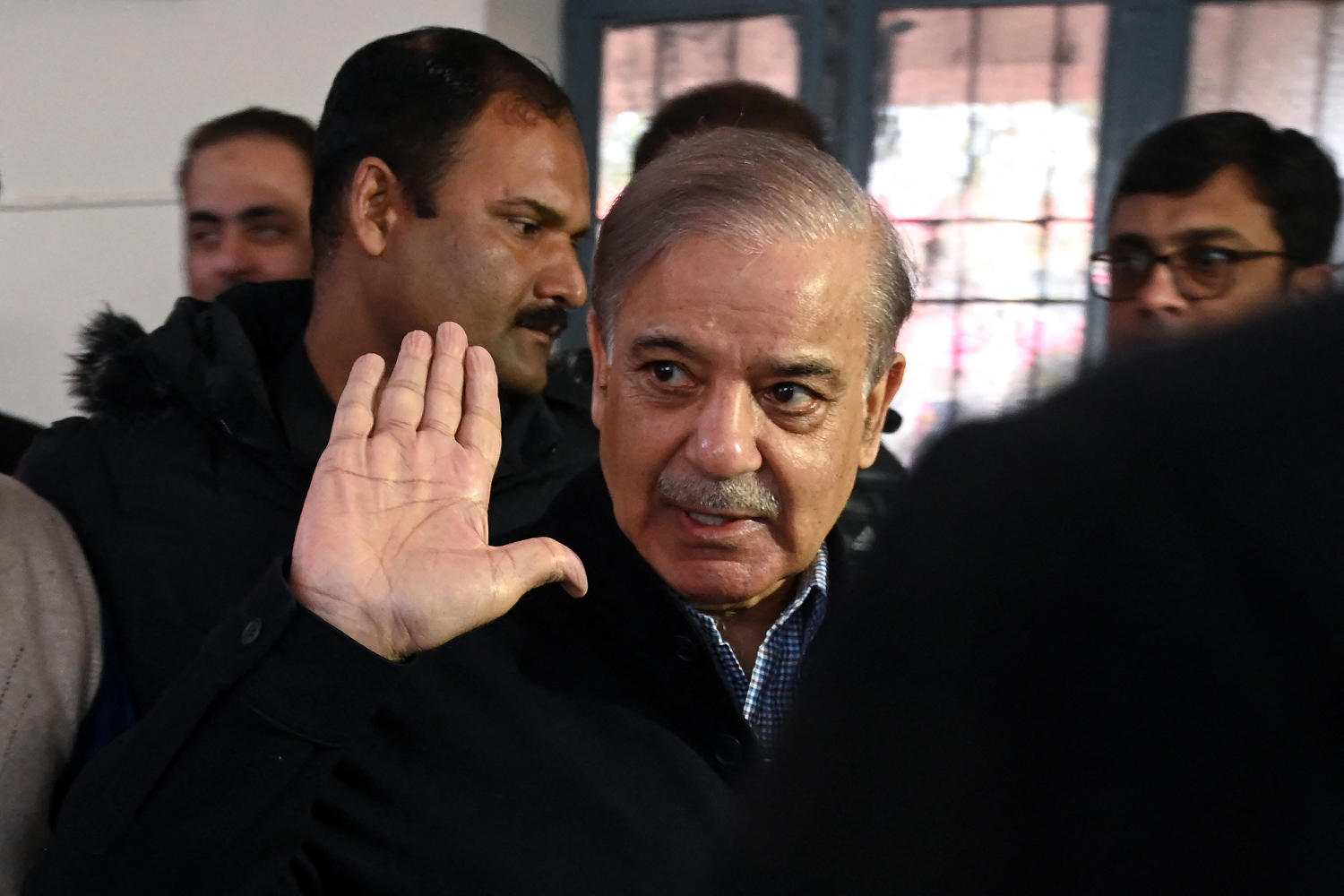
KARACHI — Pakistan’s newly formed parliament elected Shehbaz Sharif on Sunday as prime minister for a second time, three weeks after uncertain national elections caused delays in the formation of a coalition government.
He beat Omar Ayub, the candidate backed by jailed former Prime Minister Imran Khan, who secured 92 votes. Sharif returns to the role he held until August when parliament was dissolved ahead of the elections and a caretaker government took over. No single party won enough seats to form government on their own.
“Shehbaz Sharif is declared to have been elected the prime minister of the Islamic Republic of Pakistan,” National Assembly Speaker Ayaz Sadiq said, after announcing Sharif had secured 201 votes, above the required 169 votes in the house.
The declaration was met with loud protests from the Sunni Ittehad Council (SIC) party backed by Khan. The lawmakers called for Khan’s release and shouted slogans alleging Sharif had come to power through electoral rigging.
In a wide ranging speech, Sharif touched on a number of topics, including the need for economic reforms as well as international relations, but stopped short of announcing definitive changes in policy.
“The work is difficult but it is not impossible,” he said of the effort to pull Pakistan from multiple crises.
He invited the opposition for talks about reconciling political and policy differences.
SIC continued to protest throughout Sharif’s speech, holding up posters with pictures of Khan and chanting “mandate thieves”.
The Feb. 8 election was marred by a mobile internet shutdown, arrests and violence in its build-up and the unusually delayed results triggered accusations that the vote was rigged.
Sharif, 72, is the younger brother of three-time Prime Minister Nawaz Sharif, who spearheaded their Pakistan Muslim League-Nawaz (PML-N) party’s election campaign.
Candidates backed by Khan gained the most seats but the PML-N and the Pakistan Peoples Party (PPP) agreed to form a coalition government, which enabled Shehbaz Sharif to be elected as prime minister as his brother stepped aside.
“It’s not the first time Shabaz Sharif has become PM of Pakistan without actually being elected. But this time around the nation will not allow him to get away with stealing their mandate. This is only going to make Pakistan nose further economically, causing further deterioration as a nation,” Khan’s close aide Zulfikar Bukhari told Reuters.
In his previous term, Sharif’s government was able to negotiate a critical International Monetary Fund (IMF) deal but the process was mired in challenges, and measures required by the agreement — which expires in April — have contributed to rising prices and added pressure on poor and middle class households.
The new government will have to immediately start talks with the IMF for the next agreement to shore up the country’s economy whilst also dealing with growing discontent over deepening poverty.
The government will also have to grapple with ongoing challenges from Khan’s supporters.
Reporting by Charlotte Greenfield and Ariba Shahid; Editing by Raju Gopalakrishnan, Miral Fahmy and Elaine Hardcastle

Khamrah by Lattafa for Men - 3.4 oz EDP Spray
4% Off
Ghost Sweetheart Eau de Toilette | Pineapple, Jasmine and Sandalwood | Perfume for Women 50 ml
50% Off
Marc Jacobs Dot Eau De Parfum for Women, 100 ml
42% Off
Ted Baker W Eau de Toilette for Her, Fig Leaf, White Peony and Violet Top Notes, Pink Orchid and Raspberry Middle Notes, 75ml
£11.77 (£15.69 / 100 ml) (as of 21/08/2026 04:39 GMT +01:00 - More infoProduct prices and availability are accurate as of the date/time indicated and are subject to change. Any price and availability information displayed on [relevant Amazon Site(s), as applicable] at the time of purchase will apply to the purchase of this product.)
Ted Baker Woman Pink Eau de Toilette Spray Floral Green Feminine Fragrance, Opening Notes are Fresh Peach, Bergamot and Tangerine with Warm Musk, Vanilla and Vetiver Base, 100ml
11% Off
Vera Wang Princess Eau de Toilette - 30 ml

Choco Musk 50ml Eau De Parfum for men and women | Chocolate Musk by Jannat Aromas
17% Off
Christina Aguilera Signature Eau de Parfum (50ml) Floral, Fruity & Exotic Scent, Luxury Fragrance for Women
9% Off
Calvin Klein - Eau De Toilette CKIN2U - Calvin Klein Women, Ladies Perfume, Women's Perfume, Calvin Klein Perfume, Calvin Klein One - 150 ml
5% Off
Jimmy Choo Flash Eau de Parfum, 60 ml (Pack of 1)
3% Off
Fruit of the Loom Men's Heavy T Shirt, White, XL UK
28% Off
ATNKE LED Lighted Beanie Cap,USB Rechargeable Running Hat Ultra Bright 4 LED Waterproof Light Winter Warm Gifts for Men and Women/Pink
17% Off
Men's 1/4 Zip Pullover UK Sale Clearance, Fleece Sweatshirt Casual Jumper Long Sleeve T-shirt Top Stand Collar Sweater Plain Pullover Sports Leisure Workwear Quarter Zip Sweater Lightweight Jumpers
£5.88 (as of 12/11/2025 00:52 GMT +01:00 - More infoProduct prices and availability are accurate as of the date/time indicated and are subject to change. Any price and availability information displayed on [relevant Amazon Site(s), as applicable] at the time of purchase will apply to the purchase of this product.)
Crevice Cleaning Brush, Bathroom Tile Groove Gap Cleaning Brush,Premium Crevice Cleaning Tool Aluminum Support with 15° Angle Magic Brush, Thin Brush for Home Kitchen
19% Off
Wireless Earbuds, Bluetooth 5.3 Headphones in Ear with HiFi Stereo Deep Bass, 4 ENC Noise Cancelling Mic Wireless Earphones 40H Playtime, Bluetooth Earbuds Dual LED Display, IP7 Waterproof, USB-C
42% Off