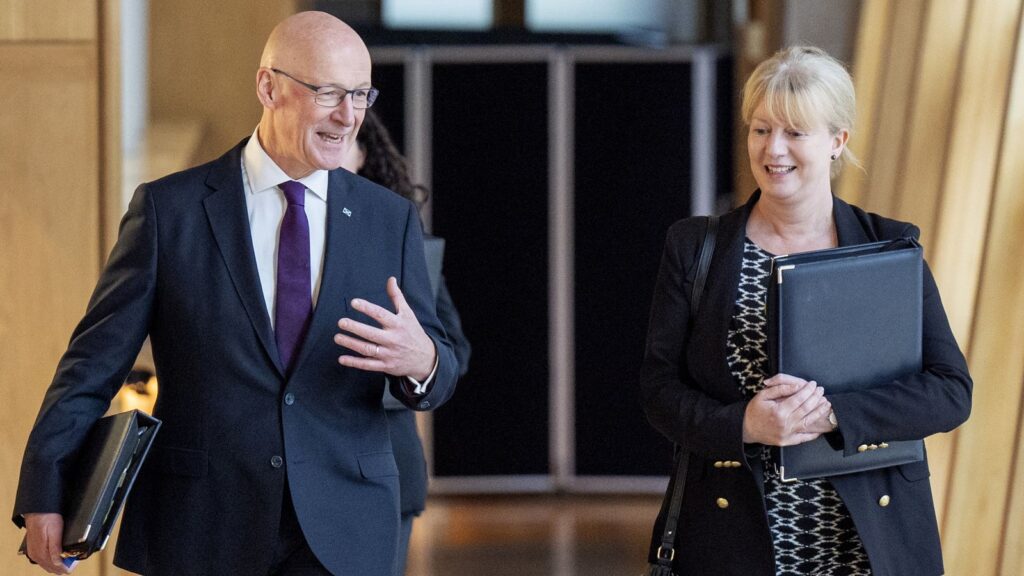
Scotland’s finance secretary has unveiled the nation’s draft budget for the coming year – with plans to scrap Westminster’s two-child benefit cap and a record investment in the NHS.
Shona Robison set out the Scottish government’s tax and spending proposals for 2025-26 in a speech at Holyrood.
The MSP previously said the budget will put “the people of Scotland first”.
Ms Robison told the chamber on Wednesday: “This budget invests in public services, lifts children out of poverty, acts in the face of the climate emergency, and supports jobs and economic growth.
“It is a budget filled with hope for Scotland’s future.”
Highlights from the draft budget:
• The Scottish government will mitigate the impact of the UK government’s two-child benefit cap. Ms Robison has urged Westminster to provide the necessary data to allow for the change to be made. She said: “Be in no doubt that the cap will be scrapped.”
• The nation’s NHS will receive a record £21bn for health and social care – an increase of £2bn for frontline NHS boards. The investment comes as spending watchdog Audit Scotland warned that the NHS is unsustainable in its present state, with a fundamental change “urgently needed”.
• Almost £200m will be invested to reduce NHS waiting times. Ms Robison said by March 2026, no one will wait longer than 12 months for a new outpatient appointment, inpatient treatment or day case treatment.
• Local authority funding will be increased by more than £1bn, taking the total amount to more than £15bn.
• More than £300m of ScotWind revenues will be invested in jobs and in measures to meet the climate challenge.
• £768m will be invested into affordable homes, enabling more than 8,000 new properties for social rent, mid-market rent and low-cost home ownership to be built or acquired this coming year.
• The Scottish government will also work with the City of Edinburgh Council to “unlock” more than 800 new net zero homes at the local authority’s Granton development site.
• New funding of £4m will be invested to tackle homelessness and for prevention pilots.
• An additional £800m will be invested into social security benefits.
• More than £2.5m will be delivered to support actions within the Disability Equality Action Plan.
• £120m will be provided to headteachers to support initiatives designed to address the poverty-related attainment gap.
• Free school meals will also be expanded to primary 6 and 7 children from low-income families.
• A new initiative titled “bright start breakfasts” will be funded to help deliver more breakfast clubs in primary schools across the country.
• £29m will be invested into an additional support needs (ASN) plan, which will help maintain teacher numbers at 2023 levels and additionally train new ASN teachers.
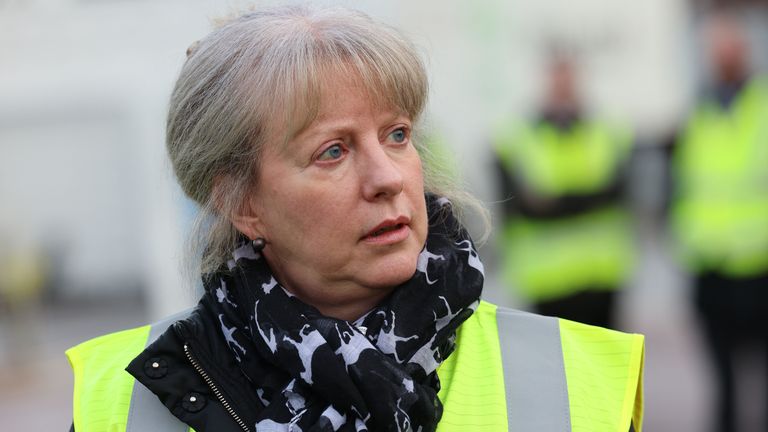
Ms Robison during a visit to Logan Energy in Edinburgh earlier on Wednesday. Pic: PA
The Scottish budget is largely funded through the block grant alongside taxes raised north of the border.
Holyrood has an additional £3.4bn to spend in 2025-26, thanks to cash announced by UK Chancellor Rachel Reeves in her budget in October – taking the overall settlement to £47.7bn.
However, the Scottish budget for 2023-24 amounted to around £59.7bn.
Holyrood ministers are legally obliged to balance the books and have limited borrowing powers with which to raise additional funds.
The SNP had already confirmed plans to use some of the funding to restore a universal winter fuel payment for pensioners next year.
Under the plans, those in receipt of pension credit or other benefits will receive a £200 or £300 payment, depending on their age.
All other pensioners will receive a reduced payment of £100.
The draft budget will be scrutinised in the Scottish parliament over the coming weeks before an expected vote in February, where the SNP will need to garner support from outside its minority administration for it to pass.
Following her statement, Ms Robison said she is looking forward to working with all parties at the Scottish parliament to get the plans passed.
She said: “I am proud to present a budget that delivers on the priorities of the people of Scotland.
“Parliament can show that we understand the pressures people are facing.
“We can choose to come together to bring hope to people, to renew our public services, and deliver a wealth of new opportunities in our economy.”
Source link

Khamrah by Lattafa for Men - 3.4 oz EDP Spray
4% Off
Ghost Sweetheart Eau de Toilette | Pineapple, Jasmine and Sandalwood | Perfume for Women 50 ml
50% Off
Marc Jacobs Dot Eau De Parfum for Women, 100 ml
42% Off
Ted Baker W Eau de Toilette for Her, Fig Leaf, White Peony and Violet Top Notes, Pink Orchid and Raspberry Middle Notes, 75ml
£11.77 (£15.69 / 100 ml) (as of 17/06/2026 03:33 GMT +01:00 - More infoProduct prices and availability are accurate as of the date/time indicated and are subject to change. Any price and availability information displayed on [relevant Amazon Site(s), as applicable] at the time of purchase will apply to the purchase of this product.)
Ted Baker Woman Pink Eau de Toilette Spray Floral Green Feminine Fragrance, Opening Notes are Fresh Peach, Bergamot and Tangerine with Warm Musk, Vanilla and Vetiver Base, 100ml
11% Off
Vera Wang Princess Eau de Toilette - 30 ml

Choco Musk 50ml Eau De Parfum for men and women | Chocolate Musk by Jannat Aromas
17% Off
Christina Aguilera Signature Eau de Parfum (50ml) Floral, Fruity & Exotic Scent, Luxury Fragrance for Women
9% Off
Calvin Klein - Eau De Toilette CKIN2U - Calvin Klein Women, Ladies Perfume, Women's Perfume, Calvin Klein Perfume, Calvin Klein One - 150 ml
5% Off
Jimmy Choo Flash Eau de Parfum, 60 ml (Pack of 1)
3% Off
Fruit of the Loom Men's Heavy T Shirt, White, XL UK
28% Off
ATNKE LED Lighted Beanie Cap,USB Rechargeable Running Hat Ultra Bright 4 LED Waterproof Light Winter Warm Gifts for Men and Women/Pink

Men's 1/4 Zip Pullover UK Sale Clearance, Fleece Sweatshirt Casual Jumper Long Sleeve T-shirt Top Stand Collar Sweater Plain Pullover Sports Leisure Workwear Quarter Zip Sweater Lightweight Jumpers
£5.88 (as of 12/11/2025 00:52 GMT +01:00 - More infoProduct prices and availability are accurate as of the date/time indicated and are subject to change. Any price and availability information displayed on [relevant Amazon Site(s), as applicable] at the time of purchase will apply to the purchase of this product.)
Crevice Cleaning Brush, Bathroom Tile Groove Gap Cleaning Brush,Premium Crevice Cleaning Tool Aluminum Support with 15° Angle Magic Brush, Thin Brush for Home Kitchen
19% Off
Wireless Earbuds, Bluetooth 5.3 Headphones in Ear with HiFi Stereo Deep Bass, 4 ENC Noise Cancelling Mic Wireless Earphones 40H Playtime, Bluetooth Earbuds Dual LED Display, IP7 Waterproof, USB-C
42% Off