
 Getty Images
The Scottish government was too reliant on UK ministers to lead the response to the Covid-19 pandemic and was “significantly under-prepared” for what was to come, an inquiry has found.
The UK Covid-19 Inquiry found that the response of all four governments in the UK to the virus “repeatedly amounted to a case of ‘too little, too late'”.
It says strict lockdowns could have been avoided had voluntary restrictions and social distancing been introduced earlier – and that thousands of lives could have been saved by faster action.
And it says there was a “lack of trust” between ministers in Edinburgh and London which coloured the approach to decision-making.
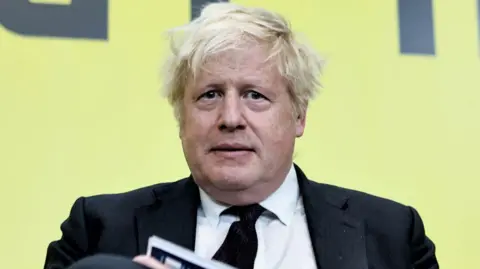
The report by inquiry chairwoman Baroness Hallett is damning of a “toxic and chaotic culture” at the heart of the UK government led by Boris Johnson.
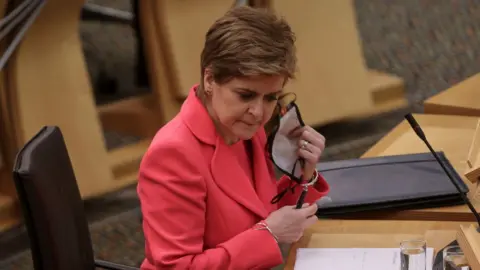
And while it says Nicola Sturgeon was a “serious and diligent leader”, it criticises the former first minister’s clashes with Johnson and her approach of taking decisions within a small group.
Baroness Hallett acknowledged that leaders “were presented with unenviable choices” and “had to make decisions in conditions of extreme pressure”.
And she said that “in a future emergency, leaders of each of the four nations should seek to minimise political division and prioritise collective working in the public interest”.
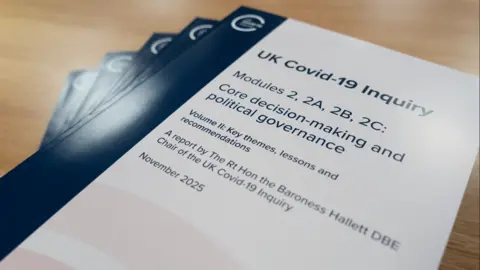
The report, which runs to more than 760 pages, works its way through the events of the pandemic in turn, examining political decision-making.
It says all four nations failed to take more immediate emergency steps in early 2020, when Covid-19 was beginning to spread worldwide.
The devolved administrations in Scotland, Wales and Northern Ireland are described as being “too reliant on the UK government to lead the response”, having “failed to adequately conduct their own planning”.
It says the Scottish government had “no real strategy” between January and March other than monitoring the spread of the virus.
The report finds that by the time possibility of lockdown was first considered across the UK, it was already too late and had become unavoidable.
It says 23,000 deaths could have been avoided in England alone had sweeping restrictions come in a week earlier.
 Getty Images
Baroness Hallett ultimately backed the decisions that governments took to impose a mandatory lockdown – but said this “only became inevitable because of the acts and omissions of the four governments”.
And she said the fact these mistakes were repeated later in 2020 was “inexcusable”.
Once mandatory restrictions had been imposed at the end of March that year, the report says “none of the four governments had a strategy for when or how they would exit the lockdown”.
It says the UK government took a “high-risk” approach to easing restrictions in England that summer, and that the more gradual approach in Scotland, Wales and Northern Ireland had reduced the chances of further lockdowns.
The report also praises the Scottish government for “the quick introduction of stringent, locally targeted measures” in the autumn of 2020.
Ultimately a further lockdown was imposed due to the spread of a new variant of the virus, and the report says “all four governments failed to recognise this threat and did not take action until infection levels were critical”.
 UK Covid Inquiry
The report is critical of Boris Johnson’s leadership, talking about a “toxic and chaotic culture” at the centre of the UK government.
There were frequent political spats between the Scottish and UK administrations during the pandemic, with both sides claiming the other was trying to further political arguments.
Former Chancellor to the Duchy of Lancaster Michael Gove claimed that Scottish ministers occasionally viewed decisions “through a political lens” as to whether divergence from the UK approach would further the case for independence.
Meanwhile Sturgeon repeatedly clashed with Johnson, claiming that a visit he made to Scotland in July 2020 was used “as a political campaigning tool” for the Union.
The inquiry said it had found no evidence that either government “allowed political considerations to affect their pandemic-related decision-making”.
However it said the relationship between Sturgeon and her UK counterparts was “poor”, and that neither side had done anything to improve it.
It said the perception of political maneuvering “hindered intergovernmental relations at a time when trust between the administrations was paramount”.
 Getty Images
The report praises Sturgeon as a “serious and diligent leader who took responsibility for decisions”.
However it says this meant that that ministers and advisers “were often excluded from decision-making”, with important choices often made “outside the formal structures” of government.
A “Gold Command” group made up of Sturgeon and senior ministers and advisors – such as her deputy John Swinney – regularly met in advance of Scottish cabinet meetings, without any formal minutes being taken.
Sturgeon told the inquiry that these were “not decision-making meetings” – but the report rejects this, saying the use of this informal group “diminished the role of the Scottish cabinet and reduced the transparency of decision-making”.
It highlights that the decision to close schools in Scotland was taken by Sturgeon and Swinney alone – and says that cabinet “should not have been sidelined” in this.
The report said the Scottish cabinet ended up ratifying decisions made elsewhere rather than being the “ultimate decision-making body” – in contrast to the Welsh government approach, where cabinet was “fully engaged throughout the pandemic” and decisions were made by consensus.
It also nods to the fact Sturgeon fronted 98% of Scottish government briefings broadcast to the public, suggesting that sharing the burden of communications would “reduce the risk of polarisation among members of the public”.
BBC News

Khamrah by Lattafa for Men - 3.4 oz EDP Spray
4% Off
Ghost Sweetheart Eau de Toilette | Pineapple, Jasmine and Sandalwood | Perfume for Women 50 ml
50% Off
Marc Jacobs Dot Eau De Parfum for Women, 100 ml
42% Off
Ted Baker W Eau de Toilette for Her, Fig Leaf, White Peony and Violet Top Notes, Pink Orchid and Raspberry Middle Notes, 75ml
£11.77 (£15.69 / 100 ml) (as of 18/08/2026 04:23 GMT +01:00 - More infoProduct prices and availability are accurate as of the date/time indicated and are subject to change. Any price and availability information displayed on [relevant Amazon Site(s), as applicable] at the time of purchase will apply to the purchase of this product.)
Ted Baker Woman Pink Eau de Toilette Spray Floral Green Feminine Fragrance, Opening Notes are Fresh Peach, Bergamot and Tangerine with Warm Musk, Vanilla and Vetiver Base, 100ml
11% Off
Vera Wang Princess Eau de Toilette - 30 ml

Choco Musk 50ml Eau De Parfum for men and women | Chocolate Musk by Jannat Aromas
17% Off
Christina Aguilera Signature Eau de Parfum (50ml) Floral, Fruity & Exotic Scent, Luxury Fragrance for Women
9% Off
Calvin Klein - Eau De Toilette CKIN2U - Calvin Klein Women, Ladies Perfume, Women's Perfume, Calvin Klein Perfume, Calvin Klein One - 150 ml
5% Off
Jimmy Choo Flash Eau de Parfum, 60 ml (Pack of 1)
3% Off
Fruit of the Loom Men's Heavy T Shirt, White, XL UK
28% Off
ATNKE LED Lighted Beanie Cap,USB Rechargeable Running Hat Ultra Bright 4 LED Waterproof Light Winter Warm Gifts for Men and Women/Pink
17% Off
Men's 1/4 Zip Pullover UK Sale Clearance, Fleece Sweatshirt Casual Jumper Long Sleeve T-shirt Top Stand Collar Sweater Plain Pullover Sports Leisure Workwear Quarter Zip Sweater Lightweight Jumpers
£5.88 (as of 12/11/2025 00:52 GMT +01:00 - More infoProduct prices and availability are accurate as of the date/time indicated and are subject to change. Any price and availability information displayed on [relevant Amazon Site(s), as applicable] at the time of purchase will apply to the purchase of this product.)
Crevice Cleaning Brush, Bathroom Tile Groove Gap Cleaning Brush,Premium Crevice Cleaning Tool Aluminum Support with 15° Angle Magic Brush, Thin Brush for Home Kitchen
19% Off
Wireless Earbuds, Bluetooth 5.3 Headphones in Ear with HiFi Stereo Deep Bass, 4 ENC Noise Cancelling Mic Wireless Earphones 40H Playtime, Bluetooth Earbuds Dual LED Display, IP7 Waterproof, USB-C
42% Off