



 Getty Images
A saliva test may help “turn the tide” on prostate cancer, UK scientists claim.
It analyses men’s DNA to work out who was born with the greatest risk of developing the disease.
Targeting them for prostate biopsies and MRI scans discovered some aggressive cancers that would otherwise have gone unnoticed.
However, the test has not yet been proven to save lives and experts say it will be “years” before such tests could be used routinely.
Around 12,000 men in the UK die from prostate cancer every year.
Calls for the routine testing of healthy men – known as screening – have grown louder since Olympic cyclist Sir Chris Hoy announced he had terminal prostate cancer.
Screening has been rejected in the past because using the current test – which looks for levels of prostate specific antigen (PSA) in the blood – risks causing more harm than good.
This saliva test does not look for signs of prostate cancer inside the body.
Instead it looks for 130 mutations in men’s DNA, each of which can increase the risk of prostate cancers developing.
In the study, scientists tested men aged 55-69 and calculated their risk. Men in the top 10% of scores were invited for further investigations. This included a biopsy and an MRI scan.
The study, published in the New England Journal of Medicine, showed:
- Out of 745 men with a high score, 468 were prepared to have the extra tests
- 187 were found to have prostate cancer
- 103 were higher risk tumours that needed treatment, 74 of these would not have been discovered at this stage with current tests
“With this test, it could be possible to turn the tide on prostate cancer,” said Prof Ros Eeles, from the Institute of Cancer Research, London.
“We can identify men at risk of aggressive cancers who need further tests and spare the men who are at lower risk from unnecessary treatments,” she added
‘Two lives saved’
 Dheeresh Turnbull
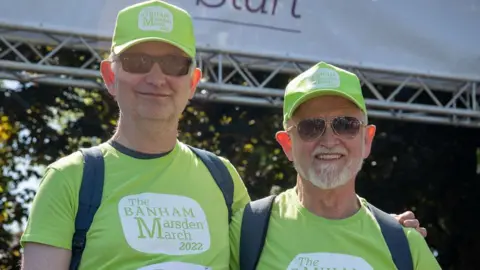
Dheeresh Turnbull, who is 71 and from Brighton, took part in the trial.
He discovered he was in the highest risk category despite having no family history of prostate cancer. Further examination showed he had cancer.
“I was completely shocked, I would never have been diagnosed at this stage if I hadn’t joined the trial.”
His younger brother was then invited to take part in the study and also discovered he had an aggressive tumour.
“It’s incredible to think that because of this study two lives have now been saved in my family,” Dheeresh said.
‘Still a long road’
However, the test is not ready to be rolled out.
Prof Dusko Ilic, from King’s College London, said it was “promising” but improved cancer detection “only modestly” when used alongside current risk factors such as age, PSA levels and MRI scans.
And he said there was still “no direct evidence” of it improving survival or quality of life, which meant more studies were needed.
The research also focused people of European ancestry and work is still under way to adapt it for people from other backgrounds. Black men are thought to have double the risk of prostate cancer.
The research team also say there are questions around cost-effectiveness, potential harms and the best time to analyse the risk.
The saliva test will become part of the pivotal Transform trial which is trying to discover the best way of introducing prostate cancer screening in the UK.
Prof Michael Inouye, from the University of Cambridge, said he believes we will look back on this study “as a landmark” that made the case for using genetics to assess risk.
But he added: “This is a big step along the path to clinical implementation, but it is still a long road.”
He said it will “likely be years” before the NHS used such a test.
Source link

Khamrah by Lattafa for Men - 3.4 oz EDP Spray
4% Off
Ghost Sweetheart Eau de Toilette | Pineapple, Jasmine and Sandalwood | Perfume for Women 50 ml
50% Off
Marc Jacobs Dot Eau De Parfum for Women, 100 ml
42% Off
Ted Baker W Eau de Toilette for Her, Fig Leaf, White Peony and Violet Top Notes, Pink Orchid and Raspberry Middle Notes, 75ml
£11.77 (£15.69 / 100 ml) (as of 17/10/2026 06:36 GMT +01:00 - More infoProduct prices and availability are accurate as of the date/time indicated and are subject to change. Any price and availability information displayed on [relevant Amazon Site(s), as applicable] at the time of purchase will apply to the purchase of this product.)
Ted Baker Woman Pink Eau de Toilette Spray Floral Green Feminine Fragrance, Opening Notes are Fresh Peach, Bergamot and Tangerine with Warm Musk, Vanilla and Vetiver Base, 100ml
11% Off
Vera Wang Princess Eau de Toilette - 30 ml

Choco Musk 50ml Eau De Parfum for men and women | Chocolate Musk by Jannat Aromas
17% Off
Christina Aguilera Signature Eau de Parfum (50ml) Floral, Fruity & Exotic Scent, Luxury Fragrance for Women
9% Off
Calvin Klein - Eau De Toilette CKIN2U - Calvin Klein Women, Ladies Perfume, Women's Perfume, Calvin Klein Perfume, Calvin Klein One - 150 ml
5% Off
Jimmy Choo Flash Eau de Parfum, 60 ml (Pack of 1)
3% Off
Fruit of the Loom Men's Heavy T Shirt, White, XL UK
28% Off
ATNKE LED Lighted Beanie Cap,USB Rechargeable Running Hat Ultra Bright 4 LED Waterproof Light Winter Warm Gifts for Men and Women/Pink
17% Off
Men's 1/4 Zip Pullover UK Sale Clearance, Fleece Sweatshirt Casual Jumper Long Sleeve T-shirt Top Stand Collar Sweater Plain Pullover Sports Leisure Workwear Quarter Zip Sweater Lightweight Jumpers
£5.88 (as of 12/11/2025 00:52 GMT +01:00 - More infoProduct prices and availability are accurate as of the date/time indicated and are subject to change. Any price and availability information displayed on [relevant Amazon Site(s), as applicable] at the time of purchase will apply to the purchase of this product.)
Crevice Cleaning Brush, Bathroom Tile Groove Gap Cleaning Brush,Premium Crevice Cleaning Tool Aluminum Support with 15° Angle Magic Brush, Thin Brush for Home Kitchen
19% Off
Wireless Earbuds, Bluetooth 5.3 Headphones in Ear with HiFi Stereo Deep Bass, 4 ENC Noise Cancelling Mic Wireless Earphones 40H Playtime, Bluetooth Earbuds Dual LED Display, IP7 Waterproof, USB-C
42% Off


