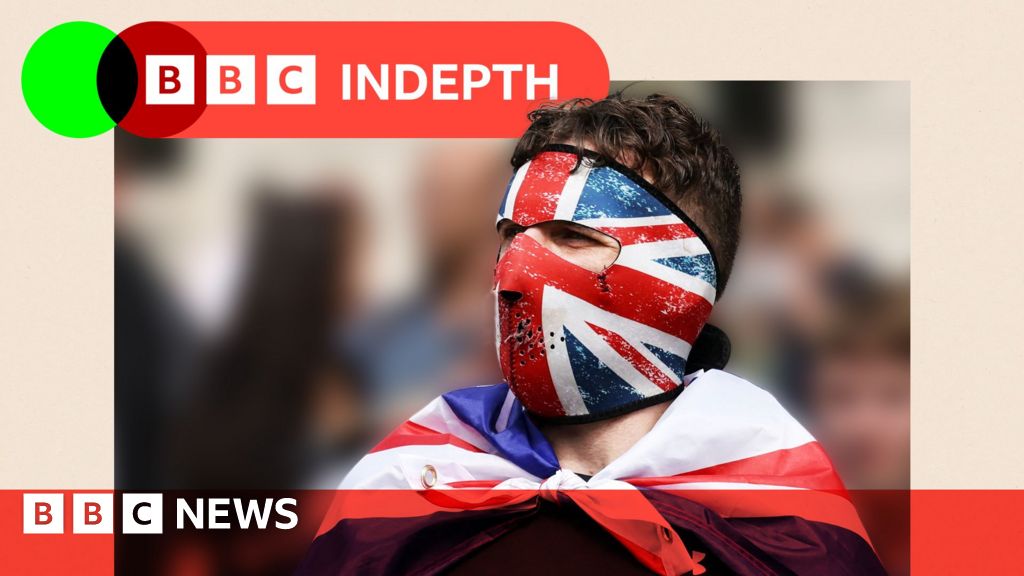
This lack of cohesion makes the situation more unpredictable and dangerous. For the authorities, there are so many potential rioters and potential targets, and a lack of obvious national organisations to disrupt.
By contrast, counter-demonstrations by anti-racism campaigners have been far more cohesive and organised.
Right-wing extremism itself can be thought of a spectrum, rather than a coherent whole. It includes genocidal neo-Nazis treated as terrorists by the state, who hide behind online aliases, scorn campaigning, want to destroy society and venerate Adolf Hitler. But the term is also used to describe people who stand in democratic elections, engage in public campaigns and put forward policy platforms.
I tend to use “extreme right” for the first type and “far right” for the latter.
There are hatreds that unite different parts of the spectrum, but there are also differences. For example, the central antisemitic conspiracy theories espoused by neo-Nazis will not always be shared by some far-right figures, who might mainly target Muslims.
In key respects, right-wing extremism in the UK today has moved beyond being driven mainly by organisations and parties to instead being composed of looser networks of people, typically coalescing online.
There is no neo-fascist political party achieving electoral success in the way the British National Party (BNP) did in the recent past.
Today, there are no prominent political leaders as we’d traditionally understand them, either. The anti-Islam activist Tommy Robinson, real name Stephen Yaxley-Lennon, is probably the best-known public figure – but the convicted criminal oversees a personality cult rather than a coherent movement, with the endless spectacle of his online diatribes and legal issues providing a living soap opera.
Groups like the BNP and National Front still exist, but they are ghosts of their former selves, populated by older fascists and lacking appeal to younger people.
Newer, more extreme organisations have been created by younger people in the UK but the key examples – including the neo-Nazi groups National Action and Sonnenkrieg Division – have been outlawed by the government as terrorist organisations and disrupted by anti-fascists, journalists and the police.
Some right-wing extremists have moved away from setting up formal groups that draw attention from the police and have instead have sought to create looser networks, particularly online, where anyone can follow extremist channels or influencers.
For instance, some have formed in small groups like Patriotic Alternative (PA) and a network of fighting clubs in which white men meet to engage in violent training. These have adopted less overtly extreme rhetoric than organisations that have been banned, but contain similar people, and some PA members have been convicted of terrorism and racial hatred offences.
When violence occurs, it does not always come from the neo-Nazi end of the spectrum, nor are those responsible necessarily long-term extremists.
Most of those who took part in the disorder had no known links to the extreme or far right. There were a range of people involved, from people in their late 60s to children, with a range of different motivations. Some were opportunistic criminals who took part in looting and stealing. Others were drunk and joined in after the chaos had started.
However, some of those at the riots did have links to the extreme right. These include John Honey, who had attended PA events in the past and was jailed for his part in what Judge John Thackray described as “12 hours of racist, hate-fuelled mob violence” in Hull.
Present at the Southport riot was Matthew Hankinson, who had been released from prison only months earlier after being jailed for membership of the banned terrorist group National Action.
Source link

Khamrah by Lattafa for Men - 3.4 oz EDP Spray
4% Off
Ghost Sweetheart Eau de Toilette | Pineapple, Jasmine and Sandalwood | Perfume for Women 50 ml
50% Off
Marc Jacobs Dot Eau De Parfum for Women, 100 ml
42% Off
Ted Baker W Eau de Toilette for Her, Fig Leaf, White Peony and Violet Top Notes, Pink Orchid and Raspberry Middle Notes, 75ml
£11.77 (£15.69 / 100 ml) (as of 12/08/2026 04:10 GMT +01:00 - More infoProduct prices and availability are accurate as of the date/time indicated and are subject to change. Any price and availability information displayed on [relevant Amazon Site(s), as applicable] at the time of purchase will apply to the purchase of this product.)
Ted Baker Woman Pink Eau de Toilette Spray Floral Green Feminine Fragrance, Opening Notes are Fresh Peach, Bergamot and Tangerine with Warm Musk, Vanilla and Vetiver Base, 100ml
11% Off
Vera Wang Princess Eau de Toilette - 30 ml

Choco Musk 50ml Eau De Parfum for men and women | Chocolate Musk by Jannat Aromas
17% Off
Christina Aguilera Signature Eau de Parfum (50ml) Floral, Fruity & Exotic Scent, Luxury Fragrance for Women
9% Off
Calvin Klein - Eau De Toilette CKIN2U - Calvin Klein Women, Ladies Perfume, Women's Perfume, Calvin Klein Perfume, Calvin Klein One - 150 ml
5% Off
Jimmy Choo Flash Eau de Parfum, 60 ml (Pack of 1)
3% Off
Fruit of the Loom Men's Heavy T Shirt, White, XL UK
28% Off
ATNKE LED Lighted Beanie Cap,USB Rechargeable Running Hat Ultra Bright 4 LED Waterproof Light Winter Warm Gifts for Men and Women/Pink
17% Off
Men's 1/4 Zip Pullover UK Sale Clearance, Fleece Sweatshirt Casual Jumper Long Sleeve T-shirt Top Stand Collar Sweater Plain Pullover Sports Leisure Workwear Quarter Zip Sweater Lightweight Jumpers

Crevice Cleaning Brush, Bathroom Tile Groove Gap Cleaning Brush,Premium Crevice Cleaning Tool Aluminum Support with 15° Angle Magic Brush, Thin Brush for Home Kitchen
19% Off
Wireless Earbuds, Bluetooth 5.3 Headphones in Ear with HiFi Stereo Deep Bass, 4 ENC Noise Cancelling Mic Wireless Earphones 40H Playtime, Bluetooth Earbuds Dual LED Display, IP7 Waterproof, USB-C
42% Off