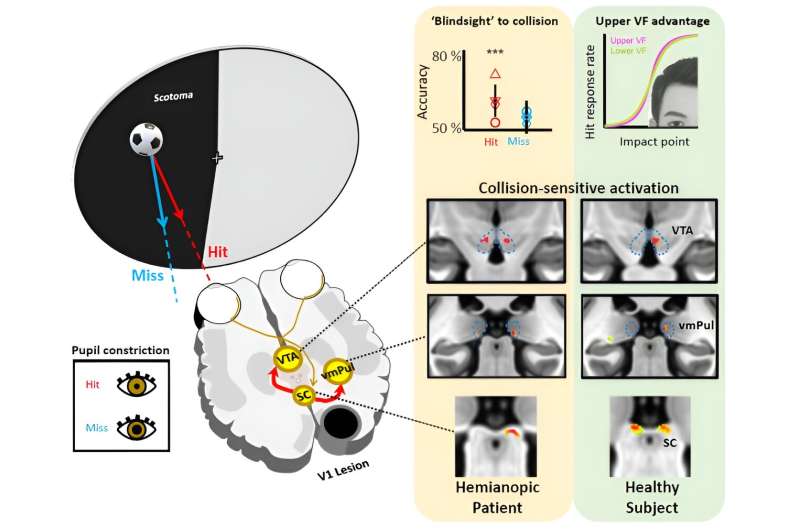
A research team has revealed the human subcortical neural pathway underlying the automatic detection of collision trajectories, even in the absence of attention and awareness. The work was published in PLOS Biology.
Using healthy human adults and hemianopic patients as experimental subjects, the researchers, led by Prof. Zhang Peng and Prof. He Sheng from the Institute of Biophysics of the Chinese Academy of Sciences and Prof. Wang Dajing from the Third Medical Center of PLA General Hospital, combined behavioral experiments, eye-tracking, and high-resolution 7T functional magnetic resonance imaging (fMRI) to investigate the neural mechanisms of collision trajectory detection.
The behavioral experiments showed that healthy participants were able to accurately distinguish between collision and non-collision trajectories, and their pupil size was reduced for collision events. High-resolution fMRI revealed that subcortical pathways from the superior colliculus to the ventromedial pulvinar and ventral tegmental area can automatically detect collision trajectories even without attention.
Compared to the lower visual field, both behavioral performance, pupil size changes and subcortical responses were more sensitive to collision trajectories from the upper visual field. These findings suggest that human subcortical pathways may be optimized and specialized for detecting transient and biologically salient information in the upper visual field.
When visual stimuli were presented in the blind visual field of hemianopic patients, even without subjective awareness of the visual stimuli, their subcortical pathways showed significant activation to the collision trajectory. Subcortical responses also predicted the behavioral performance in collision detection.
This study has revealed the neural basis for “blindsight” in detecting visual threats and provides theoretical support for optimizing computer vision algorithms for collision detection.
More information:
Fanhua Guo et al, Human subcortical pathways automatically detect collision trajectory without attention and awareness, PLOS Biology (2024). DOI: 10.1371/journal.pbio.3002375
Citation:
Researchers reveal human brain mechanisms for subconscious collision detection (2024, February 26)
retrieved 26 February 2024
from https://medicalxpress.com/news/2024-02-reveal-human-brain-mechanisms-subconscious.html
This document is subject to copyright. Apart from any fair dealing for the purpose of private study or research, no
part may be reproduced without the written permission. The content is provided for information purposes only.

Khamrah by Lattafa for Men - 3.4 oz EDP Spray
4% Off
Ghost Sweetheart Eau de Toilette | Pineapple, Jasmine and Sandalwood | Perfume for Women 50 ml
50% Off
Marc Jacobs Dot Eau De Parfum for Women, 100 ml
42% Off
Ted Baker W Eau de Toilette for Her, Fig Leaf, White Peony and Violet Top Notes, Pink Orchid and Raspberry Middle Notes, 75ml
£11.77 (£15.69 / 100 ml) (as of 09/07/2026 03:55 GMT +01:00 - More infoProduct prices and availability are accurate as of the date/time indicated and are subject to change. Any price and availability information displayed on [relevant Amazon Site(s), as applicable] at the time of purchase will apply to the purchase of this product.)
Ted Baker Woman Pink Eau de Toilette Spray Floral Green Feminine Fragrance, Opening Notes are Fresh Peach, Bergamot and Tangerine with Warm Musk, Vanilla and Vetiver Base, 100ml
11% Off
Vera Wang Princess Eau de Toilette - 30 ml

Choco Musk 50ml Eau De Parfum for men and women | Chocolate Musk by Jannat Aromas
17% Off
Christina Aguilera Signature Eau de Parfum (50ml) Floral, Fruity & Exotic Scent, Luxury Fragrance for Women
9% Off
Calvin Klein - Eau De Toilette CKIN2U - Calvin Klein Women, Ladies Perfume, Women's Perfume, Calvin Klein Perfume, Calvin Klein One - 150 ml
5% Off
Jimmy Choo Flash Eau de Parfum, 60 ml (Pack of 1)
3% Off
Fruit of the Loom Men's Heavy T Shirt, White, XL UK
28% Off
ATNKE LED Lighted Beanie Cap,USB Rechargeable Running Hat Ultra Bright 4 LED Waterproof Light Winter Warm Gifts for Men and Women/Pink
17% Off
Men's 1/4 Zip Pullover UK Sale Clearance, Fleece Sweatshirt Casual Jumper Long Sleeve T-shirt Top Stand Collar Sweater Plain Pullover Sports Leisure Workwear Quarter Zip Sweater Lightweight Jumpers
£5.88 (as of 12/11/2025 00:52 GMT +01:00 - More infoProduct prices and availability are accurate as of the date/time indicated and are subject to change. Any price and availability information displayed on [relevant Amazon Site(s), as applicable] at the time of purchase will apply to the purchase of this product.)
Crevice Cleaning Brush, Bathroom Tile Groove Gap Cleaning Brush,Premium Crevice Cleaning Tool Aluminum Support with 15° Angle Magic Brush, Thin Brush for Home Kitchen
19% Off
Wireless Earbuds, Bluetooth 5.3 Headphones in Ear with HiFi Stereo Deep Bass, 4 ENC Noise Cancelling Mic Wireless Earphones 40H Playtime, Bluetooth Earbuds Dual LED Display, IP7 Waterproof, USB-C
42% Off