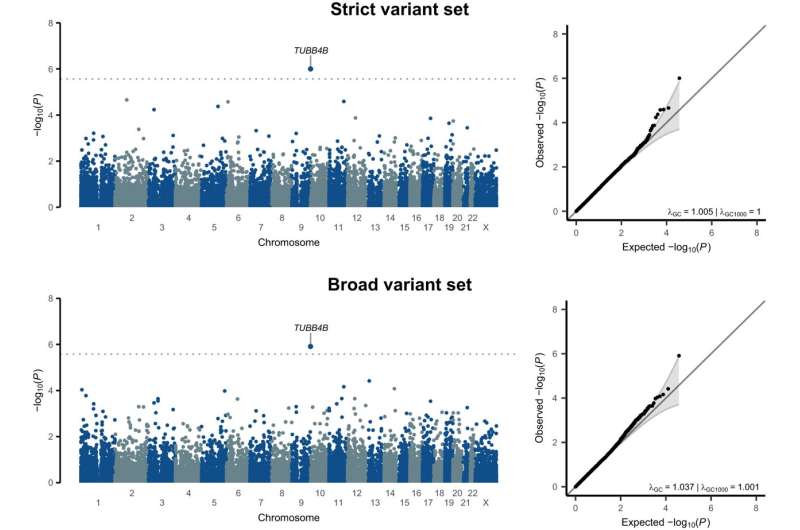
A team of geneticists at the Max Planck Institute for Psycholinguistics, in The Netherlands, has found a genetic variant that codes for a tubulin protein that may be partially responsible for left-handedness in humans. In their study, published in the journal Nature Communications, the group analyzed genetic data from hundreds of thousands of people who have medical profiles in the UK Biobank.
Prior research has shown that approximately 10% of people are left-handed and until recently, the reason has been a mystery. Several years ago, researchers determined that left-handed people have right-brain hemisphere dominance, while everyone else has left-brain hemisphere dominance.
Then, in 2019, a team of genetics researchers found evidence that there are four genetic regions involved in handedness; the following year, another team found 41 gene variants that could be linked to left-handedness. Together, these findings suggest that like some other human characteristics, handedness is due to a combination of factors that are influenced by a myriad of genes.
In this new study, the researchers found a genetic variant that results in differences in tubulin protein production between people who are left- or right-handed.
To learn more about the underlying cause of left-handedness, the research team analyzed genetic data from 313,271 right-handed people and 38,043 left-handed people in the Biobank, looking for differences between the two. They found that left-handed people in the database are 2.7 times as likely to have a rare genetic variant that encodes for a tubulin protein involved in the creation of microtubules—parts of the cytoskeleton that give cells their physical shape.
Prior research has suggested a link between microtubules and hemisphere dominance. And other research has shown that microtubules are also heavily involved in the development of neurons.
The researchers acknowledge that it is still not clear how microtubule development might lead to left-handedness, though they note that previous findings suggest they may be associated with cellular chirality, which in turn may be associated with hemisphere dominance.
More information:
Dick Schijven et al, Exome-wide analysis implicates rare protein-altering variants in human handedness, Nature Communications (2024). DOI: 10.1038/s41467-024-46277-w
© 2024 Science X Network
Citation:
Researchers find genetic variant coding for tubulin protein that may be partially responsible for left-handedness (2024, April 3)
retrieved 3 April 2024
from https://medicalxpress.com/news/2024-04-genetic-variant-coding-tubulin-protein.html
This document is subject to copyright. Apart from any fair dealing for the purpose of private study or research, no
part may be reproduced without the written permission. The content is provided for information purposes only.

Khamrah by Lattafa for Men - 3.4 oz EDP Spray
4% Off
Ghost Sweetheart Eau de Toilette | Pineapple, Jasmine and Sandalwood | Perfume for Women 50 ml
50% Off
Marc Jacobs Dot Eau De Parfum for Women, 100 ml
42% Off
Ted Baker W Eau de Toilette for Her, Fig Leaf, White Peony and Violet Top Notes, Pink Orchid and Raspberry Middle Notes, 75ml
£11.77 (£15.69 / 100 ml) (as of 01/09/2026 04:56 GMT +01:00 - More infoProduct prices and availability are accurate as of the date/time indicated and are subject to change. Any price and availability information displayed on [relevant Amazon Site(s), as applicable] at the time of purchase will apply to the purchase of this product.)
Ted Baker Woman Pink Eau de Toilette Spray Floral Green Feminine Fragrance, Opening Notes are Fresh Peach, Bergamot and Tangerine with Warm Musk, Vanilla and Vetiver Base, 100ml
11% Off
Vera Wang Princess Eau de Toilette - 30 ml

Choco Musk 50ml Eau De Parfum for men and women | Chocolate Musk by Jannat Aromas
17% Off
Christina Aguilera Signature Eau de Parfum (50ml) Floral, Fruity & Exotic Scent, Luxury Fragrance for Women
9% Off
Calvin Klein - Eau De Toilette CKIN2U - Calvin Klein Women, Ladies Perfume, Women's Perfume, Calvin Klein Perfume, Calvin Klein One - 150 ml
5% Off
Jimmy Choo Flash Eau de Parfum, 60 ml (Pack of 1)
3% Off
Fruit of the Loom Men's Heavy T Shirt, White, XL UK
28% Off
ATNKE LED Lighted Beanie Cap,USB Rechargeable Running Hat Ultra Bright 4 LED Waterproof Light Winter Warm Gifts for Men and Women/Pink
17% Off
Men's 1/4 Zip Pullover UK Sale Clearance, Fleece Sweatshirt Casual Jumper Long Sleeve T-shirt Top Stand Collar Sweater Plain Pullover Sports Leisure Workwear Quarter Zip Sweater Lightweight Jumpers
£5.88 (as of 12/11/2025 00:52 GMT +01:00 - More infoProduct prices and availability are accurate as of the date/time indicated and are subject to change. Any price and availability information displayed on [relevant Amazon Site(s), as applicable] at the time of purchase will apply to the purchase of this product.)
Crevice Cleaning Brush, Bathroom Tile Groove Gap Cleaning Brush,Premium Crevice Cleaning Tool Aluminum Support with 15° Angle Magic Brush, Thin Brush for Home Kitchen
19% Off
Wireless Earbuds, Bluetooth 5.3 Headphones in Ear with HiFi Stereo Deep Bass, 4 ENC Noise Cancelling Mic Wireless Earphones 40H Playtime, Bluetooth Earbuds Dual LED Display, IP7 Waterproof, USB-C
42% Off