Researchers from the National Institutes of Health (NIH) have discovered the source of dysfunction in the process whereby cells in the eye’s retina remove waste.
A report by scientists at NIH and Johns Hopkins University, Baltimore, details how alterations in a factor called AKT2 affect the function of organelles called lysosomes and results in the production of deposits in the retina called drusen, a hallmark sign of dry age-related macular degeneration (AMD). According to the researchers, the findings suggest drusen formation is a downstream effect of AKT2-related lysosome dysfunction and points to a new target for therapeutic intervention.
The findings are published in the journal Nature Communications.
Lysosomes are like cells’ garbage disposals, and they play a crucial role in maintaining the eye’s light-sensing retina. Key cells that make up the retinal pigment epithelium (RPE) provide oxygen and nutrients to the retina’s energetically active neurons. They also collect and process the retina’s waste products through lysosomes. Failure in the cells’ ability to process these waste products leads to the formation of drusen. As AMD progresses, drusen increase in number and volume. But despite intensive research, drusen formation is still largely a mystery.
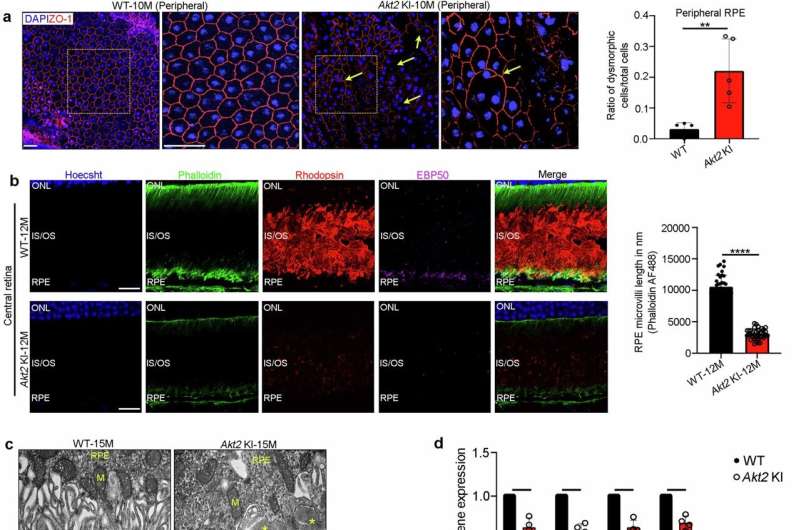
In mice, the researchers manipulated AKT2 expression levels in RPE. When they overexpressed AKT2, lysosomes lost normal function and the mice developed dry AMD symptoms such as RPE degeneration. The researchers saw similar features in RPE cells from human donors with AMD or in RPE cells generated from patient stem cells. Cells from donors who possessed a gene variant called CFH Y402H, which increases AMD risk, had relatively greater expression of AKT2, showed functionally defective lysosomes, and formed drusen deposits.
This study’s findings form the basis for a possible future treatment for dry AMD, for which no therapy currently exists. AMD is one of the most common causes of vision loss in the United States. People with dry AMD develop drusen in an area of the light-sensing retina called the macula that people use for sharp, central vision.
The study builds upon previous work published by Ruchi Sharma, Ph.D., also of the NEI Section on Ocular Stem Cell and Translational Research Section, who developed the AMD patient stem cell-derived RPE model.
More information:
Sayan Ghosh et al, The AKT2/SIRT5/TFEB pathway as a potential therapeutic target in non-neovascular AMD, Nature Communications (2024). DOI: 10.1038/s41467-024-50500-z
Citation:
Researchers discover potential therapeutic target for degenerative eye disease (2024, July 26)
retrieved 27 July 2024
from https://medicalxpress.com/news/2024-07-potential-therapeutic-degenerative-eye-disease.html
This document is subject to copyright. Apart from any fair dealing for the purpose of private study or research, no
part may be reproduced without the written permission. The content is provided for information purposes only.

Khamrah by Lattafa for Men - 3.4 oz EDP Spray
4% Off
Ghost Sweetheart Eau de Toilette | Pineapple, Jasmine and Sandalwood | Perfume for Women 50 ml
50% Off
Marc Jacobs Dot Eau De Parfum for Women, 100 ml
42% Off
Ted Baker W Eau de Toilette for Her, Fig Leaf, White Peony and Violet Top Notes, Pink Orchid and Raspberry Middle Notes, 75ml
£11.77 (£15.69 / 100 ml) (as of 01/07/2026 03:53 GMT +01:00 - More infoProduct prices and availability are accurate as of the date/time indicated and are subject to change. Any price and availability information displayed on [relevant Amazon Site(s), as applicable] at the time of purchase will apply to the purchase of this product.)
Ted Baker Woman Pink Eau de Toilette Spray Floral Green Feminine Fragrance, Opening Notes are Fresh Peach, Bergamot and Tangerine with Warm Musk, Vanilla and Vetiver Base, 100ml
11% Off
Vera Wang Princess Eau de Toilette - 30 ml

Choco Musk 50ml Eau De Parfum for men and women | Chocolate Musk by Jannat Aromas
17% Off
Christina Aguilera Signature Eau de Parfum (50ml) Floral, Fruity & Exotic Scent, Luxury Fragrance for Women
9% Off
Calvin Klein - Eau De Toilette CKIN2U - Calvin Klein Women, Ladies Perfume, Women's Perfume, Calvin Klein Perfume, Calvin Klein One - 150 ml
5% Off
Jimmy Choo Flash Eau de Parfum, 60 ml (Pack of 1)
3% Off
Fruit of the Loom Men's Heavy T Shirt, White, XL UK
28% Off
ATNKE LED Lighted Beanie Cap,USB Rechargeable Running Hat Ultra Bright 4 LED Waterproof Light Winter Warm Gifts for Men and Women/Pink
17% Off
Men's 1/4 Zip Pullover UK Sale Clearance, Fleece Sweatshirt Casual Jumper Long Sleeve T-shirt Top Stand Collar Sweater Plain Pullover Sports Leisure Workwear Quarter Zip Sweater Lightweight Jumpers
£5.88 (as of 12/11/2025 00:52 GMT +01:00 - More infoProduct prices and availability are accurate as of the date/time indicated and are subject to change. Any price and availability information displayed on [relevant Amazon Site(s), as applicable] at the time of purchase will apply to the purchase of this product.)
Crevice Cleaning Brush, Bathroom Tile Groove Gap Cleaning Brush,Premium Crevice Cleaning Tool Aluminum Support with 15° Angle Magic Brush, Thin Brush for Home Kitchen
19% Off
Wireless Earbuds, Bluetooth 5.3 Headphones in Ear with HiFi Stereo Deep Bass, 4 ENC Noise Cancelling Mic Wireless Earphones 40H Playtime, Bluetooth Earbuds Dual LED Display, IP7 Waterproof, USB-C
42% Off