Epilepsy, where patients suffer from unexpected seizures, affects roughly 1% of the population. These seizures often involve repetitive and excessive neuronal firing, and the trigger behind this still poorly understood.
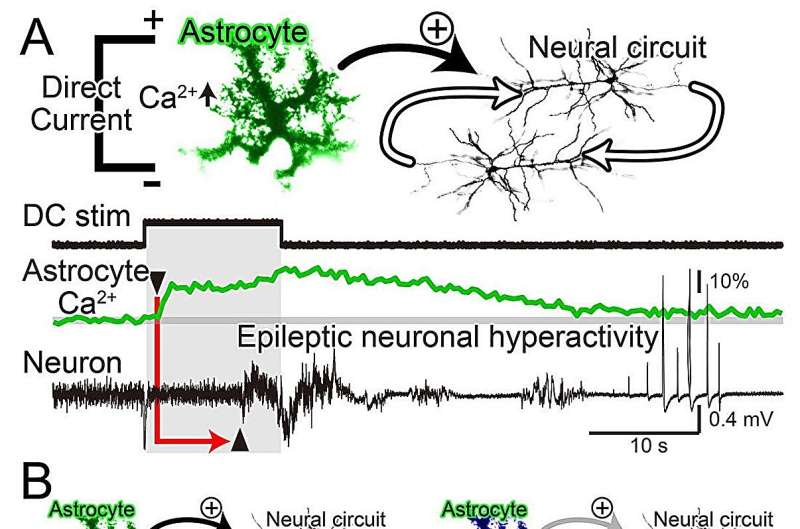
Now, researchers at Tohoku University have monitored astrocyte activity using fluorescence calcium sensors, discovering that astrocyte activity starts approximately 20 seconds before the onset of epileptic neuronal hyperactivity. This suggests that astrocytes play a significant part in triggering epileptic seizures, facilitating the hyper-drive of the neural circuit.
These findings were detailed in the journal Glia on April 9, 2024.
Astrocytes are non-neuronal glial cells that occupy almost half of the brain. They have been shown to control the local ionic and metabotropic environment. Yet, since they do not exhibit electrical activity that can be easily monitored, their role in brain function has largely been neglected. Fluorescence sensor proteins are changing this, revealing more about the mesmerizing activity of astrocytes.
“Astrocytes appear to have a determinant role in controlling the state of neuronal activity and synaptic plasticity both in physiological and pathophysiological situations,” says Professor Ko Matsui of the Super-network Brain Physiology lab at Tohoku University, who led the research. “Therefore, astrocytes could be considered as a new therapeutic target for epilepsy treatment.”
When brain tissue makes contact with metals such as copper, it is known to induce inflammation that leads to acute symptomatic seizures, which occurs a few times per day in mice. Matsui and his team observed these events, where they discovered that astrocyte activity may be the trigger for neuronal hyperactivity. Astrocytes can also be activated by low-amplitude direct current stimulation.
The researchers noticed that such a stimulation induced a robust increase in the astrocyte calcium, which was followed by an epileptic neuronal hyperactivity episode. When the metabolic activity of the astrocytes was blocked by applying fluorocitrate, the magnitude of the epileptic neuronal hyperactivity was significantly reduced. These all point to the fact that astrocytes have the potential to control neuronal activity.
Lead study investigator Shun Araki emphasizes that with appropriate guidance, astrocytes’ functions could be harnessed to address a range of neurological conditions. This includes not only epilepsy but also potentially enhancing cognitive abilities beyond natural limitations.
More information:
Shun Araki et al, Astrocyte switch to the hyperactive mode, Glia (2024). DOI: 10.1002/glia.24537
Citation:
Researchers discover glial hyper-drive for triggering epileptic seizures (2024, April 19)
retrieved 21 April 2024
from https://medicalxpress.com/news/2024-04-glial-hyper-triggering-epileptic-seizures.html
This document is subject to copyright. Apart from any fair dealing for the purpose of private study or research, no
part may be reproduced without the written permission. The content is provided for information purposes only.

Khamrah by Lattafa for Men - 3.4 oz EDP Spray
4% Off
Ghost Sweetheart Eau de Toilette | Pineapple, Jasmine and Sandalwood | Perfume for Women 50 ml
50% Off
Marc Jacobs Dot Eau De Parfum for Women, 100 ml
42% Off
Ted Baker W Eau de Toilette for Her, Fig Leaf, White Peony and Violet Top Notes, Pink Orchid and Raspberry Middle Notes, 75ml
£11.77 (£15.69 / 100 ml) (as of 10/08/2026 04:10 GMT +01:00 - More infoProduct prices and availability are accurate as of the date/time indicated and are subject to change. Any price and availability information displayed on [relevant Amazon Site(s), as applicable] at the time of purchase will apply to the purchase of this product.)
Ted Baker Woman Pink Eau de Toilette Spray Floral Green Feminine Fragrance, Opening Notes are Fresh Peach, Bergamot and Tangerine with Warm Musk, Vanilla and Vetiver Base, 100ml
11% Off
Vera Wang Princess Eau de Toilette - 30 ml

Choco Musk 50ml Eau De Parfum for men and women | Chocolate Musk by Jannat Aromas
17% Off
Christina Aguilera Signature Eau de Parfum (50ml) Floral, Fruity & Exotic Scent, Luxury Fragrance for Women
9% Off
Calvin Klein - Eau De Toilette CKIN2U - Calvin Klein Women, Ladies Perfume, Women's Perfume, Calvin Klein Perfume, Calvin Klein One - 150 ml
5% Off
Jimmy Choo Flash Eau de Parfum, 60 ml (Pack of 1)
3% Off
Fruit of the Loom Men's Heavy T Shirt, White, XL UK
28% Off
ATNKE LED Lighted Beanie Cap,USB Rechargeable Running Hat Ultra Bright 4 LED Waterproof Light Winter Warm Gifts for Men and Women/Pink
17% Off
Men's 1/4 Zip Pullover UK Sale Clearance, Fleece Sweatshirt Casual Jumper Long Sleeve T-shirt Top Stand Collar Sweater Plain Pullover Sports Leisure Workwear Quarter Zip Sweater Lightweight Jumpers
£5.88 (as of 12/11/2025 00:52 GMT +01:00 - More infoProduct prices and availability are accurate as of the date/time indicated and are subject to change. Any price and availability information displayed on [relevant Amazon Site(s), as applicable] at the time of purchase will apply to the purchase of this product.)
Crevice Cleaning Brush, Bathroom Tile Groove Gap Cleaning Brush,Premium Crevice Cleaning Tool Aluminum Support with 15° Angle Magic Brush, Thin Brush for Home Kitchen
19% Off
Wireless Earbuds, Bluetooth 5.3 Headphones in Ear with HiFi Stereo Deep Bass, 4 ENC Noise Cancelling Mic Wireless Earphones 40H Playtime, Bluetooth Earbuds Dual LED Display, IP7 Waterproof, USB-C
42% Off