

Researchers from Children’s Hospital of Philadelphia (CHOP) have developed a new tool to help analyze data collected from spatial transcriptomics technologies (SRTs), which simultaneously profile gene expression and spatial location information in tissues to pinpoint which cells in which layers of tissue may drive various diseases.
The findings, published in the journal Nature Methods, enable researchers to better identify and understand new therapeutic targets for optimized treatment strategies.
SRTs are powerful tools with incredible versatility. Some methods profile tens of thousands of genes on thousands of locations on a tissue, while others measure hundreds of genes at a single-cell level.
However, with so much data, it can be challenging to identify which cells are expressing which genes and how these might cause diseases. For example, in the brain it’s difficult for researchers to distinguish which genes are active in the different types of cells and neurons in its complex layers.
“While the data being generated by SRTs is important, by itself it is difficult to understand the big picture of how this information can be translated in a way that helps drive discovery,” said senior study author Hakon Hakonarson, MD, Ph.D., director of the Center for Applied Genomics (CAG) at CHOP.
“This tool helps cluster the data to identify relationships between different data points and data types better than any other method currently available.”
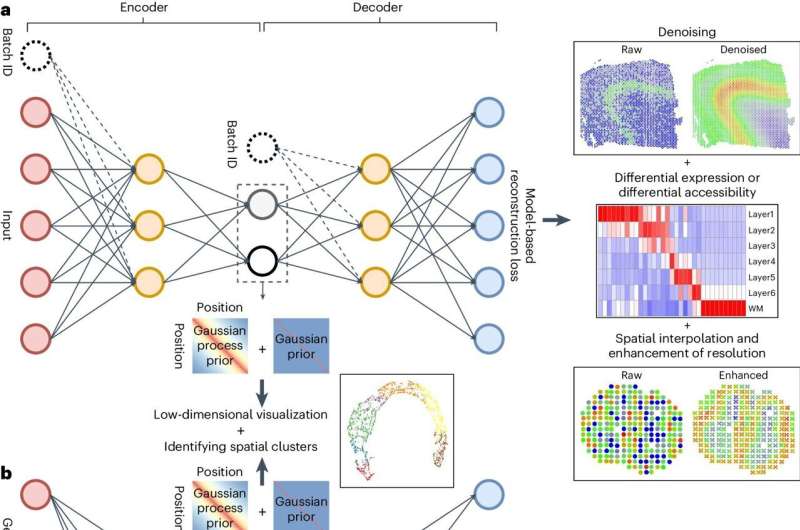
To tackle this issue, researchers from the CAG at CHOP developed a new tool called spaVAE designed to handle the unique challenges of spatial gene data.
Using advanced deep learning techniques, spaVAE is designed to understand patterns in the data, especially how different data points relate to each other in a three-dimensional part of the tissue.
After collecting data from a variety of SRTs, spaVAE helps simplify complex data, creating visual representations of the data, combining data from different experiments, predicting gene activity in unmeasured areas of tissue, identifying differences in gene activity, and most importantly, finding genes that vary across different spatial regions.
Additionally, the researchers adapted spaVAE to handle multiple types of data, including data captured from multi-omics sources—the genome, proteome, transcriptome, metabolome, and epigenome.
“Using what we have learned from this study, we hope this approach could be used to ascertain more meaningful data from other spatial genomic technology, allowing us to investigate cell-to-cell communication and delving deeper into single cell genomics data,” said Tian Tian, Ph.D., a former postdoctoral fellow with the CAG laboratory at CHOP.
More information:
Tian Tian et al, Dependency-aware deep generative models for multitasking analysis of spatial omics data, Nature Methods (2024). DOI: 10.1038/s41592-024-02257-y
Citation:
Researchers develop new tool to aid processing of spatial transcriptomic data (2024, June 11)
retrieved 11 June 2024
from https://medicalxpress.com/news/2024-06-tool-aid-spatial-transcriptomic.html
This document is subject to copyright. Apart from any fair dealing for the purpose of private study or research, no
part may be reproduced without the written permission. The content is provided for information purposes only.

Khamrah by Lattafa for Men - 3.4 oz EDP Spray
4% Off
Ghost Sweetheart Eau de Toilette | Pineapple, Jasmine and Sandalwood | Perfume for Women 50 ml
50% Off
Marc Jacobs Dot Eau De Parfum for Women, 100 ml
42% Off
Ted Baker W Eau de Toilette for Her, Fig Leaf, White Peony and Violet Top Notes, Pink Orchid and Raspberry Middle Notes, 75ml
£11.77 (£15.69 / 100 ml) (as of 14/10/2026 06:35 GMT +01:00 - More infoProduct prices and availability are accurate as of the date/time indicated and are subject to change. Any price and availability information displayed on [relevant Amazon Site(s), as applicable] at the time of purchase will apply to the purchase of this product.)
Ted Baker Woman Pink Eau de Toilette Spray Floral Green Feminine Fragrance, Opening Notes are Fresh Peach, Bergamot and Tangerine with Warm Musk, Vanilla and Vetiver Base, 100ml
11% Off
Vera Wang Princess Eau de Toilette - 30 ml

Choco Musk 50ml Eau De Parfum for men and women | Chocolate Musk by Jannat Aromas
17% Off
Christina Aguilera Signature Eau de Parfum (50ml) Floral, Fruity & Exotic Scent, Luxury Fragrance for Women
9% Off
Calvin Klein - Eau De Toilette CKIN2U - Calvin Klein Women, Ladies Perfume, Women's Perfume, Calvin Klein Perfume, Calvin Klein One - 150 ml
5% Off
Jimmy Choo Flash Eau de Parfum, 60 ml (Pack of 1)
3% Off
Fruit of the Loom Men's Heavy T Shirt, White, XL UK
28% Off
ATNKE LED Lighted Beanie Cap,USB Rechargeable Running Hat Ultra Bright 4 LED Waterproof Light Winter Warm Gifts for Men and Women/Pink
17% Off
Men's 1/4 Zip Pullover UK Sale Clearance, Fleece Sweatshirt Casual Jumper Long Sleeve T-shirt Top Stand Collar Sweater Plain Pullover Sports Leisure Workwear Quarter Zip Sweater Lightweight Jumpers
£5.88 (as of 12/11/2025 00:52 GMT +01:00 - More infoProduct prices and availability are accurate as of the date/time indicated and are subject to change. Any price and availability information displayed on [relevant Amazon Site(s), as applicable] at the time of purchase will apply to the purchase of this product.)
Crevice Cleaning Brush, Bathroom Tile Groove Gap Cleaning Brush,Premium Crevice Cleaning Tool Aluminum Support with 15° Angle Magic Brush, Thin Brush for Home Kitchen
19% Off
Wireless Earbuds, Bluetooth 5.3 Headphones in Ear with HiFi Stereo Deep Bass, 4 ENC Noise Cancelling Mic Wireless Earphones 40H Playtime, Bluetooth Earbuds Dual LED Display, IP7 Waterproof, USB-C
42% Off