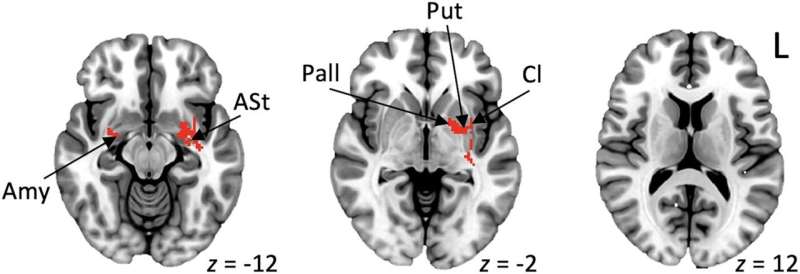
A new study published in the journal Brain has identified a specific brain network hub that plays a key role in stuttering.
The research, by Te Whare Wānanga o Waitaha | University of Canterbury (UC) Associate Professor Catherine Theys, examines two different types of stuttering—developmental and acquired—to show a clear neural basis for the speech condition.
“Stuttering affects approximately 1% of adults and can result in significant communication problems and social anxiety, yet the cause of stuttering is still unknown,” says Associate Professor Theys.
“It most often occurs as a developmental disorder but can also be caused by focal brain damage following a stroke or other neurological conditions. While most research treats these different types of stuttering as separate conditions, this study takes a unique approach by combining datasets to see if we can identify a common link.”
The multidisciplinary study, in collaboration with researchers from the University of Turku (Finland), University of Toronto, Boston University, and Brigham and Women’s Hospital at Harvard Medical School, used three independent datasets: case reports from published literature of acquired neurogenic stuttering following stroke; a clinical single study cohort with acquired neurogenic stuttering following stroke; and adults with persistent developmental stuttering.
While previous research has looked at specific brain lesion locations to try to find out how the brain works, Associate Professor Theys says this research uses a new technique that looks at the brain networks affected by lesions and whether there might be a common hub.
“We used the first two datasets and lesion network mapping to test whether lesions causing acquired stuttering map to a common brain network. We then used the third dataset to test whether this lesion-based network was relevant to developmental stuttering.
“By looking at each of the datasets we were able to locate a common stuttering network, narrowing it down to a specific part of the left putamen, which is responsible for lip and face movements, and timing and sequencing of speech.
“We also identified two additional new areas of interest for speech imaging and stuttering research, which are the claustrum and amygdalostriatal transition area. They are tiny areas of the brain—only a few millimeters wide—which is why they may typically not have been identified in previous studies. This shows a plausible network for stuttering.
“People have always looked at acquired and developmental stuttering as two separate things, but we have been able to show that as well as the similarities at the behavioral level, there are also similarities at the neural level.”
Dr. Theys says the findings have relevance for treatment.
“For people with acquired stuttering, this provides a good explanation of what might be going on. When you look at that part of the putamen, it’s really the sequencing of movements that seems to be a key underlying difficulty, and therefore an important aspect to focus our treatments on. The identified network areas also provide insights in possible links with emotional responses in stuttering.
“The claustrum and amygdalostriatal transition area findings provide an important new direction in mapping the neural basis of stuttering, and ensuring the best possible diagnostic and treatment approaches can be developed.”
More information:
Catherine Theys et al, Localization of stuttering based on causal brain lesions, Brain (2024). DOI: 10.1093/brain/awae059
Citation:
Research identifies brain network link to stuttering (2024, May 27)
retrieved 28 May 2024
from https://medicalxpress.com/news/2024-05-brain-network-link-stuttering.html
This document is subject to copyright. Apart from any fair dealing for the purpose of private study or research, no
part may be reproduced without the written permission. The content is provided for information purposes only.

Khamrah by Lattafa for Men - 3.4 oz EDP Spray
4% Off
Ghost Sweetheart Eau de Toilette | Pineapple, Jasmine and Sandalwood | Perfume for Women 50 ml
50% Off
Marc Jacobs Dot Eau De Parfum for Women, 100 ml
42% Off
Ted Baker W Eau de Toilette for Her, Fig Leaf, White Peony and Violet Top Notes, Pink Orchid and Raspberry Middle Notes, 75ml
£11.77 (£15.69 / 100 ml) (as of 03/05/2026 03:10 GMT +01:00 - More infoProduct prices and availability are accurate as of the date/time indicated and are subject to change. Any price and availability information displayed on [relevant Amazon Site(s), as applicable] at the time of purchase will apply to the purchase of this product.)
Ted Baker Woman Pink Eau de Toilette Spray Floral Green Feminine Fragrance, Opening Notes are Fresh Peach, Bergamot and Tangerine with Warm Musk, Vanilla and Vetiver Base, 100ml
11% Off
Vera Wang Princess Eau de Toilette - 30 ml

Choco Musk 50ml Eau De Parfum for men and women | Chocolate Musk by Jannat Aromas
17% Off
Christina Aguilera Signature Eau de Parfum (50ml) Floral, Fruity & Exotic Scent, Luxury Fragrance for Women
9% Off
Calvin Klein - Eau De Toilette CKIN2U - Calvin Klein Women, Ladies Perfume, Women's Perfume, Calvin Klein Perfume, Calvin Klein One - 150 ml
5% Off
Jimmy Choo Flash Eau de Parfum, 60 ml (Pack of 1)
3% Off
Fruit of the Loom Men's Heavy T Shirt, White, XL UK
28% Off
ATNKE LED Lighted Beanie Cap,USB Rechargeable Running Hat Ultra Bright 4 LED Waterproof Light Winter Warm Gifts for Men and Women/Pink
17% Off
Men's 1/4 Zip Pullover UK Sale Clearance, Fleece Sweatshirt Casual Jumper Long Sleeve T-shirt Top Stand Collar Sweater Plain Pullover Sports Leisure Workwear Quarter Zip Sweater Lightweight Jumpers
£5.88 (as of 12/11/2025 00:52 GMT +01:00 - More infoProduct prices and availability are accurate as of the date/time indicated and are subject to change. Any price and availability information displayed on [relevant Amazon Site(s), as applicable] at the time of purchase will apply to the purchase of this product.)
Crevice Cleaning Brush, Bathroom Tile Groove Gap Cleaning Brush,Premium Crevice Cleaning Tool Aluminum Support with 15° Angle Magic Brush, Thin Brush for Home Kitchen
19% Off
Wireless Earbuds, Bluetooth 5.3 Headphones in Ear with HiFi Stereo Deep Bass, 4 ENC Noise Cancelling Mic Wireless Earphones 40H Playtime, Bluetooth Earbuds Dual LED Display, IP7 Waterproof, USB-C
42% Off