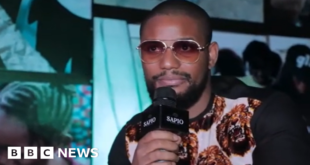
“We see his death as a blow to many victims who were awaiting to see the senator to face justice given his role in the civil war,” human rights activist and campaigner for a special war crimes court Adama Dempster told the BBC.
An estimated 250,000 people died in the conflicts and many survivors from sexual assault and other attacks were left permanently scarred.
The cause of Johnson’s death in the capital, Monrovia, has not been disclosed.
In a condolence message to his family, President Joseph Boakai – who Johnson supported in his presidential campaign last year – described him as “a figure who played a pivotal role in Liberia’s complex historical evolution and contributed to national discourse through his service in the Senate”.
Back in 1990, rebel soldiers from Johnson’s Independent National Patriotic Front of Liberia captured President Samuel Doe and were then, in front of their leader, filmed mutilating him – his ear was sliced off – before he was killed.
The warlord later expressed regret for what had happened, but, as quoted by the AFP news agency, justified his role in the war, saying he was defending “my country, my people, who were led to the slaughterhouse as if they were chickens and goats, by the Doe regime”.
He also said he had changed and had become a pastor in an evangelical church.
As a politician he was praised by his constituents in Nimba county for working to improve their lives.
But he also courted controversy.
In 2021 Johnson was sanctioned by the US for alleged involvement in so-called pay-for-play funding, where he would reportedly personally benefit from the distribution of government funding to various ministries.
He was also accused of selling votes for personal gain in several elections, leading to criticism from some of his allies.
But Wilfred Bangura, a former leading official in Johnson’s Movement for Democracy and Reconstruction, said “politically he was very weighty and strong” and that he only changed alliances once he saw people moving away from him.
While certainly revered and being mourned by many in his home county – where he was seen as a hero and liberator – elsewhere people feel he was not made to pay for the crimes committed during the civil war.
Source link

Khamrah by Lattafa for Men - 3.4 oz EDP Spray
4% Off
Ghost Sweetheart Eau de Toilette | Pineapple, Jasmine and Sandalwood | Perfume for Women 50 ml
50% Off
Marc Jacobs Dot Eau De Parfum for Women, 100 ml
42% Off
Ted Baker W Eau de Toilette for Her, Fig Leaf, White Peony and Violet Top Notes, Pink Orchid and Raspberry Middle Notes, 75ml
£11.77 (£15.69 / 100 ml) (as of 15/05/2026 03:14 GMT +01:00 - More infoProduct prices and availability are accurate as of the date/time indicated and are subject to change. Any price and availability information displayed on [relevant Amazon Site(s), as applicable] at the time of purchase will apply to the purchase of this product.)
Ted Baker Woman Pink Eau de Toilette Spray Floral Green Feminine Fragrance, Opening Notes are Fresh Peach, Bergamot and Tangerine with Warm Musk, Vanilla and Vetiver Base, 100ml
11% Off
Vera Wang Princess Eau de Toilette - 30 ml

Choco Musk 50ml Eau De Parfum for men and women | Chocolate Musk by Jannat Aromas
17% Off
Christina Aguilera Signature Eau de Parfum (50ml) Floral, Fruity & Exotic Scent, Luxury Fragrance for Women
9% Off
Calvin Klein - Eau De Toilette CKIN2U - Calvin Klein Women, Ladies Perfume, Women's Perfume, Calvin Klein Perfume, Calvin Klein One - 150 ml
5% Off
Jimmy Choo Flash Eau de Parfum, 60 ml (Pack of 1)
3% Off
Fruit of the Loom Men's Heavy T Shirt, White, XL UK
28% Off
ATNKE LED Lighted Beanie Cap,USB Rechargeable Running Hat Ultra Bright 4 LED Waterproof Light Winter Warm Gifts for Men and Women/Pink
17% Off
Men's 1/4 Zip Pullover UK Sale Clearance, Fleece Sweatshirt Casual Jumper Long Sleeve T-shirt Top Stand Collar Sweater Plain Pullover Sports Leisure Workwear Quarter Zip Sweater Lightweight Jumpers

Crevice Cleaning Brush, Bathroom Tile Groove Gap Cleaning Brush,Premium Crevice Cleaning Tool Aluminum Support with 15° Angle Magic Brush, Thin Brush for Home Kitchen
19% Off
Wireless Earbuds, Bluetooth 5.3 Headphones in Ear with HiFi Stereo Deep Bass, 4 ENC Noise Cancelling Mic Wireless Earphones 40H Playtime, Bluetooth Earbuds Dual LED Display, IP7 Waterproof, USB-C
42% Off