 [
[

A first-in-class PET imaging approach can accurately detect a biomarker for chronic traumatic encephalopathy (CTE), a devastating neurodegenerative disease associated with repeated head impact. Rather than waiting until after death for a definitive diagnosis, this imaging biomarker has the potential to diagnose patients while they are still alive and could play a critical role in supporting clinical trials to develop CTE treatments.
This research was presented at the Society of Nuclear Medicine and Molecular Imaging 2026 Annual Meeting.
CTE is common among contact sports athletes, military veterans, and victims of interpersonal or intimate partner violence, as well as anyone who has experienced a traumatic brain injury. Individuals with suspected CTE often experience mental health consequences including cognitive decline, mood symptoms, impulsivity, and dementia.
At present, CTE can only be definitively diagnosed after death through neuropathological examination.
“Post-mortem, CTE is confirmed by the presence of tau plaques in the brain,” said Isabelle Boileau, Ph.D., senior scientist and associate director of the Brain Health Imaging Center and head of the Addiction Imaging Research Group at the Center for Addiction and Mental Health in Toronto.
“Existing tau PET tracers, however, are largely developed for Alzheimer’s disease and may not adequately detect the distinct tau pathology seen in CTE.”
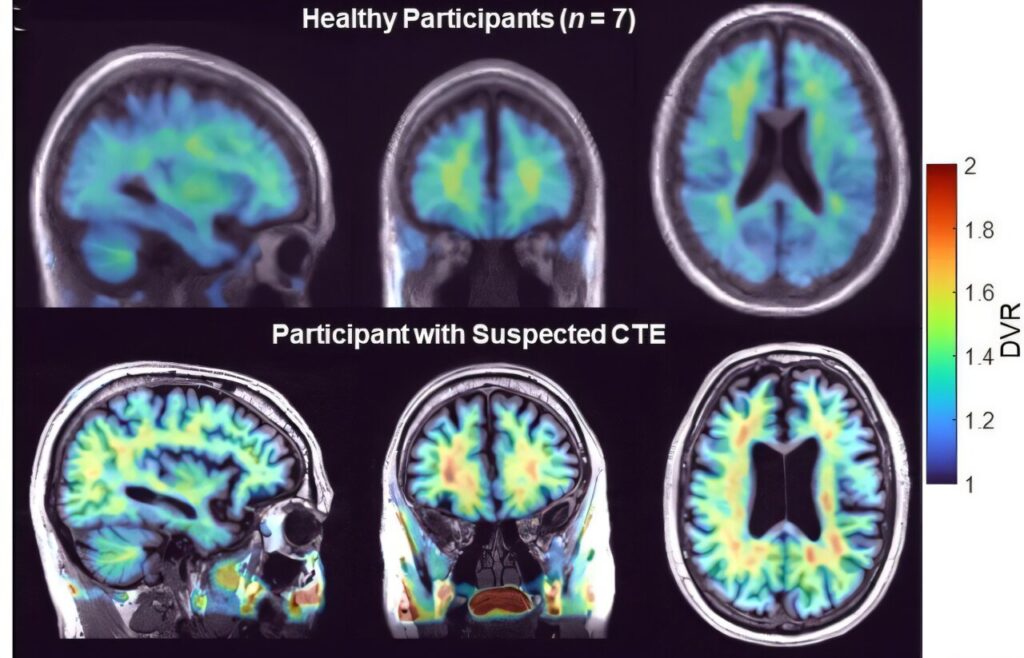
In the study, researchers evaluated a new tau PET radiotracer for its ability to recognize tau plaques in patients with suspected CTE. Three retired collision-sport athletes and seven healthy controls underwent dynamic brain PET with 18F-OXD-2314.
Tau distribution patterns were analyzed, and specific regions of interest were assessed. Additional studies were also conducted to assess 3H-OXD-2314 binding in post-mortem CTE tissue.
Compared to healthy controls, images of individuals with suspected CTE revealed elevated uptake of 18F-OXD-2314 in the gray-white matter junction and in white matter. Additionally, the 3H-OXD-2314 signal was observed in all post-mortem CTE cases examined, providing early biological confirmation that the tracer binds to tau pathology in human CTE tissue.
“If validated, 18F-OXD-2314 could help provide the first accurate in-life diagnostic biomarker for CTE,” said Boileau. “This work could also establish a clinical role for PET in traumatic brain injury and sports- and military-related neurodegeneration and spark next generation tau-radiopharmaceuticals optimized for non-Alzheimer’s disease tauopathies including CTE.”
She continued, “While this radiopharmaceutical is in the early clinical research stage, our data in both people with suspected CTE and other non-Alzheimer’s disease tauopathies are very promising. The PET imaging for CTE could be available to patients as early as the next two years, pending further studies.”
More information
Abstract 262070: Isabelle Boileau, et al. First-in-Human Tau PET using [18F]OXD-2314 in People with Suspected Chronic Traumatic Encephalopathy
Key medical concepts
Clinical categories
Provided by
Society of Nuclear Medicine and Molecular Imaging


Citation:
PET suggests potential chronic traumatic encephalopathy biomarker in living humans (2026, May 31)
retrieved 31 May 2026
from https://medicalxpress.com/news/2026-05-pet-potential-chronic-traumatic-encephalopathy.html
This document is subject to copyright. Apart from any fair dealing for the purpose of private study or research, no
part may be reproduced without the written permission. The content is provided for information purposes only.

Khamrah by Lattafa for Men - 3.4 oz EDP Spray
4% Off
Ghost Sweetheart Eau de Toilette | Pineapple, Jasmine and Sandalwood | Perfume for Women 50 ml
50% Off
Marc Jacobs Dot Eau De Parfum for Women, 100 ml
42% Off
Ted Baker W Eau de Toilette for Her, Fig Leaf, White Peony and Violet Top Notes, Pink Orchid and Raspberry Middle Notes, 75ml
£11.77 (£15.69 / 100 ml) (as of 31/05/2026 03:24 GMT +01:00 - More infoProduct prices and availability are accurate as of the date/time indicated and are subject to change. Any price and availability information displayed on [relevant Amazon Site(s), as applicable] at the time of purchase will apply to the purchase of this product.)
Ted Baker Woman Pink Eau de Toilette Spray Floral Green Feminine Fragrance, Opening Notes are Fresh Peach, Bergamot and Tangerine with Warm Musk, Vanilla and Vetiver Base, 100ml
11% Off
Vera Wang Princess Eau de Toilette - 30 ml

Choco Musk 50ml Eau De Parfum for men and women | Chocolate Musk by Jannat Aromas
17% Off
Christina Aguilera Signature Eau de Parfum (50ml) Floral, Fruity & Exotic Scent, Luxury Fragrance for Women
9% Off
Calvin Klein - Eau De Toilette CKIN2U - Calvin Klein Women, Ladies Perfume, Women's Perfume, Calvin Klein Perfume, Calvin Klein One - 150 ml
5% Off
Jimmy Choo Flash Eau de Parfum, 60 ml (Pack of 1)
3% Off
Fruit of the Loom Men's Heavy T Shirt, White, XL UK
28% Off
ATNKE LED Lighted Beanie Cap,USB Rechargeable Running Hat Ultra Bright 4 LED Waterproof Light Winter Warm Gifts for Men and Women/Pink
17% Off
Men's 1/4 Zip Pullover UK Sale Clearance, Fleece Sweatshirt Casual Jumper Long Sleeve T-shirt Top Stand Collar Sweater Plain Pullover Sports Leisure Workwear Quarter Zip Sweater Lightweight Jumpers
£5.88 (as of 12/11/2025 00:52 GMT +01:00 - More infoProduct prices and availability are accurate as of the date/time indicated and are subject to change. Any price and availability information displayed on [relevant Amazon Site(s), as applicable] at the time of purchase will apply to the purchase of this product.)
Crevice Cleaning Brush, Bathroom Tile Groove Gap Cleaning Brush,Premium Crevice Cleaning Tool Aluminum Support with 15° Angle Magic Brush, Thin Brush for Home Kitchen
19% Off
Wireless Earbuds, Bluetooth 5.3 Headphones in Ear with HiFi Stereo Deep Bass, 4 ENC Noise Cancelling Mic Wireless Earphones 40H Playtime, Bluetooth Earbuds Dual LED Display, IP7 Waterproof, USB-C
42% Off