
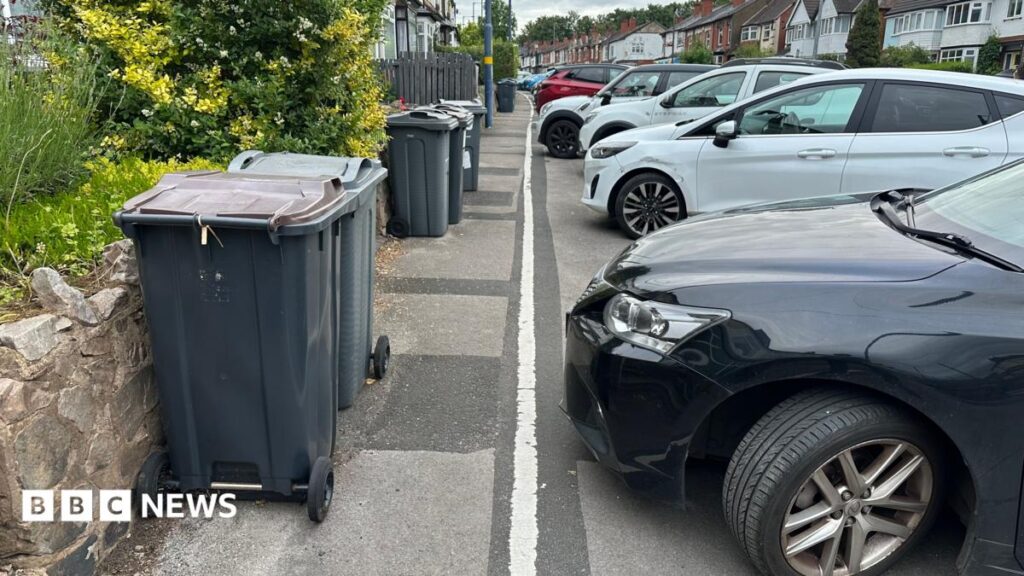
The National Federation of the Blind has called for a full pavement parking ban, arguing any parking on pavements “damages them in the longer term, leaving them in a worse state for pedestrians”.
Rob Moulds, 57, from Birmingham, is visually impaired and uses a cane when walking. He compared trying to find a path between bins and cars as being “like a pinball machine”.
“You’re going from left to right, constantly hitting obstacles. It’s disgraceful.”
He said he understood the problem of a lack of parking, but argued the solution should not “be then to impact pedestrians because that’s unfair on the pedestrians”.
“Why are we being hindered? Why are we being penalised?”
Another Fordhouse Lane resident, Clive Hawkins, said the road would be “manic” if cars were not parked on the pavement, as it is used regularly by ambulances and buses.
“There are plots round the back where you’ve got garages but there’s not enough to put all the cars, so obviously they have to stay where they are,” he said.
Councillor Harris Khaliq, Birmingham City Council’s cabinet member for city operations and digital, acknowledged the difficulties pavement parking could cause for walkers, cyclists and the disabled, but confirmed it was allowed in some locations in the city.
“The council has been pushing for new powers to keep pavements clear and has welcomed the government’s decision to grant councils new powers,” he said.
“We are awaiting guidance from government to help local authorities use these powers in a proportionate and locally appropriate way.”
Birmingham is not the only council putting parking spaces on pavements. Of the 164 local authorities who responded to a BBC Freedom of Information request, just over half confirmed they do it too.
Only five of the 84 councils that have placed parking spaces on pavements said they had plans to remove those spaces.
The number of licensed vehicles in the UK hit a record high last year, with 42.3 million as of December 2025.
Cars have also been getting wider, with critics dubbing the trend ‘carspreading’.
But pre-existing roads cannot simply expand, leaving less room for more cars.
A few parts of the UK have a general pavement-parking ban: London, Exeter and the whole of Scotland. Elsewhere, only the police can take enforcement action against vehicles blocking the pavement.
But the government has said it would give councils new enforcement powers against unnecessary pavement obstructions. From September, it will allow councils to take action outside of areas where a Traffic Regulation Order is in place.
In London, 27 of the capital’s 33 local authorities said in their FOI responses that they allowed exceptions to the pavement parking ban through bays or signage in some locations.
Source link

Khamrah by Lattafa for Men - 3.4 oz EDP Spray
4% Off
Ghost Sweetheart Eau de Toilette | Pineapple, Jasmine and Sandalwood | Perfume for Women 50 ml
50% Off
Marc Jacobs Dot Eau De Parfum for Women, 100 ml
42% Off
Ted Baker W Eau de Toilette for Her, Fig Leaf, White Peony and Violet Top Notes, Pink Orchid and Raspberry Middle Notes, 75ml
£11.77 (£15.69 / 100 ml) (as of 22/07/2026 04:02 GMT +01:00 - More infoProduct prices and availability are accurate as of the date/time indicated and are subject to change. Any price and availability information displayed on [relevant Amazon Site(s), as applicable] at the time of purchase will apply to the purchase of this product.)
Ted Baker Woman Pink Eau de Toilette Spray Floral Green Feminine Fragrance, Opening Notes are Fresh Peach, Bergamot and Tangerine with Warm Musk, Vanilla and Vetiver Base, 100ml
11% Off
Vera Wang Princess Eau de Toilette - 30 ml

Choco Musk 50ml Eau De Parfum for men and women | Chocolate Musk by Jannat Aromas
17% Off
Christina Aguilera Signature Eau de Parfum (50ml) Floral, Fruity & Exotic Scent, Luxury Fragrance for Women
9% Off
Calvin Klein - Eau De Toilette CKIN2U - Calvin Klein Women, Ladies Perfume, Women's Perfume, Calvin Klein Perfume, Calvin Klein One - 150 ml
5% Off
Jimmy Choo Flash Eau de Parfum, 60 ml (Pack of 1)
3% Off
Fruit of the Loom Men's Heavy T Shirt, White, XL UK
28% Off
ATNKE LED Lighted Beanie Cap,USB Rechargeable Running Hat Ultra Bright 4 LED Waterproof Light Winter Warm Gifts for Men and Women/Pink
17% Off
Men's 1/4 Zip Pullover UK Sale Clearance, Fleece Sweatshirt Casual Jumper Long Sleeve T-shirt Top Stand Collar Sweater Plain Pullover Sports Leisure Workwear Quarter Zip Sweater Lightweight Jumpers

Crevice Cleaning Brush, Bathroom Tile Groove Gap Cleaning Brush,Premium Crevice Cleaning Tool Aluminum Support with 15° Angle Magic Brush, Thin Brush for Home Kitchen
19% Off
Wireless Earbuds, Bluetooth 5.3 Headphones in Ear with HiFi Stereo Deep Bass, 4 ENC Noise Cancelling Mic Wireless Earphones 40H Playtime, Bluetooth Earbuds Dual LED Display, IP7 Waterproof, USB-C
42% Off


