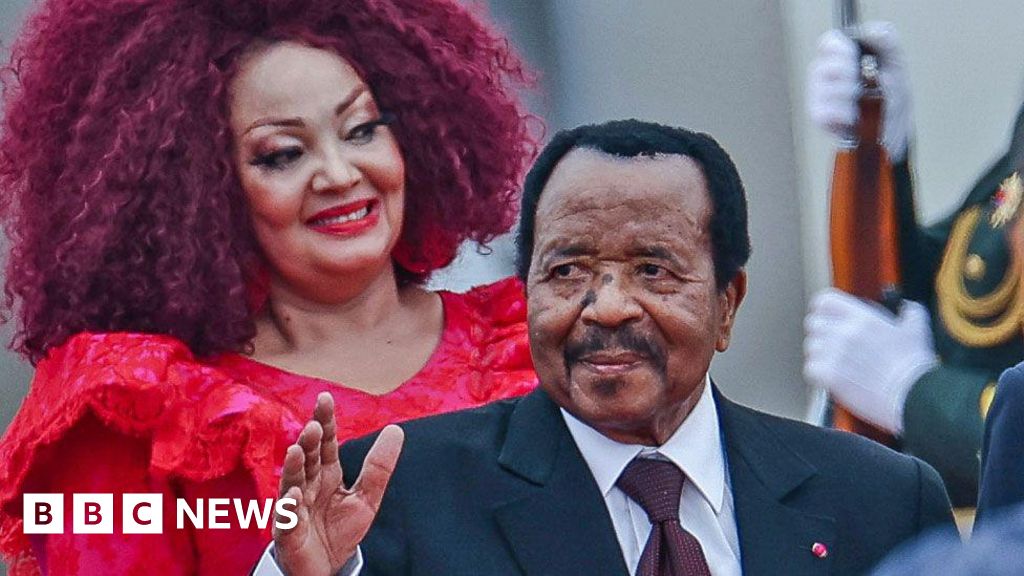
Some Cameroonians are, however, comfortable with Biya’s restrained approach to leadership and his readiness to leave successive prime ministers to handle routine decisions.
They see his role as more symbolic and distant, akin almost to a constitutional monarch.
Certainly, this representational role is a dimension of the presidency with which he has seemed at ease.
On 15 August, for example, he was at Boulouris, on the Côte d’Azur in France, where he gave a detailed 12-minute address at the commemoration of the 1944 Allied landings to liberate southern France from the Nazis – an operation in which many troops from the French African territories took part.
And in fact, despite frequent absences from the Cameroonian capital Yaoundé – usually retreating either to his home village in the forested south or to his preferred international base, Geneva’s Intercontinental Hotel – Biya has continued to take the key sensitive political and strategic decisions.
The main gatekeeper to the heart of power at the Étoudi presidential palace is the Secretary General of the Presidency, Ferdinand Ngoh Ngoh.
A power system where Biya, as the head of state, keeps his cards so close to his chest inevitably generates gossip about his own intentions for the 2025 election and about potential successors.
But some of the senior regime figures most frequently tipped, such as Laurent Esso and René Sadi, are by now themselves far from youthful.
Support groups have also appeared to promote a passing of the torch to the president’s elder son Franck Biya, a businessman – although Franck himself has never shown any interest in politics or given any hint of such ambitions.
But in today’s Africa, where disenchantment with the political establishment runs deep, particularly among young urban populations, establishment attempts to secure the continuation of power can carry risks.
In neighbouring Gabon, President Ali Bongo was deposed by the army last year after the regime manipulated the 2023 election to deliver him a further seven-year term despite his fragile state of health.
And when Senegal’s President Macky Sall lined up his Prime Minister Amadou Ba as his successor, he was decisively rebuffed by the voters who opted instead for the young reformist opponent Bassirou Diomaye Faye.
Biya and his inner circle may feel confident of avoiding such scenarios. But that will require a shrewd reading of popular sentiment, especially among youth and the middle-class in big cities such as Yaoundé and Douala.
Paul Melly is a consulting fellow with the Africa Programme at Chatham House in London.
Source link

Khamrah by Lattafa for Men - 3.4 oz EDP Spray
4% Off
Ghost Sweetheart Eau de Toilette | Pineapple, Jasmine and Sandalwood | Perfume for Women 50 ml
50% Off
Marc Jacobs Dot Eau De Parfum for Women, 100 ml
42% Off
Ted Baker W Eau de Toilette for Her, Fig Leaf, White Peony and Violet Top Notes, Pink Orchid and Raspberry Middle Notes, 75ml
£11.77 (£15.69 / 100 ml) (as of 28/04/2026 03:08 GMT +01:00 - More infoProduct prices and availability are accurate as of the date/time indicated and are subject to change. Any price and availability information displayed on [relevant Amazon Site(s), as applicable] at the time of purchase will apply to the purchase of this product.)
Ted Baker Woman Pink Eau de Toilette Spray Floral Green Feminine Fragrance, Opening Notes are Fresh Peach, Bergamot and Tangerine with Warm Musk, Vanilla and Vetiver Base, 100ml
11% Off
Vera Wang Princess Eau de Toilette - 30 ml

Choco Musk 50ml Eau De Parfum for men and women | Chocolate Musk by Jannat Aromas
17% Off
Christina Aguilera Signature Eau de Parfum (50ml) Floral, Fruity & Exotic Scent, Luxury Fragrance for Women
9% Off
Calvin Klein - Eau De Toilette CKIN2U - Calvin Klein Women, Ladies Perfume, Women's Perfume, Calvin Klein Perfume, Calvin Klein One - 150 ml
5% Off
Jimmy Choo Flash Eau de Parfum, 60 ml (Pack of 1)
3% Off
Fruit of the Loom Men's Heavy T Shirt, White, XL UK
28% Off
ATNKE LED Lighted Beanie Cap,USB Rechargeable Running Hat Ultra Bright 4 LED Waterproof Light Winter Warm Gifts for Men and Women/Pink
17% Off
Men's 1/4 Zip Pullover UK Sale Clearance, Fleece Sweatshirt Casual Jumper Long Sleeve T-shirt Top Stand Collar Sweater Plain Pullover Sports Leisure Workwear Quarter Zip Sweater Lightweight Jumpers

Crevice Cleaning Brush, Bathroom Tile Groove Gap Cleaning Brush,Premium Crevice Cleaning Tool Aluminum Support with 15° Angle Magic Brush, Thin Brush for Home Kitchen
19% Off
Wireless Earbuds, Bluetooth 5.3 Headphones in Ear with HiFi Stereo Deep Bass, 4 ENC Noise Cancelling Mic Wireless Earphones 40H Playtime, Bluetooth Earbuds Dual LED Display, IP7 Waterproof, USB-C
42% Off