

Julian O’Neill BBC News NI Crime and justice correspondent

 PA
PAThe Police Ombudsman has pinpointed failings in investigations into two IRA attacks 35 years ago.
Marie Anderson’s office has issued a report on the murders of Henry Babington and police constables Harold Beckett and Gary Meyer.
The killings in Belfast were connected by one of the guns which was used. Mrs Anderson’s office had received complaints from relatives of Mr Babington and Mr Beckett a number of years ago.
The Police Service of Northern Ireland (PSNI) it would consider the report in full and “when the time is right will meet the families affected”.
 PA Media
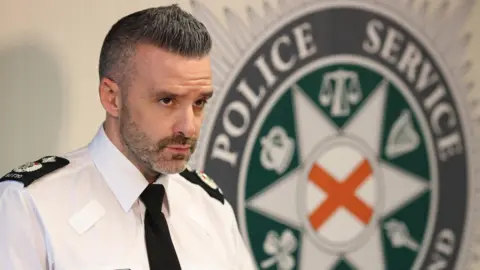
Deputy Chief Constable Bobby Singleton publicly apologised to the Beckett, Meyer and Babington families on behalf of the PSNI for the “failings which have been highlighted in the handling of this case, the events prior to their murders and the subsequent investigation”.
Mr Babington, 52, was shot in Chichester Park in October 1989, as a result of mistaken identity.
The ombudsman investigation revealed that a brown leather jacket, which had “specks of dried human blood” on it, was seized from one of the suspects who was arrested.
It was not possible to establish a blood grouping and therefore could not be linked to the murder.
The forensic laboratory was told the individual had been eliminated from inquiries and the jacket was destroyed as no further tests were needed.
Mrs Anderson stated: “Police indicated that this person had been eliminated from the investigation despite intelligence linking him to the murder.
“My investigators have been unable to establish the rationale for this decision.
“The retention and proper storage of the leather jacket could have been significant due to later advancements in forensic technology.
“This mishandling potentially limited future investigative opportunities.”
Mrs Anderson described the original investigation by the Royal Ulster Constabulary (RUC) as “incomplete”.
‘Knew the gunmen’
The weapon used in the murder, a 9mm Browning pistol, also featured in the attack on RUC officer Harold Beckett, 47, in June 1990.
He was shot dead in Belfast city centre, along with fellow constable, 35-year-old Gary Meyer.
The ombudsman investigation found that information provided to the RUC by the army was not acted upon.
It related to a potential witness who “knew the gunmen by name”.
Mrs Anderson said: “This information highlighted a person that potentially had very significant information pertaining to the identity of the gunmen.
“It is not known why the SIO (senior investigating officer) did not generate any enquiries emanating from this intelligence.”
She also uncovered other evidence that highlighted why the planned arrest of two people did not occur.
“I am of the view that the investigative failings in this case are so significant that it was incapable of leading to the apprehension and prosecution of the perpetrators, and therefore, was not Article 2 compliant.”
The Browning pistol had been stolen during the abduction and murders of Corporals Derek Wood and David Howes in west Belfast in 1988.
It was recovered during a police search of a property in October 1990.
A man arrested in the operation was later sentenced to seven years imprisonment for possession.
It was previously revealed the gun was returned to the army in 1996 and enquiries by the ombudsman’s office confirmed the location of the weapon is “unknown”.
Mrs Anderson concluded: “I am of the view, based on the available intelligence reviewed by Police Ombudsman investigators, that there was no intelligence that, if acted upon, would have been capable of preventing the murders of Henry Babington and Constables Beckett and Meyer.
“I believe that Henry Babington, Constable Beckett and Constable Meyer were the innocent victims of a campaign of terror mounted by republican paramilitaries.
“The IRA alone was responsible for the murders.”
She also stated her investigation was “unable to conclude definitively” whether the guns were returned to an IRA arms dump as part of a covert security operation, prior to being used in the three murders.
Kevin Winters, the solicitor acting for the Babington and Beckett families, said the ombudsman revelations were “a damning indictment on the respective police investigations”.
He said that RUC Special Branch had “knowledge and oversight” of the arms dump which contained the murder weapons.
The Deputy Chief Constable said policing had developed over the past 30 years and the PSNI had implemented revised policies and procedures which guide how it approaches “criminal investigations, intelligence handling, training and investigative standards for detectives, forensic opportunities and family liaison processes today are unrecognisable from what was in place at the time of these awful murders”.
“However, we acknowledge this will be of little comfort to these families who continue to suffer owing to policing’s past failures,” he added.
BBC News

Khamrah by Lattafa for Men - 3.4 oz EDP Spray
4% Off
Ghost Sweetheart Eau de Toilette | Pineapple, Jasmine and Sandalwood | Perfume for Women 50 ml
50% Off
Marc Jacobs Dot Eau De Parfum for Women, 100 ml
42% Off
Ted Baker W Eau de Toilette for Her, Fig Leaf, White Peony and Violet Top Notes, Pink Orchid and Raspberry Middle Notes, 75ml
£11.77 (£15.69 / 100 ml) (as of 15/10/2026 06:35 GMT +01:00 - More infoProduct prices and availability are accurate as of the date/time indicated and are subject to change. Any price and availability information displayed on [relevant Amazon Site(s), as applicable] at the time of purchase will apply to the purchase of this product.)
Ted Baker Woman Pink Eau de Toilette Spray Floral Green Feminine Fragrance, Opening Notes are Fresh Peach, Bergamot and Tangerine with Warm Musk, Vanilla and Vetiver Base, 100ml
11% Off
Vera Wang Princess Eau de Toilette - 30 ml

Choco Musk 50ml Eau De Parfum for men and women | Chocolate Musk by Jannat Aromas
17% Off
Christina Aguilera Signature Eau de Parfum (50ml) Floral, Fruity & Exotic Scent, Luxury Fragrance for Women
9% Off
Calvin Klein - Eau De Toilette CKIN2U - Calvin Klein Women, Ladies Perfume, Women's Perfume, Calvin Klein Perfume, Calvin Klein One - 150 ml
5% Off
Jimmy Choo Flash Eau de Parfum, 60 ml (Pack of 1)
3% Off
Fruit of the Loom Men's Heavy T Shirt, White, XL UK
28% Off
ATNKE LED Lighted Beanie Cap,USB Rechargeable Running Hat Ultra Bright 4 LED Waterproof Light Winter Warm Gifts for Men and Women/Pink
17% Off
Men's 1/4 Zip Pullover UK Sale Clearance, Fleece Sweatshirt Casual Jumper Long Sleeve T-shirt Top Stand Collar Sweater Plain Pullover Sports Leisure Workwear Quarter Zip Sweater Lightweight Jumpers
£5.88 (as of 12/11/2025 00:52 GMT +01:00 - More infoProduct prices and availability are accurate as of the date/time indicated and are subject to change. Any price and availability information displayed on [relevant Amazon Site(s), as applicable] at the time of purchase will apply to the purchase of this product.)
Crevice Cleaning Brush, Bathroom Tile Groove Gap Cleaning Brush,Premium Crevice Cleaning Tool Aluminum Support with 15° Angle Magic Brush, Thin Brush for Home Kitchen
19% Off
Wireless Earbuds, Bluetooth 5.3 Headphones in Ear with HiFi Stereo Deep Bass, 4 ENC Noise Cancelling Mic Wireless Earphones 40H Playtime, Bluetooth Earbuds Dual LED Display, IP7 Waterproof, USB-C
42% Off