


Julian O’NeillBBC News NI crime and justice correspondent

 Getty Images
There is no evidence UK security forces co-operated with the Ulster Volunteer Force to carry out the 1974 Dublin and Monaghan car bombings, a review has concluded.
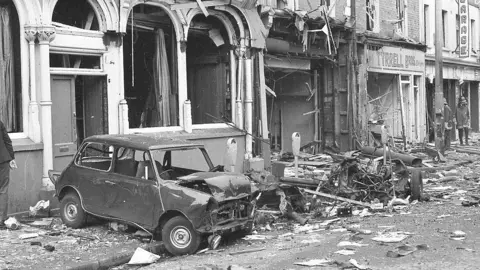
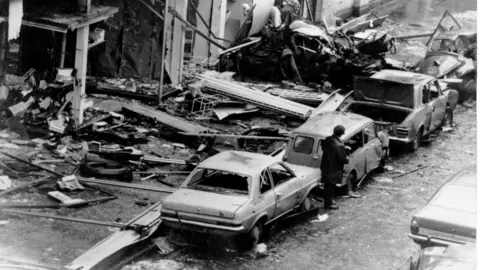
Thirty-three people, including a pregnant woman, were killed in the four explosions, which occurred without warning.
Detectives re-examined the bombings as part of a wide-ranging review of scores of loyalist attacks in the 1970s.
The findings are contained in the final Operation Kenova report published on Tuesday.
“This review has not identified any evidence or intelligence which would indicate that British security forces colluded with the UVF (Ulster Volunteer Force) to carry out the attacks in Dublin or Monaghan,” the report said.
“Nor has any evidence of state collusion been identified.”
Future prosecutions ‘extremely unlikely’
Claims of collusion have persisted for years.
The review stated the UVF was “independently capable” of carrying out the bombings without any help.
No-one has ever been charged over the attacks and the review states prosecutions in future seem “extremely unlikely”.
It added: “There do not appear any realistic opportunities from an investigative or forensic perspective to warrant any form of criminal investigation into these attacks.”
 PA Media
The review, known as Operation Denton, also looked into a wider series of UVF attacks attributed to the so-called Glenanne gang.
It has been blamed for around 120 killings throughout the 1970s.
They include the 1975 Miami Showband massacre, when three musicians were shot dead.
The gang’s principal base was a farm in the County Armagh village of Glenanne, which belonged to a Royal Ulster Constabulary (RUC) officer, James Mitchell, who is now deceased.
It has been alleged the gang’s members included other police officers, as well as soldiers in the Ulster Defence Regiment (UDR).
The review found “clear evidence” of the active involvement of members of the security forces “in a number of individual cases”.
It went on: “This collusion involved extremely vicious and serious criminal activity, including bombing attacks and murder.”
It said UVF “members or sympathisers” existed within the Royal Ulster Constabulary (RUC), the Territorial Army and the Ulster Defence Regiment (UDR).
‘Inappropriate’ relationships with UVF members
The UVF was supplied with intelligence by these “corrupt” individuals.
A number of RUC officers had “inappropriate relationships” with members of the Mid-Ulster UVF.
“Whilst there was clear collusion between some members of the UDR and RUC… the review has not discovered any material which indicates the security forces systematically collaborated with prolific offenders.
“Or that any individuals or groups were organisationally ‘protected’ by the security forces.
“However, Operation Denton recognises if it were the case, it is unlikely there would be records either made or retained which would reflect this.”
BBC News

Khamrah by Lattafa for Men - 3.4 oz EDP Spray
4% Off
Ghost Sweetheart Eau de Toilette | Pineapple, Jasmine and Sandalwood | Perfume for Women 50 ml
50% Off
Marc Jacobs Dot Eau De Parfum for Women, 100 ml
42% Off
Ted Baker W Eau de Toilette for Her, Fig Leaf, White Peony and Violet Top Notes, Pink Orchid and Raspberry Middle Notes, 75ml
£11.77 (£15.69 / 100 ml) (as of 30/09/2026 05:08 GMT +01:00 - More infoProduct prices and availability are accurate as of the date/time indicated and are subject to change. Any price and availability information displayed on [relevant Amazon Site(s), as applicable] at the time of purchase will apply to the purchase of this product.)
Ted Baker Woman Pink Eau de Toilette Spray Floral Green Feminine Fragrance, Opening Notes are Fresh Peach, Bergamot and Tangerine with Warm Musk, Vanilla and Vetiver Base, 100ml
11% Off
Vera Wang Princess Eau de Toilette - 30 ml

Choco Musk 50ml Eau De Parfum for men and women | Chocolate Musk by Jannat Aromas
17% Off
Christina Aguilera Signature Eau de Parfum (50ml) Floral, Fruity & Exotic Scent, Luxury Fragrance for Women
9% Off
Calvin Klein - Eau De Toilette CKIN2U - Calvin Klein Women, Ladies Perfume, Women's Perfume, Calvin Klein Perfume, Calvin Klein One - 150 ml
5% Off
Jimmy Choo Flash Eau de Parfum, 60 ml (Pack of 1)
3% Off
Fruit of the Loom Men's Heavy T Shirt, White, XL UK
28% Off
ATNKE LED Lighted Beanie Cap,USB Rechargeable Running Hat Ultra Bright 4 LED Waterproof Light Winter Warm Gifts for Men and Women/Pink
17% Off
Men's 1/4 Zip Pullover UK Sale Clearance, Fleece Sweatshirt Casual Jumper Long Sleeve T-shirt Top Stand Collar Sweater Plain Pullover Sports Leisure Workwear Quarter Zip Sweater Lightweight Jumpers
£5.88 (as of 12/11/2025 00:52 GMT +01:00 - More infoProduct prices and availability are accurate as of the date/time indicated and are subject to change. Any price and availability information displayed on [relevant Amazon Site(s), as applicable] at the time of purchase will apply to the purchase of this product.)
Crevice Cleaning Brush, Bathroom Tile Groove Gap Cleaning Brush,Premium Crevice Cleaning Tool Aluminum Support with 15° Angle Magic Brush, Thin Brush for Home Kitchen
19% Off
Wireless Earbuds, Bluetooth 5.3 Headphones in Ear with HiFi Stereo Deep Bass, 4 ENC Noise Cancelling Mic Wireless Earphones 40H Playtime, Bluetooth Earbuds Dual LED Display, IP7 Waterproof, USB-C
42% Off