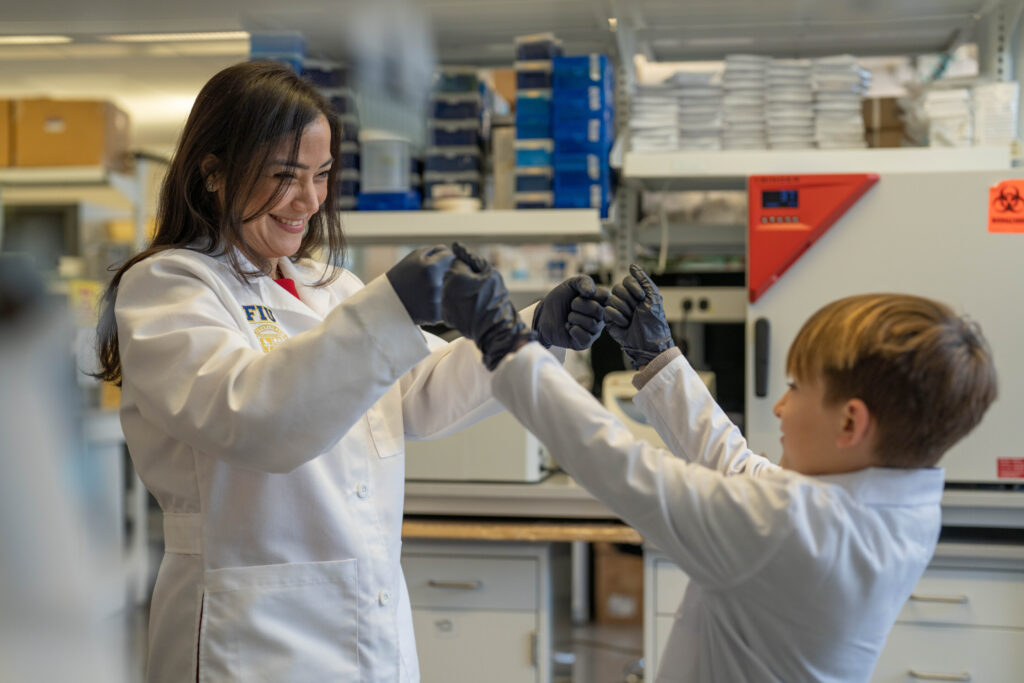
Researchers have developed a functional precision medicine approach that targets cancer by combining genetic testing with a new way to test individual drugs on tumor samples. The results of the clinical study were published in Nature Medicine.
This combined approach, developed by Florida International University cancer researcher Diana Azzam, was used successfully for the first time to guide treatment of relapsed pediatric cancer patients in collaboration with First Ascent Biomedical and Dr. Maggie Fader at the Helen & Jacob Shaham Cancer & Blood Disorders Institute at Nicklaus Children’s Hospital in Miami.
It resulted in 83% of the children showing improvement, including Logan Jenner, 8, whose relapsed leukemia was successfully treated through Azzam’s new guided approach.
“The results are exciting because cancer that comes back is much harder to treat. Seeing improvement in 83% of patients is incredibly promising,” said Azzam, the assistant professor of environmental health sciences at the FIU Robert Stempel College of Public Health and Social Work and Society for Functional Precision Medicine board member who led the study. “This could be the way we turn cancer into a manageable disease.”
Approximately 2 million people are diagnosed with cancer in the United States each year, according to the National Cancer Institute. Nearly 30% (more than 600,000) are expected to die.
Breakthrough approach
The approach Azzam is pioneering has a few advantages over existing precision medicine processes, including faster results and more treatment options for doctors.
Azzam’s approach involves taking a sample of blood or tumor and enriching and processing the cancer cells in the lab in a way that closely resembles how they would normally grow in the body. Then the cancer is exposed to more than 120 FDA-approved drugs, including both cancer and non-cancer drugs. These drugs also may be tested in various combinations recommended by the clinical team. The best cancer destroyers emerge. The entire process takes about a week.
“The Azzam lab approach gets rid of the guesswork and delivers a list of the most effective drugs that the oncologist can work with,” said Stempel College Dean Tomás R. Guilarte, who is also one of the authors of the Nature Medicine article. “It’s accelerating our understanding of which cancer treatments work best for patients and their specific needs.”
Logan’s story
At the age of 3, Logan Jenner was diagnosed with acute myeloid leukemia. He received chemotherapy and bone marrow transplant. The cancer came back 14 months later.
Fader, Logan’s oncologist and co-investigator on the study, enrolled him in the clinical trial.
“What’s unique is that it’s easy and fast to get results about what would be the most optimal regimen, so we can act quickly,” said Fader who is employed by KIDZ Medical Services and cares for patients at Nicklaus Children’s Hospital. “That’s important because we’re talking about a child with cancer getting worse day by day.”
Azzam’s test results revealed which combination of drugs might work well for Logan. Equally valuable, the results indicated that Idarubicin, known to cause cardiac toxicity at very high doses, could be withheld without impacting the efficacy of the treatment. Thirty-three days after starting treatment guided by Azzam’s results, Logan reached remission—compared to the 150 days the previous time. Two years later, Logan remains cancer-free.
The trial returned recommendations for the 19 patients that participated. Six received treatment guided by Azzam’s results and five, including Logan, showed improved survival outcomes over the course of the study.
What’s next
This study is particularly relevant because the majority of the participants were members of ethnic minority populations, who can have different responses to FDA-approved drugs. Azzam also spearheads a research project as part of FIU’s Research Center in Minority Institutions to reduce health disparities in childhood cancer patients.
Larger personalized cancer treatment clinical trials for children and adults are ongoing.
Azzam’s lab is set to become the first federally certified large-scale lab dedicated to functional cancer drug testing in Florida.
More information:
Arlet M. Acanda De La Rocha et al, Feasibility of functional precision medicine for guiding treatment of relapsed or refractory pediatric cancers, Nature Medicine (2024). DOI: 10.1038/s41591-024-02848-4
Citation:
New treatment approach shows promise in hard-to-treat pediatric cancers (2024, April 11)
retrieved 11 April 2024
from https://medicalxpress.com/news/2024-04-treatment-approach-hard-pediatric-cancers.html
This document is subject to copyright. Apart from any fair dealing for the purpose of private study or research, no
part may be reproduced without the written permission. The content is provided for information purposes only.

Khamrah by Lattafa for Men - 3.4 oz EDP Spray
4% Off
Ghost Sweetheart Eau de Toilette | Pineapple, Jasmine and Sandalwood | Perfume for Women 50 ml
50% Off
Marc Jacobs Dot Eau De Parfum for Women, 100 ml
42% Off
Ted Baker W Eau de Toilette for Her, Fig Leaf, White Peony and Violet Top Notes, Pink Orchid and Raspberry Middle Notes, 75ml
£11.77 (£15.69 / 100 ml) (as of 15/07/2026 03:57 GMT +01:00 - More infoProduct prices and availability are accurate as of the date/time indicated and are subject to change. Any price and availability information displayed on [relevant Amazon Site(s), as applicable] at the time of purchase will apply to the purchase of this product.)
Ted Baker Woman Pink Eau de Toilette Spray Floral Green Feminine Fragrance, Opening Notes are Fresh Peach, Bergamot and Tangerine with Warm Musk, Vanilla and Vetiver Base, 100ml
11% Off
Vera Wang Princess Eau de Toilette - 30 ml

Choco Musk 50ml Eau De Parfum for men and women | Chocolate Musk by Jannat Aromas
17% Off
Christina Aguilera Signature Eau de Parfum (50ml) Floral, Fruity & Exotic Scent, Luxury Fragrance for Women
9% Off
Calvin Klein - Eau De Toilette CKIN2U - Calvin Klein Women, Ladies Perfume, Women's Perfume, Calvin Klein Perfume, Calvin Klein One - 150 ml
5% Off
Jimmy Choo Flash Eau de Parfum, 60 ml (Pack of 1)
3% Off
Fruit of the Loom Men's Heavy T Shirt, White, XL UK
28% Off
ATNKE LED Lighted Beanie Cap,USB Rechargeable Running Hat Ultra Bright 4 LED Waterproof Light Winter Warm Gifts for Men and Women/Pink
17% Off
Men's 1/4 Zip Pullover UK Sale Clearance, Fleece Sweatshirt Casual Jumper Long Sleeve T-shirt Top Stand Collar Sweater Plain Pullover Sports Leisure Workwear Quarter Zip Sweater Lightweight Jumpers
£5.88 (as of 12/11/2025 00:52 GMT +01:00 - More infoProduct prices and availability are accurate as of the date/time indicated and are subject to change. Any price and availability information displayed on [relevant Amazon Site(s), as applicable] at the time of purchase will apply to the purchase of this product.)
Crevice Cleaning Brush, Bathroom Tile Groove Gap Cleaning Brush,Premium Crevice Cleaning Tool Aluminum Support with 15° Angle Magic Brush, Thin Brush for Home Kitchen
19% Off
Wireless Earbuds, Bluetooth 5.3 Headphones in Ear with HiFi Stereo Deep Bass, 4 ENC Noise Cancelling Mic Wireless Earphones 40H Playtime, Bluetooth Earbuds Dual LED Display, IP7 Waterproof, USB-C
42% Off