 [
[

Researchers have uncovered how the brain is able to detect and process tiny sensory signals with remarkable accuracy—even when those signals are buried in the brain’s constant internal activity. The findings shed new light on how groups of brain cells cooperate to rapidly transmit information, helping explain one of neuroscience’s biggest mysteries: how the brain makes sense of the world in real time.
The study by Dr. Omer Revah and Prof. Michael J. Gutnick from the Hebrew University of Jerusalem, in collaboration with Prof. Fred Wolf and Dr. Andreas Neef from the Max Planck Institutes in Germany, was published in PLOS Biology. The researchers discovered that the physical shape of neurons, the timing of background brain activity and specific electrical properties of the cells all work together to make sensory processing fast and reliable.
“We found that the brain carefully balances several different features of neurons so they can respond extremely quickly to sensory input,” an author of the study said. “Even very small signals can be detected and passed on with millisecond precision.”
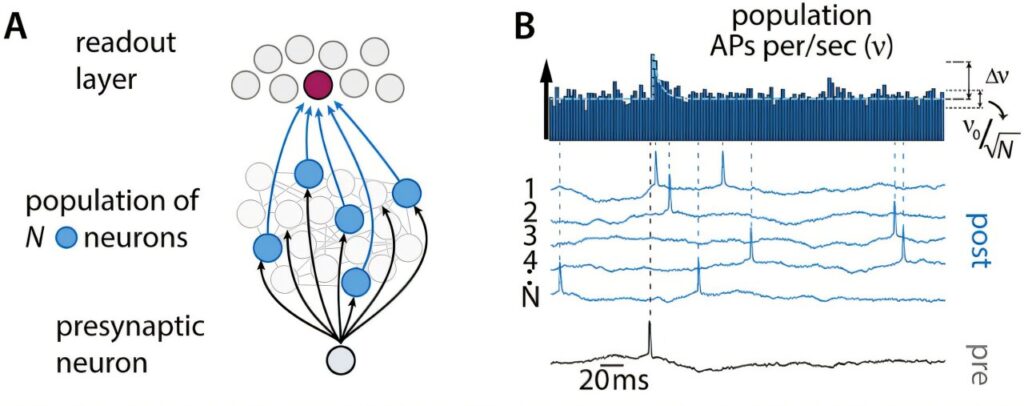
The team found that although some neurons involved in sensory processing are unusually small, something that would normally limit their performance, the brain compensates by using slower, more coordinated background activity. This allows large groups of neurons to amplify weak incoming signals.
Remarkably, the researchers showed that the activity triggered by a single incoming sensory signal can be reliably detected by hundreds of neurons working together.
The study also identified an important role for potassium channels, tiny molecular “gates” that control electrical activity in brain cells. Because these channels are influenced by chemicals linked to attention and alertness, the findings suggest that the brain’s ability to process sensory information may change depending on a person’s mental state.
“This study helps explain how the brain stays both sensitive and efficient,” the authors added. “The brain is constantly active, yet it can still pick out the faintest sensory events almost instantly.”
The findings could eventually help scientists better understand neurological conditions that affect sensory processing, attention or brain excitability.
Publication details
Omer Revah et al, Encoding performance of cortical neurons critically depends on their morphological and neurophysiological properties, PLOS Biology (2026). DOI: 10.1371/journal.pbio.3003789
Journal information:
PLoS Biology
Key medical concepts
Clinical categories


Citation:
New study reveals how the brain detects the smallest sensory signals (2026, September 9)
retrieved 9 September 2026
from https://medicalxpress.com/news/2026-09-reveals-brain-smallest-sensory.html
This document is subject to copyright. Apart from any fair dealing for the purpose of private study or research, no
part may be reproduced without the written permission. The content is provided for information purposes only.

Khamrah by Lattafa for Men - 3.4 oz EDP Spray
4% Off
Ghost Sweetheart Eau de Toilette | Pineapple, Jasmine and Sandalwood | Perfume for Women 50 ml
50% Off
Marc Jacobs Dot Eau De Parfum for Women, 100 ml
42% Off
Ted Baker W Eau de Toilette for Her, Fig Leaf, White Peony and Violet Top Notes, Pink Orchid and Raspberry Middle Notes, 75ml
£11.77 (£15.69 / 100 ml) (as of 10/09/2026 05:01 GMT +01:00 - More infoProduct prices and availability are accurate as of the date/time indicated and are subject to change. Any price and availability information displayed on [relevant Amazon Site(s), as applicable] at the time of purchase will apply to the purchase of this product.)
Ted Baker Woman Pink Eau de Toilette Spray Floral Green Feminine Fragrance, Opening Notes are Fresh Peach, Bergamot and Tangerine with Warm Musk, Vanilla and Vetiver Base, 100ml
11% Off
Vera Wang Princess Eau de Toilette - 30 ml

Choco Musk 50ml Eau De Parfum for men and women | Chocolate Musk by Jannat Aromas
17% Off
Christina Aguilera Signature Eau de Parfum (50ml) Floral, Fruity & Exotic Scent, Luxury Fragrance for Women
9% Off
Calvin Klein - Eau De Toilette CKIN2U - Calvin Klein Women, Ladies Perfume, Women's Perfume, Calvin Klein Perfume, Calvin Klein One - 150 ml
5% Off
Jimmy Choo Flash Eau de Parfum, 60 ml (Pack of 1)
3% Off
Fruit of the Loom Men's Heavy T Shirt, White, XL UK
28% Off
ATNKE LED Lighted Beanie Cap,USB Rechargeable Running Hat Ultra Bright 4 LED Waterproof Light Winter Warm Gifts for Men and Women/Pink
17% Off
Men's 1/4 Zip Pullover UK Sale Clearance, Fleece Sweatshirt Casual Jumper Long Sleeve T-shirt Top Stand Collar Sweater Plain Pullover Sports Leisure Workwear Quarter Zip Sweater Lightweight Jumpers
£5.88 (as of 12/11/2025 00:52 GMT +01:00 - More infoProduct prices and availability are accurate as of the date/time indicated and are subject to change. Any price and availability information displayed on [relevant Amazon Site(s), as applicable] at the time of purchase will apply to the purchase of this product.)
Crevice Cleaning Brush, Bathroom Tile Groove Gap Cleaning Brush,Premium Crevice Cleaning Tool Aluminum Support with 15° Angle Magic Brush, Thin Brush for Home Kitchen
19% Off
Wireless Earbuds, Bluetooth 5.3 Headphones in Ear with HiFi Stereo Deep Bass, 4 ENC Noise Cancelling Mic Wireless Earphones 40H Playtime, Bluetooth Earbuds Dual LED Display, IP7 Waterproof, USB-C
42% Off