


A study of mice suggests a father’s diet may shape the anxiety of his sons and the metabolic health of his daughters before they are even conceived.
New research published in Nature Communications finds that the macronutrient balance in the diet of male mice affects the level of anxiety-like behavior of sons and the metabolic health of daughters.
The research provides a step towards understanding how the effect of diet can transmit from one generation to the next via a father’s sperm. It could ultimately inform dietary guidelines for fathers-to-be, with the goal of lowering the risk of metabolic disease and mood disorders in the next generation.
Parents like to believe they can shape the interests and behavior of their children, with mixed success. But a new study from an international team of researchers confirms this is the case for mice, with father’s shaping their children’s health through their own diet.
Scientists have already discovered that a mouse father’s diet can have an impact not only on his own reproductive health but on that of his offspring. Over- or under-feeding male mice can affect their offspring’s metabolism and behavior, as well as their risk of cancer).
What is less understood is whether there are diverse types of health impacts on the health of offspring, depending on the type and composition of the diet of male mice before conception.
This was the starting point for the research by scientists in the international GECKO consortium, with lead investigators in Copenhagen, Sydney, and Chicago.
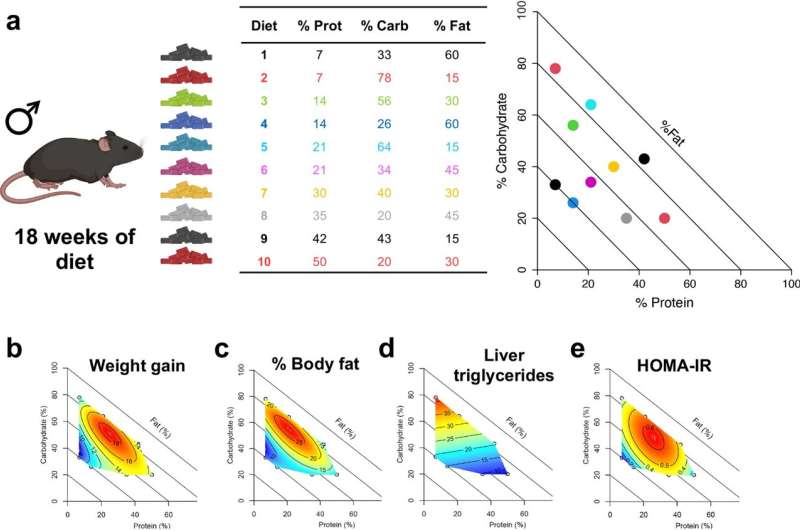
At the University of Sydney’s Charles Perkins Center in Australia researchers fed male mice one of ten diets differing in the proportions of protein, fats, and carbohydrates, then allowed them to mate with females reared on standard diet. The behavior and physiology of the resulting pups were then studied.
Dietary composition as important as number of calories
The scientists discovered that male mice fed low protein and high carbohydrate diets were more likely to have male offspring with higher levels of anxiety, as measured by time spent in the safety zones of their maze. They also found that male mice that were fed high fat diets were more likely to have daughters with higher levels of body fat and markers of metabolic disease.
“Our study shows that the type of diet eaten before conception can program specific characteristics of the next generation,” says co-senior author and leader of the GECKO consortium Professor Romain Barrès, from the University of Copenhagen and Université Côte d’Azur, Nice.
“It is extraordinary that by titrating mixtures of protein, fat and carbs in the father’s diet we could influence specific features of his sons and daughters health and behavior. There is some important biology at play here,” said Professor Stephen Simpson, co-senior author and Academic Director of the Charles Perkins Center at the University of Sydney.
The team also observed that males on a low protein diet also ate more food overall. However, thanks to the study design, they could determine that both the amount of calories, and the macronutrient composition of the males’ diets, influenced the health of their offspring.
“Our study shows that it’s not just eating too much or too little, but the composition of the diet that can have an impact on future children,” says Professor Romain Barrès.
The work was conducted in mice and has opened the way for the team to study the molecular mechanisms involved. The mouse work is part of a broader series of studies within the GECKO consortium, involving humans and other mammals at partner institutions.
“We think our study is a step towards establishing dietary guidelines for fathers to be, with the ultimate goal of lowering the risk of metabolic disease and mood disorders in the next generation,” says Professor Romain Barrès.
More information:
Angela Jane Crean et al, Paternal dietary macronutrient balance and energy intake drive metabolic and behavioral differences among offspring, Nature Communications (2024). DOI: 10.1038/s41467-024-46782-y
Citation:
Mouse study shows how a father’s diet can shape the health of his offspring (2024, April 17)
retrieved 17 April 2024
from https://medicalxpress.com/news/2024-04-mouse-father-diet-health-offspring.html
This document is subject to copyright. Apart from any fair dealing for the purpose of private study or research, no
part may be reproduced without the written permission. The content is provided for information purposes only.

Khamrah by Lattafa for Men - 3.4 oz EDP Spray
4% Off
Ghost Sweetheart Eau de Toilette | Pineapple, Jasmine and Sandalwood | Perfume for Women 50 ml
50% Off
Marc Jacobs Dot Eau De Parfum for Women, 100 ml
42% Off
Ted Baker W Eau de Toilette for Her, Fig Leaf, White Peony and Violet Top Notes, Pink Orchid and Raspberry Middle Notes, 75ml
£11.77 (£15.69 / 100 ml) (as of 21/10/2026 06:36 GMT +01:00 - More infoProduct prices and availability are accurate as of the date/time indicated and are subject to change. Any price and availability information displayed on [relevant Amazon Site(s), as applicable] at the time of purchase will apply to the purchase of this product.)
Ted Baker Woman Pink Eau de Toilette Spray Floral Green Feminine Fragrance, Opening Notes are Fresh Peach, Bergamot and Tangerine with Warm Musk, Vanilla and Vetiver Base, 100ml
11% Off
Vera Wang Princess Eau de Toilette - 30 ml

Choco Musk 50ml Eau De Parfum for men and women | Chocolate Musk by Jannat Aromas
17% Off
Christina Aguilera Signature Eau de Parfum (50ml) Floral, Fruity & Exotic Scent, Luxury Fragrance for Women
9% Off
Calvin Klein - Eau De Toilette CKIN2U - Calvin Klein Women, Ladies Perfume, Women's Perfume, Calvin Klein Perfume, Calvin Klein One - 150 ml
5% Off
Jimmy Choo Flash Eau de Parfum, 60 ml (Pack of 1)
3% Off
Fruit of the Loom Men's Heavy T Shirt, White, XL UK
28% Off
ATNKE LED Lighted Beanie Cap,USB Rechargeable Running Hat Ultra Bright 4 LED Waterproof Light Winter Warm Gifts for Men and Women/Pink
17% Off
Men's 1/4 Zip Pullover UK Sale Clearance, Fleece Sweatshirt Casual Jumper Long Sleeve T-shirt Top Stand Collar Sweater Plain Pullover Sports Leisure Workwear Quarter Zip Sweater Lightweight Jumpers
£5.88 (as of 12/11/2025 00:52 GMT +01:00 - More infoProduct prices and availability are accurate as of the date/time indicated and are subject to change. Any price and availability information displayed on [relevant Amazon Site(s), as applicable] at the time of purchase will apply to the purchase of this product.)
Crevice Cleaning Brush, Bathroom Tile Groove Gap Cleaning Brush,Premium Crevice Cleaning Tool Aluminum Support with 15° Angle Magic Brush, Thin Brush for Home Kitchen
19% Off
Wireless Earbuds, Bluetooth 5.3 Headphones in Ear with HiFi Stereo Deep Bass, 4 ENC Noise Cancelling Mic Wireless Earphones 40H Playtime, Bluetooth Earbuds Dual LED Display, IP7 Waterproof, USB-C
42% Off